Key Takeaways
- Beech Leaf Disease (BLD) is an emerging tree disease affecting American beech and related species, now confirmed in parts of Michigan and threatening West Michigan landscapes.
- Early symptoms include dark banding between leaf veins, curling, and thickened leaves, often starting on lower branches and spreading upward over several seasons.
- There is currently no known cure for BLD; management focuses on monitoring, reducing stress, sanitation, and timely removal of severely affected or hazardous trees.
- Unchecked BLD can cause severe canopy thinning, decline, and mortality, raising safety concerns for trees near homes, driveways, and play areas.
- Big Chipper Tree Service helps West Michigan property owners by evaluating suspected BLD, recommending management options, and safely removing or pruning affected beech trees.
Every year, more West Michigan property owners are hearing about Beech Leaf Disease (BLD) for the first time and wondering what it means for their beech trees. First recognized in the United States in the early 2010s, BLD has moved steadily across the Northeast and into the Great Lakes region. With detections in Michigan, it is now a real concern for homeowners, landowners, and municipalities in and around Grand Rapids, Holland, and other West Michigan communities. Rather than a one-season problem, BLD is a chronic, progressive disease that can weaken and eventually kill both young and mature beech trees.
What Beech Leaf Disease Is and How It Affects Trees
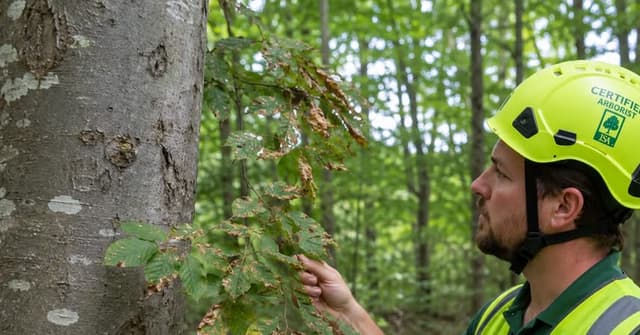
Beech Leaf Disease is characterized by distinctive changes in leaf appearance and structure. Affected leaves develop dark, thickened bands between the veins, often described as an almost “oily” or “water-soaked” striping. Over time, leaves may become curled, crinkled, or noticeably smaller than normal. As more leaves on more branches become affected, the tree’s overall canopy begins to thin out, with fewer healthy leaves available to capture sunlight and support growth.
Current research associates BLD with a microscopic foliar nematode (Litylenchus crenatae mccannii), which appears to invade leaf tissue and interfere with normal development. While scientists continue to study the exact mechanisms, the practical impact is the same for property owners: year after year, affected beech trees lose leaf area, photosynthetic capacity, and vigor. In young trees, this can lead to stunting and death within just a few seasons. In mature trees, decline may be slower but still significant, particularly when combined with other stress factors like drought, compacted soils, or root damage.
How BLD Spreads and Why It Matters in West Michigan
Like many emerging tree diseases, BLD appears to spread both locally and over longer distances.
- Short-range spread may involve – rain splash, insects, or other natural vectors moving nematodes between leaves and nearby trees.
- Long-distance jumps are often linked to the movement of nursery stock, saplings, or infested plant material from region to region.
For West Michigan, this means that both residential landscapes and wooded areas with naturally occurring beech stands are at some degree of risk once BLD is present in the state. Property owners should also understand that BLD can easily go unnoticed at first. Early symptoms may appear only on a few lower branches, be mistaken for other leaf issues, or be hidden in shaded understory trees. By the time thinning is obvious from a distance, the disease has often been active for multiple seasons. That is why regular, close-up inspections during the growing season are important, especially for prized specimen beech trees in lawns and near homes.
Recognizing Early Signs of Beech Leaf Disease on Your Property
Spotting BLD early hinges on knowing what to look for. In West Michigan yards and woodlots, you should examine beech leaves closely from late spring through summer. Key indicators include:
- Dark, thickened banding between the leaf veins, visible when you hold the leaf up to the light.
- Leaves that are curled, puckered, or unusually small, especially if normal on the same tree in previous years.
- Patchy or progressive canopy thinning, first on certain branches and then expanding across larger portions of the crown.
- More severe symptoms on younger trees or saplings, which often show faster decline than larger, established trees.
If you suspect BLD, photographing the symptoms and contacting a certified arborist is the best next step. A trained eye can distinguish BLD from other leaf problems and set a baseline for monitoring progression over time.
Current Management Realities: No Cure, But Options
There is currently no widely accepted curative treatment for Beech Leaf Disease. That means management in West Michigan focuses on reducing stress, protecting overall tree health, and making smart decisions about when to prune, when to monitor, and when to remove. Cultural practices such as proper mulching, careful watering in drought periods, avoiding soil compaction around beech roots, and preventing mechanical injuries can help affected trees better tolerate disease pressure.
Sanitation is also important. Avoid moving beech saplings, leaves, or branches from areas where BLD is suspected to new sites. If pruning is performed, tools should be cleaned and disinfected between trees to minimize the chance of transferring any pathogen or nematode. Severely affected small trees or saplings with little chance of recovery may be candidates for removal and disposal to reduce local inoculum pressure. For larger trees with moderate symptoms, staged pruning and close monitoring may extend their useful life while you plan for diversification and replacement.
When Beech Trees Become a Safety or Liability Concern
Beyond tree health, BLD raises questions about structural safety. As repeated seasons of reduced leaf area and stress wear down a tree, branches may die back, decay can advance, and overall structural integrity may decline. This is especially worrisome for beech trees that overhang homes, driveways, patios, play areas, or public sidewalks.
If your beech tree shows significant dieback in combination with BLD symptoms such as – large dead limbs, obvious cavities, or pronounced lean, it may be transitioning from a tree health issue to a tree risk issue. At that point, a risk assessment by a certified arborist is essential. The arborist can evaluate not only BLD symptoms but also branch attachment, trunk soundness, root stability, and targets below. In some cases, strategic pruning may temporarily reduce risk. In others, especially where failure could cause serious damage or injury, removal becomes the most responsible course of action.
Big Chipper Tree Service has been working with West Michigan property owners since 1986 and is well positioned to help you navigate Beech Leaf Disease concerns. Our certified arborists understand emerging disease issues and combine that knowledge with on-the-ground experience managing risk, aesthetics, and long-term landscape planning.
When you call Big Chipper, we can inspect your beech trees on-site, confirm whether symptoms are consistent with BLD, and document their current condition. Based on that, we can recommend an appropriate response, ranging from continued monitoring and cultural care to targeted pruning or full removal. If removal is needed, our crews use bucket trucks, cranes, and professional rigging to safely dismantle large beech trees in tight urban and suburban settings. We also provide stump grinding, debris removal, and guidance on replacement species that will diversify and strengthen your landscape for the future. For more information, call our team at – (616) 300-1811 to book your free estimate.
Frequently Asked Questions About Beech Leaf Disease in West Michigan
Is Beech Leaf Disease the same as beech bark disease?
No. Beech bark disease involves a scale insect and subsequent fungal infection in the bark, whereas BLD primarily affects the leaves and leaf buds, causing banding, curling, and canopy thinning. The two diseases are distinct but can both impact beech health.
Can I save my beech tree once BLD symptoms appear?
There is no guaranteed cure, but early intervention to reduce other stresses and improve overall tree health can sometimes slow decline. Whether to invest in supportive care or plan removal depends on the tree’s size, location, and the severity of symptoms.
Will BLD spread from my yard to nearby natural beech stands in West Michigan?
If BLD is present, there is potential for local spread, especially if infected material or nursery stock is moved. Responsible handling of pruned material and avoiding unnecessary movement of beech wood can help reduce risk.
Should I remove all my beech trees proactively?
No. Removing healthy beech trees solely out of fear is not recommended. Focus on monitoring, early detection, and targeted action on trees that show significant symptoms or pose clear structural risks.
How do I get a professional opinion about BLD on my property?
Contact Big Chipper Tree Service to schedule a site visit. A certified arborist will evaluate your beech trees, explain what they see, and provide a clear, written set of recommendations tailored to your property.
Summary Checklist: Beech Leaf Disease in West Michigan
| Condition | Risk Level | Recommended Action |
| Dark Banding Between Veins or Leaf Curling | Moderate | Monitor symptoms and schedule an evaluation with a certified arborist. |
| Progressive Canopy Thinning and Dieback | High | Assess the tree’s structural stability and overall rate of decline. |
| Movement of Beech Materials (Saplings, leaves, or firewood) | High | Stop moving potentially infected materials to help prevent disease spread. |
| Beech Trees Near Homes or Driveways | Moderate to High | Schedule regular tree risk assessments with a certified arborist. |
| Long-Term Landscape Planning | Low | Plant a diverse mix of non-susceptible tree species to improve landscape resilience. |
Final Advice
Beech Leaf Disease is an emerging and evolving threat, but it does not have to catch West Michigan property owners off guard. By learning what BLD looks like, watching your trees closely, and acting early when symptoms appear, you can make informed decisions that balance tree preservation, safety, and long-term landscape health. For some beech trees, careful monitoring and cultural care may buy years of additional life. For others, especially those already declining over structures or high-traffic areas, timely removal and replacement will be the safest course of action.
The key is not to ignore suspicious symptoms or delay decisions until a tree is both diseased and structurally unsound. A professional and dedicated tree service firm in Grand Rapids, Michigan, can provide the expert eyes and technical skills you need to navigate BLD confidently. Big Chipper Tree Service serves Grand Rapids, Holland, and surrounding West Michigan communities with certified arborists, transparent pricing, a workmanship guarantee, and 24/7 emergency support when hazardous trees demand immediate attention. For a clear, practical plan to address possible Beech Leaf Disease on your property, call Big Chipper Tree Service at (616) 300-1811 to schedule your free estimate now.