Key Takeaways
- Trained crews assess a tree’s structure, root zone, and surroundings together, rather than judging its health solely by the appearance of the canopy.
- Small details such as fungal growth, included bark, girdling roots, and hairline cracks can point to larger problems.
- A tree can look completely healthy while carrying internal decay or structural weakness.
- The location of a tree relative to a home, driveway, slope, or utility line can significantly change the level of risk.
- A professional assessment can identify developing problems early, giving homeowners an opportunity to address them before they become emergencies.
Most homeowners know when a tree looks obviously unhealthy. Dead branches, missing bark, a severely leaning trunk, or a completely bare canopy are hard to miss. The problem is that serious tree issues don’t always announce themselves that clearly.
A tree can have internal decay, compromised roots, weak branch unions, or developing disease while still looking green and healthy from the street. Some structural problems develop slowly over many years and may not become obvious until high winds, heavy rain, or an ice storm puts additional stress on the tree. That’s why trained & experienced tree service firms in Grand Rapids, MI look at much more than the leaves.
When a tree service firm evaluates a property, the assessment typically considers the tree’s structure, trunk, root zone, surrounding soil, nearby structures, utility lines, drainage, and overall site conditions. Small details that might seem insignificant to a homeowner can provide important clues about what is happening inside or beneath the tree.
Here are some of the things trained tree crews notice that homeowners commonly overlook.
It’s Not Just About How the Tree Looks
One of the most common mistakes homeowners make is judging a tree almost entirely by its canopy. If the leaves are green and the tree is producing normal growth, it is easy to assume everything is fine. In reality, the canopy is only one part of the picture.
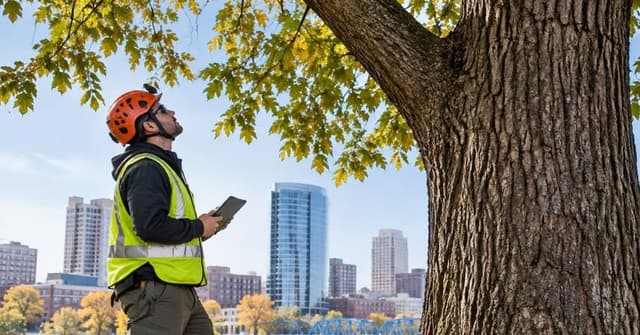
Trees have an impressive ability to continue growing despite underlying problems. A tree may compensate for damaged roots, internal decay, or a compromised branch union for years. It can continue producing leaves while its structural condition gradually deteriorates. A trained tree professional looks at the entire tree from the ground up. That includes –
- examining the trunk for cracks, cavities, seams, unusual swelling, or other abnormalities
- assessing the major limbs for weak attachments and excessive weight
- examining the base of the trunk and surrounding root zone for signs of decay, damage, soil disturbance, or root problems.
The surrounding property matters, too. A structurally compromised tree standing in an open field presents a different concern from the same tree standing directly beside a house, children’s play area, driveway, or utility line. The tree hasn’t changed. The consequences of failure have.
Signs of Structural Weakness
Tree structure is one of the first things an experienced crew learns to evaluate. Here are some signs of the structural weakness –
Included Bark
Included bark occurs when two stems or major branches grow closely together and bark becomes trapped between them. Instead of forming a strong attachment, the union can develop a narrow, weak connection. As the limbs increase in size and weight, the attachment may become increasingly vulnerable to splitting. Included bark is especially important in trees with multiple competing stems.
Codominant Stems
Codominant stems occur when two trunks or major stems of similar size develop from the same point. Rather than having one dominant central leader, the tree essentially has competing leaders. This can create a structural weakness, particularly when the stems form a narrow attachment.
A homeowner may simply see a large, attractive tree with two trunks. A trained professional sees a potential point of failure that may deserve monitoring, pruning, or structural correction.
Cracks and Seams
Cracks in a tree’s trunk or major limbs deserve attention, especially when they are vertical, deep, or located near a significant branch union. Some cracks may be superficial. Others can indicate internal stress or structural failure.
Professionals look at the location, direction, size, and progression of cracks rather than automatically assuming that every crack means a tree must be removed.
Unusual or Increasing Lean
A tree that naturally leans because of its growth pattern isn’t necessarily dangerous. A new or worsening lean, however, can be much more concerning. Changes in lean can indicate root failure, soil movement, erosion, or damage beneath the surface. After severe weather or construction activity, a previously stable tree may become significantly less secure. That is one reason changes matter just as much as what the tree looks like today.
Early Signs of Disease and Decay
Some of the most valuable clues are found at the base of the tree are as follows –
Fungal Growth
Mushrooms or shelf-like fungal structures growing around the base of a tree or along major roots can indicate fungal activity associated with decay. Not every mushroom means a tree is immediately hazardous, and fungal identification matters. However, visible fungal growth in the root or trunk area deserves professional attention because decay can weaken structural wood over time. Homeowners may see mushrooms as a temporary lawn issue. An arborist considers what their location could be telling them about the tree.
Unusual Bark Changes
Trees naturally shed bark in different ways depending on the species. But peeling, loose, discolored, or damaged bark that appears inconsistent with the tree’s normal characteristics can be a warning sign. Professionals look for patterns rather than isolated symptoms. Bark damage combined with cavities, cracks, fungal growth, or deadwood can provide a much more significant picture than any single symptom alone.
Frass and Insect Activity
Sawdust-like material, sometimes called frass, around the trunk or tree base can indicate insect activity. Depending on the species and situation, insects may be feeding beneath the bark or inside the wood. Other clues can include exit holes, galleries, unusual sap flow, or declining branches. These details are easy to overlook when simply walking past a tree.
Localized Canopy Dieback
Dead branches throughout an entire tree can have many causes. But when dieback is concentrated heavily on one side or one particular section of the canopy, professionals start asking why. Localized decline can sometimes point toward root damage, a girdling root, vascular problems, storm injury, or another localized issue affecting that portion of the tree. The pattern of decline can be just as important as the amount of decline.
Root Zone and Soil Clues
The roots are arguably one of the most important parts of a tree and one of the easiest for homeowners to ignore. A professional doesn’t only inspect what is above ground. They also look at the conditions surrounding the root zone such as –
Soil Compaction
Construction, parking, heavy equipment, landscaping projects, and repeated foot traffic can compact soil. Compacted soil contains fewer air spaces, which can restrict the oxygen and water movement roots need. A tree may appear healthy initially and decline gradually as its root system struggles.
Exposed Roots
Some exposed roots are normal, particularly on mature trees. However, damaged, unusually exposed, or unstable roots may indicate erosion, grade changes, or other site problems. Root exposure also creates opportunities for mechanical injury from lawn equipment and other activities.
Girdling Roots
A girdling root grows around or against the trunk instead of extending outward normally. As the root becomes larger, it can constrict the trunk and interfere with the movement of water and nutrients. Girdling roots are particularly difficult for homeowners to recognize because much of the problem may be hidden below the soil surface. Professionals may look for roots crossing the trunk flare, abnormal trunk development, or other signs that suggest the root system needs closer examination.
Changes in Grade
Adding soil around a mature tree or significantly changing the grade can damage its root environment. Even when the tree itself isn’t physically injured, covering roots with additional soil can reduce oxygen availability and alter drainage. This is why experienced crews pay attention to the history of the property, not just its current appearance.
Risk Factors Beyond the Tree Itself
Tree risk isn’t determined by the tree alone. The surrounding environment plays a major role. Consider two identical trees with the same structural defect. One stands in an open backyard with nothing nearby. The other stands beside a house, parked vehicles, and a heavily used driveway. The structural issue may be identical, but the consequences of failure are very different. Professionals therefore consider the target what could be damaged if a limb or tree fails. They also look at slopes, drainage patterns, recent construction, retaining walls, soil movement, and nearby structures.
Here are some of the risk factors which are beyond the tree itself –
Power Lines
Utility lines require particular caution. The distance between a tree and a power line can affect pruning requirements, safety procedures, and who should perform the work. Homeowners should never attempt to prune branches that are near or touching energized utility lines. Professional assessment is especially important when trees are growing into utility corridors.
Roofs, Driveways, and Structures
A large limb over a roof doesn’t necessarily mean that the tree is dangerous. But its location makes structural defects more consequential. Professionals evaluate both the likelihood of failure and the potential consequences if failure occurs. That’s what separates a simple visual inspection from a meaningful risk assessment.
Slopes, Drainage, and Soil Movement
Trees growing on slopes can face additional risks when heavy rain, erosion, or poor drainage affects the soil around their roots. Saturated or shifting soil can reduce root stability, particularly after severe weather. Professionals look for signs such as soil movement, exposed roots, erosion, pooling water, or changes in the ground around the tree.
Construction and Recent Property Changes
Construction, excavation, grading, and landscaping work can affect a tree even when the trunk and canopy appear undamaged. Cutting through roots, compacting soil with heavy equipment, or changing the grade around a mature tree can weaken its root system over time. Professionals consider recent changes to the property when assessing the tree’s current condition and stability.
How Big Chipper Can Help
Big Chipper Tree Service provides expert tree care focused on safety, tree health, and long-term landscape value. Our ISA-certified arborists assess trees holistically, looking beyond the canopy to evaluate structure, roots, decay, and site conditions. We identify hidden structural defects such as included bark, codominant stems, cracks, and early-stage decay, while also evaluating root-zone issues such as soil compaction, girdling roots, erosion, and grade changes.
Big Chipper Tree Service’ team considers surrounding risks, including homes, driveways, play areas, slopes, and utility lines. Based on the findings, our ISA-certified arborists may recommend monitoring, targeted pruning, cabling and bracing, or removal when necessary. Our crews use established tree risk assessment methods to prioritise safety and protect your property. Whether you need a routine inspection, post-storm assessment, or guidance on mature trees, Big Chipper provides clear, professional advice tailored to your property.
Frequently Asked Questions About Tree Inspections in Grand Rapids, MI
Can a tree look healthy and still be dangerous?
Yes. A tree can produce a full canopy every year while carrying internal decay, damaged roots, or structurally weak limb attachments. Some problems are difficult to identify without a closer professional inspection.
What does fungal growth at the base of a tree mean?
Mushrooms or shelf-like fungi around the base or major roots can be associated with decay. Because different fungi have different relationships with trees, visible fungal growth should be evaluated in context rather than automatically treated as proof that a tree must be removed.
How often should I have a professional look at my trees?
An annual inspection is a reasonable baseline for many mature trees. A professional assessment is also appropriate after major storms or whenever you notice new cracks, worsening lean, significant dieback, fungal growth, damaged roots, or other unusual changes.
What is a girdling root, and why does it matter?
A girdling root grows around the trunk instead of extending outward. As it expands, it can constrict the trunk and interfere with normal movement of water and nutrients. Because much of the root system is underground, girdling roots can remain unnoticed for years.
Is a tree assessment useful even if the tree looks fine?
Yes. Many structural and root-related problems aren’t immediately visible in the canopy. A professional assessment can identify subtle warning signs before they become obvious through major decline or storm damage.
What should I do if I see cracks or a new lean in a tree near my house?
Document the change with photos, avoid parking or spending extended time under the tree, and contact a certified arborist for an on-site evaluation. Cracks and new leans can indicate internal stress or root issues that need professional assessment.
Summary Checklist: Tree Warning Signs Homeowners Often Miss
| Condition | What It Looks Like | Why It Matters | Recommended Action |
| Included bark | Bark trapped between two stems or large branches; narrow V-shaped union | Weakens branch attachment; increases split risk | Have an arborist assess union strength and pruning options |
| Codominant stems | Two or more trunks/leaders of similar size from one point | Creates structurally weak junctions prone to failure | Schedule professional inspection; consider reduction or support |
| Vertical cracks or seams | Deep splits in trunk or major limbs, especially near branch unions | May indicate internal stress, decay, or impending failure | Urgent arborist evaluation if near structures or high-traffic areas |
| New or worsening lean | Tree leaning more than before, especially after storms or construction | Can signal root failure, soil movement, or erosion | Professional risk assessment; monitor for soil mounding or root exposure |
| Fungal growth at base | Mushrooms, shelf-like conks around trunk or major roots | Often associated with internal decay in roots or trunk | Arborist evaluation to determine decay extent and risk level |
| Girdling roots | Roots circling trunk, visible at flare or just below soil | Constricts trunk; interferes with water/nutrient flow | Careful root excavation and corrective pruning by a professional |
| Localized canopy dieback | One side or section of canopy significantly thinner or dead | May indicate root damage, vascular issues, or localized injury | Investigate root zone and trunk; consider targeted pruning or removal |
| Tree over target | Large limbs or whole tree over house, driveway, play area, or power lines | Increases consequences of any failure | Prioritize inspection and risk mitigation for high-value targets |
Final Advice
A tree doesn’t have to look sick to have a problem. The most important clues may be found in places homeowners rarely inspect: the branch unions, trunk, root flare, soil, and surrounding property.
Big Chipper Tree Service can help homeowners identify those less obvious issues through professional tree assessments. Our crews look beyond the canopy to evaluate structural conditions, root-zone clues, disease and decay indicators, and potential hazards around homes, driveways, slopes, and utility lines. If something looks unusual or if you simply want a trained set of eyes on a mature tree an assessment can help determine what deserves attention and what can safely be left alone.
Reviewed by Certified Arborist
This article has been reviewed by a certified arborist to ensure accuracy with tree structural assessment, risk evaluation, root-zone diagnostics, and hazard identification around residential properties.
Sources & Credible References