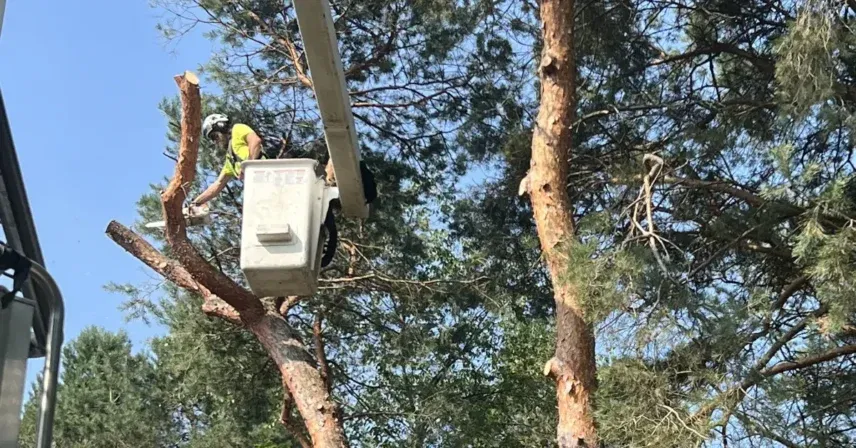
For homeowners and property managers in West Michigan, proper tree care is more than just an aesthetic choice: it is a critical investment in the health, safety, and longevity of your landscape. Because of our region’s distinct seasons, characterized by cold, snowy winters and humid, variable summers, understanding the optimal timing for pruning is essential.
While many might consider “anytime” to be acceptable, arborists and horticulturalists agree that the dormant season is the golden window for most tree maintenance.
Key Takeaways
- The Golden Window: The ideal time for most tree pruning in West Michigan is during the dormant season (late November to mid-March).
- Disease Prevention: Pruning during dormancy is essential to prevent the spread of serious diseases like Oak Wilt, which is transmitted by insects active in warmer months.
- Flowering Exceptions: Prune spring-flowering trees (e.g., dogwoods, crabapples) only after they finish blooming.
- Safety First: Dead, damaged, or hazardous branches should be removed immediately, regardless of the season.
- Avoid “Topping”: Never remove the main trunk or large branches to “shorten” a tree, as this causes permanent, irreversible damage.
The Golden Rule: Prune During Dormancy
In Michigan, the dormant season generally falls between late November and mid-March. During this period, deciduous trees have shed their leaves and entered a state of reduced metabolic activity. They are effectively “sleeping,” and this resting state provides several key advantages for pruning.
Why Dormancy Is Ideal
- Disease Prevention: Many pathogens, particularly those responsible for serious diseases like Oak Wilt, are spread by insects that are highly active in warmer months but dormant in the winter. By pruning during the coldest part of the year, you ensure that fresh wounds do not attract these disease-carrying pests.
- Visibility: Without leaves, the true structure of the tree is exposed. This allows you—or a professional—to easily identify crossing, diseased, or structurally weak branches that might otherwise be hidden.
- Reduced Stress: Because the tree is not actively growing, it does not expend energy trying to heal fresh pruning wounds during the hectic early spring cycle. Instead, it “seals” these cuts and is ready to direct all its energy into vigorous, healthy growth as soon as the weather warms.
- Easier Cleanup: Pruning when the ground is frozen or hard can make it easier to move heavy equipment around your property, and the lack of foliage makes cleanup of branches and debris much more efficient.
The Critical Exception: Flowering Trees
While the dormant season is the universal recommendation for most trees, you must adjust your schedule for spring-flowering trees and shrubs.
If you prune trees like crabapples, dogwoods, magnolias, or redbuds in the middle of winter, you will likely remove the flower buds that formed the previous summer. To enjoy the best blooms, the rule of thumb is simple: Wait until immediately after they have finished flowering. This allows the tree to display its beauty and then heal before setting buds for the following year.
Special Considerations for Specific Species
Not all trees respond to the Michigan climate in the same way.
- “Bleeders” (Maples, Birches, Walnuts): These species are notorious for “bleeding” – exuding large amounts of sap if pruned in late winter or early spring. While this fluid loss is generally not harmful to the tree’s overall health, it can be aesthetically messy. If the sap flow bothers you, it is best to wait until the tree has fully leafed out in late spring.
- Oak Trees: Due to the severe risk of Oak Wilt, which is fatal to our native oaks, never prune an oak between April 15 and July 15 in Michigan. This is the peak window for the insects that carry the disease to be attracted to fresh wounds. Winter is the safest time for oak maintenance.
What About Summer Trimming?
While dormancy is preferred, summer pruning is not strictly forbidden—it is just used for different goals.
- Corrective Pruning: If a branch is damaged in a summer storm, or if a limb is hanging dangerously over a walkway or roof, prune it immediately, regardless of the season. Safety always takes precedence over optimal biological timing.
- Growth Control: If you are trying to slow down the growth of a specific, overly vigorous branch, pruning in mid-summer (after the flush of spring growth has hardened) can be effective, as the tree has less time to recover and produce new shoots before autumn.
A Note on Harmful Practices: “Topping”
Regardless of the season, there is one practice you should always avoid: Topping.
Topping involves cutting off the top of the main trunk or large branches to “shorten” a tree. This is incredibly detrimental. It leaves massive, slow-to-heal wounds, creates a “broom” of weak, fast-growing suckers that are prone to storm damage, and significantly shortens the lifespan of the tree. If your tree is growing too tall, consult an ISA-certified arborist about professional thinning or reduction, which maintains the tree’s structural integrity.
Final Advice
If you are dealing with large, mature trees or branches that require working near power lines or close to your home, do not hesitate to contact a professional arborist. Proper pruning is as much an art as it is a science; one wrong cut can affect the health of a tree for years. For expert assistance in the region, call Big Chipper Tree Service LLC.