Most people don’t start looking for the best tree service until something forces the issue. A storm rolls through. A large limb drops. A tree starts leaning toward the house. That urgency is exactly when poor decisions happen, and when unqualified companies do their best business.
Taking a few minutes to ask the right questions before hiring can save you thousands of dollars and a significant amount of stress. Here is what actually matters.
Why Tree Work in Grand Rapids Is More Demanding Than It Looks
West Michigan’s climate creates specific challenges that separate qualified tree crews from everyone else.
The freeze-thaw cycle through late fall and early spring puts repeated stress on root systems and causes bark cracking that accelerates internal decay. A tree can look completely solid from the curb while the interior is structurally compromised. That is not something an untrained crew will catch before the job starts.
Clay-heavy soils throughout Kent County also limit how deep roots can anchor. In older neighborhoods like Eastown, Heritage Hill, and Creston, mature trees have spent decades in compacted urban soil. Shallow root systems mean a tree that appears stable can uproot in high winds, which arrive regularly off Lake Michigan.
Emerald ash borer and Dutch elm disease have both moved through the region significantly, leaving behind structurally weakened trees across the metro. When storm season arrives, those are the trees that fail. The National Weather Service regularly issues severe thunderstorm warnings for Kent and Ottawa Counties, and the area has seen multiple derecho-level wind events in recent years.
All of this means a chainsaw and a pickup truck are not enough. The job requires real technical judgment about how trees in this specific region behave.
Best Tree Service: The Credentials That Actually Matter
When you search for tree services near Grand Rapids you will find dozens of companies. Most have a website and a phone number. Fewer have verifiable credentials. Here is what to look for.
ISA Certification: The International Society of Arboriculture certifies arborists who have documented field experience, passed a written examination, and maintain continuing education. An ISA Certified Arborist understands tree biology, structural risk, and proper cutting technique. Incorrect pruning cuts can expose a tree to disease. Improper removal near a structure can shift load in ways an untrained crew won’t anticipate until something fails. Ask whether a certified arborist will be involved in your specific job, not just employed by the company.
TCIA Accreditation: The Tree Care Industry Association audits companies against ANSI A300 standards, which govern pruning technique, rigging, crew safety, and equipment. TCIA accreditation means the operation has been independently reviewed, not just self-described as professional.
OSHA Certification: Tree work consistently ranks among the most hazardous industries in the country. OSHA-certified companies follow regulated safety protocols for crew protection and equipment operation. This protects workers on your property and protects you from liability if something goes wrong.
Insurance: This is the non-negotiable. Ask for a certificate showing both general liability and workers’ compensation coverage before anyone starts work. If a crew member is injured on your property and the company has no workers’ compensation, you can be held liable. General liability covers damage to your home or neighboring properties. A legitimate company provides proof of coverage without hesitation.
Qualified vs. Unqualified: What the Difference Looks Like in Practice
| Factor | Qualified Tree Service | Unqualified Operator |
| Credentials | ISA, TCIA, OSHA certified | No verifiable accreditation |
| Insurance | Full liability and workers’ comp | Unverified or none |
| Estimate | Written, itemized, guaranteed | Verbal only |
| Equipment | Crane, aerial lift, chipper | Chainsaw and pickup truck |
| Assessment | On-site inspection before quote | Quote over the phone or at the door |
| Payment | Deposit upfront, balance at completion | Full payment demanded before work |
| Storm response | Established local company | Out-of-state plates, door-to-door |
| Cleanup | Included in scope | Often extra or incomplete |
If a company you are considering falls on the right side of this table in more than one or two categories, move on.
How to Avoid Hiring the Wrong Tree Service
Door-to-door solicitation after storms. After any significant weather event in Grand Rapids, trucks with out-of-state plates appear in residential neighborhoods offering immediate cleanup at a low price. These operators typically carry no verifiable insurance, have no local presence, and disappear after collecting payment. Some leave hazardous stubs or create new structural problems. Never hire anyone who knocks on your door uninvited after a storm.
No written estimate. A professional tree service always provides a written scope of work before the project begins. That document should specify what will be removed, how debris will be handled, what equipment will be used, and what the total cost covers. If a company will not put the estimate in writing, stop the conversation there.
Full payment is demanded upfront. A reasonable deposit to hold a scheduled date is normal. Full payment before the work starts is not. It removes your leverage entirely if the job is incomplete or substandard.
Recommending tree topping. Topping is the practice of cutting the upper canopy down to large stubs. It is condemned across the arboricultural industry because it causes decay, generates structurally weak regrowth, and shortens a tree’s life dramatically. Any company that recommends topping as routine maintenance is not operating to professional standards. That tells you something about how they approach everything else.
No local address or references. Check Google reviews, the Better Business Bureau, and ask for references from jobs completed in Kent County. Companies with an established local presence have reputations to protect. Transient operators do not.
Six Questions to Ask Before You Hire A Tree Service Company
These questions take two minutes and will tell you most of what you need to know.
- Do you have an ISA Certified Arborist on staff and will they be involved in my job?
- Can you provide a certificate of insurance for both general liability and workers’ compensation?
- What specific equipment will you use for this project?
- Is the estimate written and does it cover everything we have discussed including cleanup?
- Can you provide references from completed jobs in the Grand Rapids area?
- What is your payment structure and when is the balance due?
How a company responds to these questions is more telling than anything on their website.
What Affects the Cost of Tree Work in Grand Rapids
Pricing is project-specific. The factors that drive cost up or down include the size and species of the tree, how close it sits to structures, what equipment access is available, whether storm damage has created unpredictable load points, and whether permits are required.
Permit requirements vary by municipality in Kent County. The City of Grand Rapids has tree ordinances that apply to street trees and work in the right-of-way. Confirming permit requirements before work starts is something a qualified company handles as part of the job, not something they leave to you to figure out afterward.
Get at least two written estimates. If one comes in dramatically lower than the others, ask specifically why. The gap almost always comes down to insurance coverage, equipment capability, disposal method, or crew experience level.
Why Local Experience in Grand Rapids Is Not Interchangeable
39 years of working in Kent County means something that a newer company or out-of-region crew cannot replicate. It means knowing how large maples in tight residential lots respond to Lake Michigan wind events. It means recognizing the drainage patterns in specific neighborhoods that compromise root systems over time. It means having handled crane removals in Heritage Hill’s confined historic streetscapes and clearing jobs on larger properties in Cascade and Byron Center.
When a job requires judgment under pressure, that judgment comes from having seen how trees in this specific region fail. Local knowledge is built through years of showing up and doing the work correctly, not through a website that covers every market in the state.
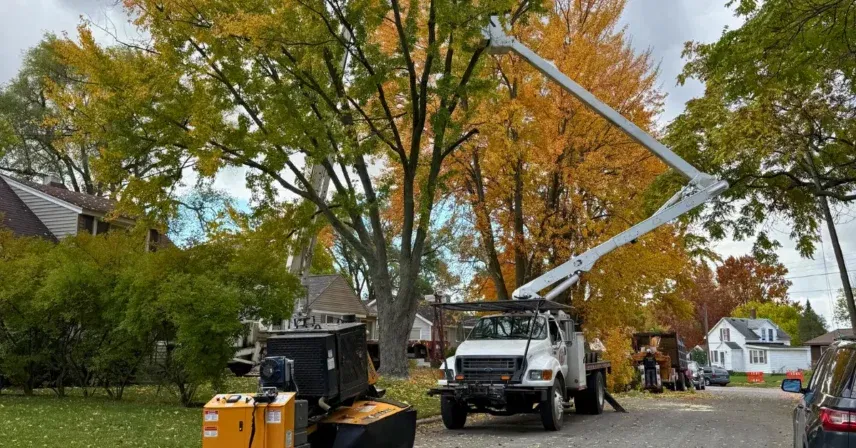
Big Chipper Tree Service has operated out of Grand Rapids since 1986. Their team holds TCIA accreditation, ISA membership, and OSHA certification. They carry full insurance, hold a BBB A+ rating, and operate an 18 to 40-ton stick crane, bucket truck, aerial lift, and grapple log truck. They provide free written estimates, back every job with a No-Surprise Guarantee, and offer 24/7 emergency response for situations that cannot wait.
Frequently Asked Questions
How do I know if a tree service in Grand Rapids is legitimate?
Ask for a written certificate of insurance showing general liability and workers’ compensation coverage. Confirm whether they employ an ISA Certified Arborist. Check their BBB rating and ask for local references from completed jobs in Kent County. A legitimate company answers all of these without hesitation. One that deflects, minimizes, or promises to follow up and does not is telling you something important.
What should a tree service estimate include?
A proper written estimate should specify which trees or limbs will be removed, what equipment will be used, how debris will be handled and removed, whether stump grinding is included or a separate cost, and the total price with payment terms. Any estimate that does not cover all of these in writing leaves room for disputes and surprise charges after the job is done.
Should I hire the cheapest tree service I can find?
Choosing the lowest bid can be risky. A significantly lower estimate often reflects missing insurance coverage, limited equipment, inexperienced crews, or incomplete cleanup. Tree work involves safety and structural risk. The right decision is based on credentials, written scope, and verified insurance, not just price.
How can I verify a tree service is properly insured?
Ask for a current certificate of insurance showing both general liability and workers’ compensation coverage. The certificate should list coverage limits and effective dates. Do not rely on verbal confirmation. A legitimate company provides documentation before work begins.
Is it safe to remove a tree myself instead of hiring a professional?
Tree removal is one of the most dangerous home maintenance tasks. Large limbs are under tension, trees can shift unpredictably during cutting, and falls from ladders are common. Professional crews use specialized equipment, controlled rigging systems, and safety protocols that reduce the risk of property damage and serious injury. For anything beyond very small trees, professional removal is the safer option.
Get a Written Estimate Before You Decide
Big Chipper Tree Service has served Grand Rapids homeowners since 1986. If you have a tree that needs attention, their team will assess your property and provide a clear, written estimate at no cost.
Call (616) 300-1811
1959 Will Ave NW, Grand Rapids, MI 49504
Serving Grand Rapids and the surrounding Kent and Ottawa County communities.