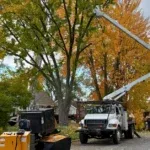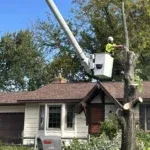
Grand Rapids is celebrated for its lush urban canopy from the towering oaks of Heritage Hill to the maples lining the streets of East Grand Rapids. However, Michigan’s volatile weather, ranging from heavy lake-effect snow to intense summer thunderstorms, puts immense pressure on these living structures.
A tree doesn’t always have to be dead to be dangerous. In many cases, a “zombie tree,” one that looks green and healthy on the outside but is structurally compromised internally, poses the greatest risk to your home and family. Understanding the subtle warning signs of tree failure is essential for any West Michigan homeowner.
Key Takeaways
- The “Three-Legged Stool” of Hazard: A tree is only a “hazard” if it has a defect, the potential for failure, and a target (your house, car, or power lines).
- Invisible Decay: Green leaves do not equal a safe tree; internal rot and root failure often hide behind a healthy-looking canopy.
- Michigan-Specific Risks: Species like Silver Maples and Ash trees are particularly prone to brittle failure in our climate.
- Immediate Red Flags: Sudden leaning, soil heaving, and “widow makers” require emergency professional intervention.
1. The Root of the Problem: Below-Ground Stability
The root system is a tree’s anchor. In Grand Rapids, where clay-heavy soils can become oversaturated during spring thaws, root stability is frequently compromised.
- Soil Heaving: If you notice the soil lifting or cracking on the side of the tree opposite a lean, the roots are physically pulling out of the ground. This is an emergency.
- Fungus at the Base: Seeing mushrooms or “shelf fungi” (conks) growing from the base or root flare is a primary indicator of root rot. This fungus feeds on the structural cellulose of the tree, effectively dissolving its foundation.
- Construction Damage: If you’ve recently had a driveway paved or a gas line installed, the severed roots may not show signs of failure for 2–5 years. By the time the canopy thins, the tree may already be unstable.
2. Trunk Defects: Cracks, Cavities, and Cankers
The trunk must support the weight of the entire canopy. Any breach in the vertical integrity of the trunk is a major red flag.
- Vertical Cracks: A deep, vertical crack that penetrates the bark into the wood suggests the tree is already failing. If two cracks occur on opposite sides of the trunk, the tree is held together by very little sound wood.
- V-Shaped Unions (Included Bark): When a tree has two main trunks (co-dominant leaders) that form a tight “V” shape, bark often gets trapped between them. Unlike a strong “U” shaped union, a “V” union has no structural connection and is prone to splitting down the middle during a windstorm.
- Hollows and Cavities: While a small hole from a lost limb is often fine, a large cavity that encompasses more than 30% of the trunk’s circumference significantly increases the risk of a “snap” failure.
3. Canopy Hazards: “Widow Makers” and Deadwood
The “crown” of the tree acts like a giant sail. If that sail is filled with dead, brittle, or detached weight, the results can be deadly.
- Deadwood: Branches that lack bark or fail to produce leaves in the spring are “deadwood.” Unlike living wood, dead wood is brittle and loses its ability to flex.
- Widow Makers: This term refers to large, broken branches that are “hung up” in the canopy. They can fall at any moment, even on a calm, sunny day with enough force to crush a vehicle.
- Lopsided Growth: A tree that is significantly heavier on one side creates uneven torque on the trunk. If a storm hits from the “heavy” side, the tree is far more likely to topple.
4. The Michigan “Hit List”: High-Risk Species
In our region, certain trees require more frequent inspections due to their natural growth patterns and susceptibility to local pests.
- Ash Trees: Due to the Emerald Ash Borer, almost every untreated Ash tree in Grand Rapids is now a structural risk. They become extremely brittle once dead and are famous for “shattering” rather than falling in one piece.
- Silver Maples: These are fast growers with very soft, weak wood. They are the #1 species for limb failure during Michigan ice storms.
- Bradford Pears: Known for their beautiful white blossoms, these trees almost always have poor “V” shaped unions and typically self-destruct once they reach 20 years of age.
5. Post-Storm “Self-Audit”
After any significant weather event in Grand Rapids, perform a quick “walk-around” of your property. Look for:
- Fresh cracks in the ground or leaning that wasn’t there yesterday.
- Bark that has “popped” off the trunk, revealing white or discolored wood underneath.
- Leaning toward “targets” like your roof, power lines, or the neighbor’s fence.
Don’t wait for a Lake Michigan gale to test the strength of your trees. Big Chipper Tree Service LLC has been Grand Rapids’ trusted authority on dangerous tree removal and 24-hour storm response since 1986. With a Certified Arborist on staff and a fleet of heavy-duty equipment, they specialize in identifying and removing hazardous “dirty trees” before they become liabilities.
Frequently Asked Questions
Can a tree with green leaves be dangerous?
Absolutely. Many trees maintain a green canopy while the interior heartwood is entirely rotted away. The leaves are fed by the outer layers (sapwood), but the structural strength comes from the center.
How do I know if a lean is natural or dangerous?
A natural lean usually has a “sweep”, the tree curves back toward the light. A dangerous lean is usually straight and accompanied by cracked soil or exposed roots at the base.
Will my insurance pay to remove a dangerous tree?
Generally, insurance only pays after a tree falls on a covered structure. However, being proactive can save you the cost of your deductible and the headache of a massive home repair.
What is “cabling and bracing”?
If a tree is valuable but has a weak V-union, an arborist can install steel cables to support the weight, preventing the tree from splitting without having to remove it.
Why are mushrooms at the base so bad?
Mushrooms are the “fruit” of a massive fungal network inside the tree. By the time you see them on the outside, the internal decay is usually advanced.
Does Big Chip Tree Service offer financing?
Yes! Big Chip understands that emergency tree removal can be an unexpected expense and offers financing options to help homeowners secure their property immediately.
How close is “too close” to a house?
It depends on the species and size. Generally, any tree whose “fall radius” includes your home should be inspected annually by a professional.
Can I prune a dangerous limb myself?
Never attempt to remove large limbs or deadwood that requires a ladder. The tension in a falling limb is unpredictable and accounts for a high percentage of homeowner injuries.
The Bottom Line
In Grand Rapids, our trees are our greatest landscape assets, but they require a watchful eye. By identifying root heaving, trunk cracks, and canopy deadwood early, you can move from a state of “emergency” to one of “management.” When in doubt, trust the eyes of a professional who knows the specific challenges of Michigan arboriculture.
Reviewed by a Certified Arborist
This safety analysis has been reviewed by an ISA Certified Arborist to ensure all information regarding soil mechanics and tree failure meets the standards of the International Society of Arboriculture.