Serving West Michigan Homeowners and Property Owners
Tree pruning in Grand Rapids involves removing specific branches to improve structure, reduce storm risk, and maintain long-term tree health. In West Michigan’s high-wind climate, structural pruning helps prevent limb failure and property damage. Professional pruning follows species-specific timing rules, especially for oaks, where pruning season directly affects disease risk.
Most trees in Grand Rapids yards do not fail because of disease or old age. They fail because nobody touched them for twenty years. A branch manageable at three inches becomes a 12-inch limb with a weakened attachment point hanging over a roof. Pruning is not cosmetic. Done correctly and on schedule, it is the primary reason a tree stays structurally sound through West Michigan’s storm seasons.
Big Chipper Tree Service prunes and trims trees across Greater Grand Rapids and West Michigan. 39 years of field experience. ISA and TCIA accredited. OSHA certified. Free written estimates before any work begins.
Call (616) 300-1811 | Free Estimates | Tree Pruning Across West Michigan
What Tree Pruning and Trimming Covers
Many homeowners often confuse pruning and trimming, using these terms interchangeably. However, they actually address different issues in gardening and plant care.
What is tree pruning?
Tree pruning is the selective removal of branches at proper biological cut points to improve structure, reduce risk, and support long-term tree health.
Trimming addresses clearance and appearance. It manages branch length, removes deadwood, and keeps growth away from structures, rooflines, and utility lines.
Most jobs involve both. Our service covers:
- Structural pruning to correct weak branch attachments and improve load distribution
- Crown thinning to reduce wind resistance and improve light penetration
- Crown raising for clearance below the canopy
- Deadwood removal throughout the canopy
- Clearance trimming from structures, rooflines, and utility lines
- Storm damage pruning to remove split or hanging branches safely
For trees already down after storm damage, see our 24/7 Emergency Tree Service in Grand Rapids page.
Why Pruning Matters More in West Michigan
West Michigan’s storm pattern makes structural tree maintenance more consequential than in calmer climates.
Spring storms arrive with serious wind loads, often when trees are fully leafed and carrying peak canopy weight. A dense, unpruned crown catches wind like a wall. That force transfers directly to branch unions, and that is where failures happen, particularly in silver maple, Bradford pear, and cottonwood, which develop weak attachment points as they mature.
The freeze-thaw cycle compounds this. Internal cracking that develops through repeated freezing and thawing is invisible from the ground. When an April storm arrives, those pre-cracked limbs fail at far lower wind loads than they should.
Proper pruning reduces storm failure risk by lowering canopy density and correcting weak branch unions. It does not eliminate risk, but it significantly reduces the likelihood of major limb failure during the events West Michigan sees every year.
Common Signs a Tree Needs Pruning
Common signs a tree needs pruning in Grand Rapids include:
- Branches crossing and rubbing each other, creating open wounds and decay entry points.
- Deadwood is visible in the upper canopy, particularly branches larger than two inches.
- Branch unions with included bark, where two limbs grow at a tight angle, squeezing bark between them and weakening the attachment.
- Canopy so dense that the wind moves the entire crown as one unit rather than flexing through it.
- Limbs extending over rooflines, driveways, or primary living spaces.
- Hanging or partially broken branches left after a recent storm.
- No professional assessment in five or more years.
In older Grand Rapids neighborhoods like Heritage Hill, Ottawa Hills, and East Grand Rapids, many mature oaks, maples, and elms have gone decades without structural work. Phased pruning over multiple visits is often the right approach rather than aggressive one-time cutting.
Our Tree Pruning Process in Grand Rapids, MI
Step 1: Full Canopy Assessment
We assess species, age, canopy structure, branch attachment quality, deadwood distribution, and overall health before any cut is made. This determines what pruning type is appropriate and where priority cuts are.
Step 2: Written Estimate
You receive a written estimate covering the full scope before anything starts. Our no-surprise guarantee applies to every job.
Step 3: Pruning Execution
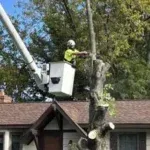
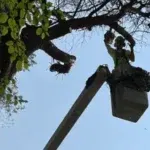
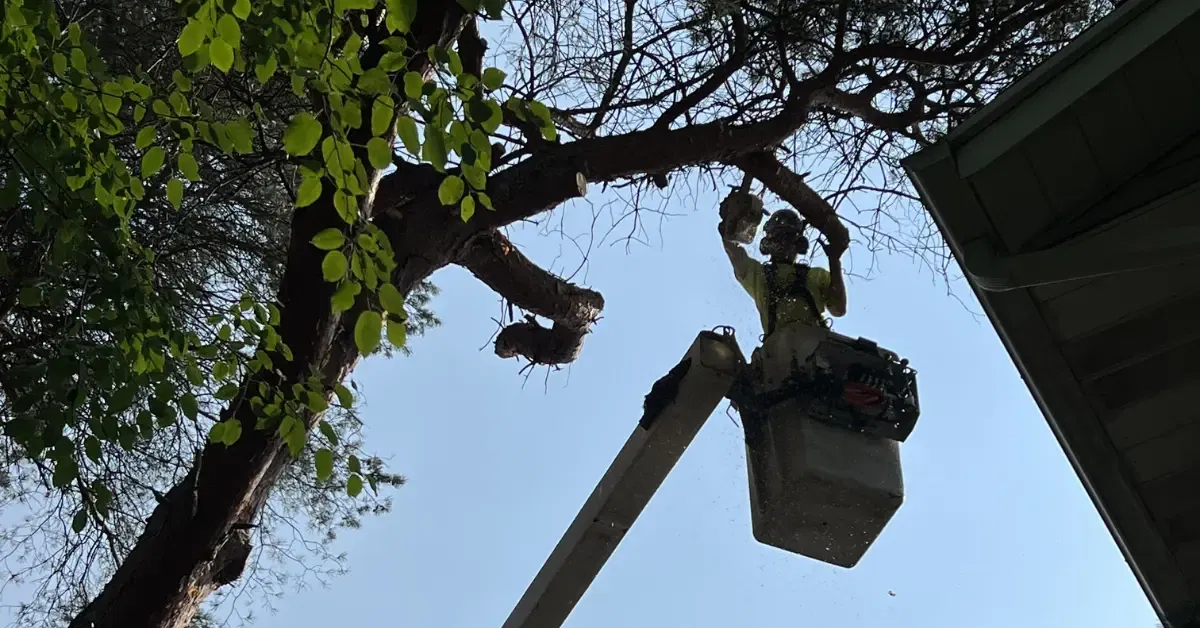
Cuts are made at the branch collar, the natural swelling where a branch meets the trunk or parent limb. This allows the tree to compartmentalize the wound and seal correctly. For large canopy work, we use the bucket truck or aerial lift. On overgrown mature trees, we use phased pruning to avoid canopy shock from excessive removal in one visit.
Step 4: Debris Removal and Walkthrough
All cut material is cleared from the site. We walk the finished work with you, explain what was removed and why, and flag anything needing future attention.
What Affects the Cost of Tree Pruning in Grand Rapids
- Tree size and canopy height: Taller trees require aerial equipment and more time to work safely through the crown.
- Scope of work: Removing a few deadwood sections differs significantly from full structural pruning of a large multi-stemmed maple.
- Species and growth pattern: Silver maple and Bradford pear have structural tendencies requiring specific pruning approaches to avoid accelerating weakness.
- Equipment and access: Trees over structures or in tight spaces require additional rigging or aerial lift positioning.
- Number of trees: Multiple trees in one visit are more cost-efficient than separate mobilizations.
Written estimates follow an on-site assessment. Every job is priced on actual site conditions.
Best Time to Prune Trees in Grand Rapids and West Michigan
Timing matters more than most homeowners realize, and getting it wrong on certain species carries real consequences.
Late fall through early spring is ideal for most species in this region. The tree’s structure is fully visible, wound response is strong going into the growing season, and pest activity is low.
- Oaks should not be pruned between April and July : Oak wilt spreads through sap-feeding beetles active during warmer months. Fresh pruning wounds attract those beetles and introduce infection directly into the vascular system. Oak wilt has killed trees across Kent County and is confirmed throughout Michigan. We follow this timing rule on every oak without exception.
- Emerald ash borer: Eliminated most ash across Grand Rapids over the past fifteen years. If you have a surviving ash, pruning is part of a management strategy that typically includes systemic treatment. We assess ash trees honestly and tell you whether investment in pruning makes sense for that specific tree.
- Silver maple: The most common yard tree across Grand Rapids and one of the most frequently mismanaged. Topping silver maples stimulates rapid regrowth of weakly attached water sprouts and leaves decay columns in the stubs. We do not top trees. It creates future hazards while charging you for the work.
Service Area
Big Chipper prunes and trims trees throughout Greater Grand Rapids and West Michigan, including Grand Rapids, Walker, Wyoming, Kentwood, East Grand Rapids, Grandville, Cascade, Byron Center, Lowell, Ada, Rockford, Comstock Park, Jenison, Hudsonville, and surrounding Kent County communities.
Within Grand Rapids, we regularly work in Eastown, Heritage Hill, Creston, Alger Heights, Westside, Belknap Lookout, Baxter, Highland Park, Ottawa Hills, and Fulton Heights.
Frequently Asked Questions About Tree Trimming & Pruning in West Michigan
Common questions about tree pruning in Grand Rapids and West Michigan include:
How often should trees be pruned in West Michigan?
Most established trees benefit from a professional assessment every three to five years. Fast-growing species like silver maple and cottonwood may need attention more frequently. Slower-growing hardwoods like oak and hickory can go longer between cycles. Young trees benefit from early structural pruning to establish good form before problems develop.
Is there a wrong time of year to prune trees in Grand Rapids?
Yes. Oak pruning between April and July carries serious oak wilt risk and should be avoided. Most other species can be pruned year-round, though late winter before bud break is generally ideal for structure visibility, wound response, and low pest activity.
Can pruning save a tree already showing decline?
Sometimes. If decline is caused by correctable issues like overcrowding or poor past pruning, professional pruning can stabilize the tree. If decline is caused by root damage, systemic disease, or advanced internal decay, pruning may slow progression but will not reverse it. We give you a direct assessment after looking at the tree.
Will bad pruning damage my tree permanently?
Yes. Flush cuts that remove the branch collar, stub cuts that leave dead wood attached, and lion-tailing that strips interior branches all cause serious long-term structural damage. Correct cuts made at the right location allow the tree to seal wounds effectively and maintain structural integrity.
Do you prune trees close to power lines?
We prune for clearance from structures and residential lines. Work immediately adjacent to energized utility lines falls under the utility company’s jurisdiction. We assess your situation and tell you directly what we can handle and when utility coordination is required.
How do I know if my tree needs pruning or full removal?
Pruning works when the tree is fundamentally sound, and issues are correctable. Removal becomes necessary when structural failure is advanced, the root system is compromised, or the location creates a risk that pruning cannot resolve. A free on-site assessment gives you a direct answer with no obligation.
Schedule Your Free Tree Pruning Estimate
If your trees have not been pruned in several years, structural assessment and selective pruning reduce storm risk and extend tree lifespan. The first step is a site visit. We look at the tree, give you a direct assessment, and provide a written estimate before any commitment is required.
Call (616) 300-1811 | Free Estimates | Tree Pruning Across Grand Rapids and West Michigan
Big Chipper Tree Service | 1959 Will Ave NW, Grand Rapids, MI 49504 | bigchipper.com Locally owned. Family operated. Serving West Michigan for 39 years. ISA Accredited | TCIA Member | OSHA Certified | BBB A+ Rated | Fully Insured