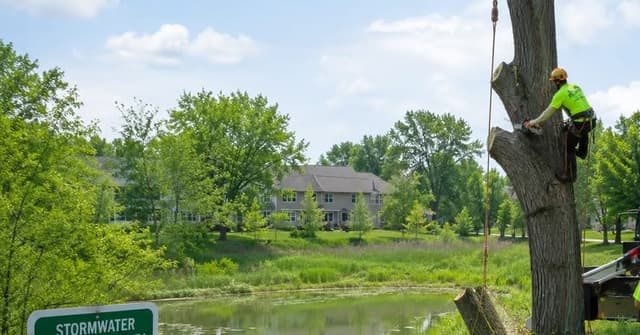
Key Takeaways:
- Grand Rapids has stormwater management regulations that can directly affect tree removal projects near drains, swales, and retention areas.
- Removing trees near stormwater infrastructure without understanding local rules can result in fines and required restoration work.
- Trees play a significant role in stormwater management, and their removal near drainage features requires careful planning.
- Both Kent County and City of Grand Rapids regulations may apply depending on tree location and drainage feature type.
- Working with an experienced, locally knowledgeable tree service like Big Chipper ensures your project stays compliant while protecting your property.
Most homeowners in Grand Rapids, Michigan think tree removal is pretty simple. If a tree needs to come down, they call a tree service, schedule the work, and the job gets done. But it’s not always that straightforward. If the tree is near a storm drain, drainage ditch, detention basin, or retention pond, local stormwater rules may come into play. In Grand Rapids and Kent City, these regulations can affect whether a tree can be removed, what permits may be needed, and how the work must be done. Knowing the requirements before the project starts can help you avoid delays, extra costs, and unexpected issues.
Why Trees and Stormwater Management Are Closely Connected
Trees do much more than make a yard look nice. They also play an important role in managing rainwater. A mature tree can catch a large amount of rainfall in its canopy, slowing down how quickly water reaches the ground. Its roots absorb moisture, help the soil drain properly, and hold the ground in place around drainage ditches, retention ponds, and other stormwater features. This helps reduce erosion and keeps sediment out of the stormwater system.
When a tree near one of these areas is removed, those benefits disappear. Rainwater can run off more quickly, soil may begin to erode, and extra sediment can wash into ponds and storm drains. Over time, that can reduce water quality and put more pressure on the local drainage system. That’s why Grand Rapids and Kent County may have rules or permit requirements for removing trees near stormwater features.
The Regulatory Framework in Grand Rapids
Several overlapping regulatory authorities govern stormwater management in Grand Rapids and Kent County.
Federal Oversight
At the federal level, the Clean Water Act and the EPA’s NPDES program require Grand Rapids to operate under a Municipal Separate Storm Sewer System (MS4) permit. This mandates active management of stormwater quality and quantity.
State Regulations
At the state level, Michigan Environment, Great Lakes, and Energy (EGLE) oversees stormwater permitting for land disturbance activities. Projects disturbing more than one acre typically require a state permit, while smaller disturbances near wetlands or county-regulated drains may also trigger review.
Local City Ordinances
At the local level, the City of Grand Rapids enforces stormwater ordinances and zoning rules that regulate tree removal near drainage features and public rights-of-way.
County Drain Authority
The Kent County Drain Commissioner also has jurisdiction over regulated drains. Properties near these drains may face restrictions on any work within a drain’s right-of-way.
Types of Regulated Features and What They Mean for Tree Removal
Storm Drains and Catch Basins
These collect surface runoff and direct it into the underground pipe network. Tree removal near storm drain infrastructure may require coordination with the City’s public works department depending on the scope of work involved.
Drainage Swales and Ditches
Many Grand Rapids neighborhoods use vegetated swales to convey stormwater across properties and toward natural waterways. These swales are often located in easements crossing private property. Removing trees within or adjacent to these easements without understanding the easement terms can result in the property owner being required to restore the disturbed area and potentially face liability for downstream erosion impacts.
Detention Basins and Retention Ponds
Trees along retention pond banks perform important erosion control functions. Removal without appropriate erosion control measures and in some cases regulatory approval can result in bank failure, pond sedimentation, and potential violations of the conditions under which the stormwater facility was originally permitted.
Regulated County Drains
The Kent County Drain Commissioner maintains rights-of-way along regulated drains in communities including Rockford, Caledonia, Ada, and Lowell. The Michigan Drain Code of 1956 establishes these rights-of-way, within which private activity including tree removal may be restricted without authorization from the Drain Commissioner’s office.
Permit Requirements: What Grand Rapids Homeowners Need to Know
Public Right-of-Way Permits
For trees in the public right-of-way, the City of Grand Rapids requires a permit before any pruning or removal. Working without approval can result in fines and required restoration.
Regulated Drainage Areas
For trees near regulated drainage features, additional permits may apply. These can come from the Kent County Drain Commissioner if the tree is within a regulated drain right-of-way.
City Development Oversight
If tree removal is part of a larger site disturbance, the City’s development services department may require permits or review before work begins.
State-Level Requirements
Michigan EGLE may require permits if wetlands or state-regulated waters are involved in or near the project area.
Private Property Considerations
For most single-tree removals on private property outside regulated areas, a formal permit is often not required. However, checking with the City’s planning or development services department is strongly recommended, especially in Kent County municipalities with additional local rules.
Consequences of Improper Tree Removal Near Stormwater Features
Removing trees near stormwater features without understanding applicable regulations or implementing proper erosion control can create serious problems. Immediate erosion along drainage channels or retention pond banks can occur rapidly after removal, particularly before heavy rain. Grand Rapids averages over 3.6 inches of precipitation in both June and July, making timing critical.
If a violation of a drain right-of-way or stormwater ordinance is identified, the property owner may be required to restore the disturbed area, replant vegetation, install erosion control measures, and pay associated fines. In situations involving state or federal requirements, consequences can be more significant. Beyond regulatory risk, poorly planned removal near drainage features can lead to long-term landscape degradation. Without the root systems and canopy cover of established trees, pond banks become vulnerable to slumping and the drainage feature itself can become less effective over time.
Big Chipper Tree Service has been serving Grand Rapids and Kent County since 1986, and our team has extensive experience on properties where stormwater features, drainage easements, and regulated drains add complexity to tree work. We understand the local regulatory landscape and approach every project with careful attention to compliance and long-term property outcomes.
When a project involves tree removal near drainage infrastructure, we evaluate access, soil stability, erosion risk, and proximity to regulated features before work begins. We can help property owners understand whether their situation requires coordination with the City of Grand Rapids, the Kent County Drain Commissioner, or Michigan EGLE before work proceeds, and we implement appropriate erosion control during and after removal.
Big Chipper is BBB A+ accredited, ISA and TCIA certified, OSHA compliant, and fully licensed and insured. We serve Grand Rapids, Rockford, Ada, Caledonia, Lowell, Grandville, Wyoming, Holland, and Hudsonville and all surrounding Kent County communities with transparent pricing, a workmanship guarantee, and 24/7 emergency service. Call Big Chipper Tree Service at (616) 300-1811 to schedule a free consultation and ensure your tree removal project near stormwater features is handled safely, professionally, and in full compliance with applicable regulations.
Frequently Asked Questions About Tree Removal and Stormwater Ordinances in Grand Rapids
Do I need a permit to remove a tree near a drainage ditch on my property?
It depends on whether the ditch is a regulated county drain and whether it falls within a drainage easement. Checking with the City of Grand Rapids and the Kent County Drain Commissioner before beginning work is always advisable.
What is the Kent County Drain Commissioner’s role in tree removal?
The Drain Commissioner maintains rights-of-way along regulated drains throughout the county. Tree removal within these rights-of-way may require authorization from the Drain Commissioner’s office.
Can I be fined for removing a tree near a stormwater feature without a permit?
Yes. Depending on the specific regulatory requirement that applies, working without required authorization can result in fines, required restoration work, and other penalties.
Does removing a tree near a retention pond require special erosion control?
In most cases, yes. Tree removal near retention pond banks disturbs root systems that stabilize soil, and erosion control measures are typically needed during and after the work.
Summary Checklist: Tree Removal and Stormwater Compliance in Grand Rapids
| Situation | Regulatory Consideration | Recommended Action |
| Tree in Public Right-of-Way | City of Grand Rapids permit required | Contact the City Forestry Department before work begins |
| Tree Within County Drain Right-of-Way | Kent County Drain Commissioner authorization required | Consult the Drain Commissioner’s Office before removing the tree |
| Tree Near a Stormwater Retention Pond | Erosion control requirements and local ordinance review | Hire a licensed professional tree service to ensure compliance |
| Tree Removal Near a FEMA Floodplain | Potential floodplain development permit required | Verify property boundaries and confirm permit requirements before work |
Final Advice
Tree removal near stormwater features in Grand Rapids is not simply a matter of cutting down a tree. The regulatory framework reflects a legitimate public interest in protecting water quality, preventing erosion, and maintaining drainage infrastructure that serves entire communities. Property owners who understand what applies to their situation and work with an experienced tree removal firm in Grand Rapids, Michigan can protect themselves from costly violations and help preserve their neighborhood’s landscape and drainage function. Call Big Chipper Tree Service at (616) 300-1811 to discuss your project and schedule a free estimate.