Key Takeaways:
- Oak wilt is a fatal fungal disease actively spreading through Kent County’s oak tree population.
- June marks the beginning of the highest-risk window for oak wilt transmission through fresh pruning wounds.
- Sap beetles carry the oak wilt fungus from infected trees to healthy ones through open cuts in bark.
- Red oaks in Grand Rapids can die within weeks of infection, while white oaks decline more slowly.
- Scheduling all oak pruning before June or after the growing season dramatically reduces infection risk.
If you have oak trees on your Grand Rapids or Kent County property, there is something you need to know before you pick up a pruning saw this spring. Oak wilt, one of the most aggressive tree diseases in Michigan, is actively spreading across West Michigan. As temperatures rise and beetles become more active heading into June, the risk of introducing a fatal fungal infection through a routine pruning cut becomes very real. Understanding what oak wilt is, how it spreads, and what steps to take right now is some of the most important tree knowledge a West Michigan homeowner can have.
What Is Oak Wilt and Why Is It a Growing Concern in Kent County
Oak wilt is caused by the fungal pathogen Bretziella fagacearum, which attacks the vascular system of oak trees, the internal channels that move water and nutrients from roots to canopy. Once infected, the tree wilts and dies from the top down. In red oaks, this process can be startlingly fast. A tree that appeared completely healthy in May can be entirely dead by August.
Kent County’s warm, humid summers create ideal conditions for both the fungal pathogen and the beetle species that spread it. Grand Rapids average highs near 79 degrees in June and into the low 80s in July precisely the range during which sap beetles are most active. Michigan State University Extension and the Michigan DNR have both flagged oak wilt as a growing problem throughout the lower peninsula, including the West Michigan region.
How Oak Wilt Spreads: The Role of Sap Beetles
The primary above-ground mechanism for spreading oak wilt is the sap beetle, including the common picnic beetle. These insects are attracted to the scent of fermenting sap released whenever bark is broken whether from a pruning cut, storm damage, or a lawnmower scrape.
The danger is in how the fungus travels. Spore-producing fungal mats develop beneath the bark of already-infected oaks. When a beetle feeds on these mats, microscopic spores attach to its body. If that beetle then visits a fresh wound on a healthy oak, it deposits the spores directly into the tree’s vascular tissue. The infection begins almost immediately, and the tree’s defenses have no time to respond.
This is why pruning timing is so critical. In winter, beetle populations are suppressed and a pruning wound poses very little risk. By June, beetle populations have exploded and a fresh pruning cut on an oak is genuinely dangerous.
Red Oaks vs. White Oaks: A Critical Distinction
Not all oaks respond to oak wilt the same way. Red oaks including pin oak and scarlet oak are dramatically more susceptible. The fungus spreads rapidly through their vascular system and the tree typically dies within a single growing season. White oaks, including bur oak, contract the disease but decline much more slowly and may respond to systemic fungicide treatment if a professional intervenes early enough.
Both red oaks and bur oaks are recommended tree species for West Michigan landscapes and are common throughout Grand Rapids, Grandville, Wyoming, and surrounding communities. If you have a red oak, getting the pruning calendar right is especially high-stakes.
Early Warning Signs of Oak Wilt
- Rapid Leaf Wilting: Sudden wilting that progresses quickly from the outer canopy inward and downward, much faster than normal seasonal change.
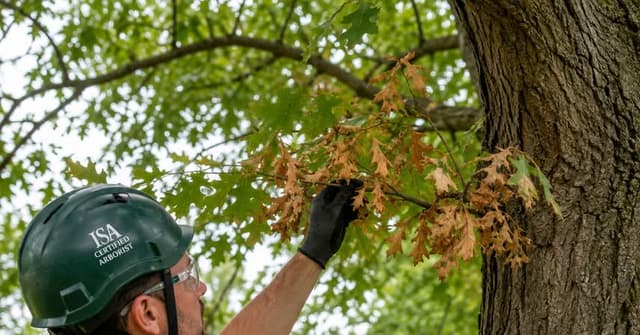
- Two-Toned Leaves in Red Oaks: Edges and tips turn bronze or tan while the leaf center stays green, a distinctive and alarming pattern that warrants an immediate call to an arborist.
- Bark Cracking and Fermented Odor: In later stages, fungal mats beneath the bark can cause cracking and produce a sweet, fermented smell detectable from several feet away.
- Rapid Overall Decline: A tree that looked healthy earlier in the season suddenly losing vitality across the entire canopy should be inspected without delay.
6 Things Grand Rapids Homeowners Must Do Before June Pruning
Inspect Oak Trees Early
Check all oak trees on your property to identify any that may need pruning. Early evaluation helps you plan work before the high-risk season begins.
Schedule Pruning Before June
Arrange all necessary pruning work as early as possible, ideally before June, to avoid peak beetle activity periods.
Complete Routine Pruning in Cooler Months
Ensure standard pruning, deadwood removal, and structural maintenance are finished during cooler seasons when beetle activity is minimal.
Postpone Non-Essential Work
If pruning cannot be completed before June, delay all non-urgent trimming and maintenance until late fall to reduce risk.
Protect Cuts if Summer Pruning Is Unavoidable
If pruning must happen during high-risk months, immediately apply a pruning sealant to fresh cuts to help deter beetle attraction.
Respond Quickly to Storm Damage
If storms expose oak wood during summer, treat it as urgent, contact a professional tree service promptly for assessment and proper wound care.
Big Chipper Tree Service has been serving Grand Rapids and Kent County homeowners since 1986. We are ISA and TCIA members, BBB A+ rated, OSHA certified, and fully licensed and insured. Our certified arborist team can evaluate your oak trees, identify early signs of oak wilt, and recommend the right course of action whether that means scheduling timely pruning, treating storm wounds, or assessing underground spread risk.
Do not wait until you notice a problem. Call Big Chipper Tree Service at (616) 300-1811 or contact us online to schedule a free estimate and protect the oaks on your Kent County property before the high-risk season begins.
Frequently Asked Questions About Oak Wilt in Kent County, Michigan
Is it safe to prune oak trees in May in Grand Rapids, Michigan?
May carries increasing risk as beetle populations begin building. The safest window is late fall through late April. If you must prune in May, seal all cuts immediately.
Can oak wilt spread from my neighbor’s tree to mine?
Yes, through underground root grafting. If a neighboring oak is infected, the fungus can travel through connected root systems without any above-ground contact. A root barrier may be necessary.
Will fungicide treatment save my infected red oak?
Once a red oak is fully infected, there is no effective treatment. White oaks in early stages may respond to systemic fungicide injection. Early detection is essential.
Should I remove a dead oak tree right away?
Yes. Leaving a dead red oak allows fungal mats to develop and produce spores that beetles can carry to healthy neighboring trees.
Summary Checklist: Oak Wilt Risk Management for Grand Rapids Homeowners
| Condition | Risk Level | Recommended Action |
| Pruning oaks in June or July | Extremely High | Postpone or seal cuts immediately |
| Pruning oaks late fall through April | Low | Safe window; proceed with proper technique |
| Storm damage exposing oak wood in summer | High | Apply wound sealant and call Big Chipper |
| Oak showing rapid canopy wilt in summer | High | Contact a certified arborist immediately |
| Neighboring infected oak within root distance | Moderate to High | Consider root barrier installation |
Final Advice
To protect your oaks, strictly complete all pruning before May. Once June arrives, avoid all non-emergency cutting until late autumn to prevent attracting disease-carrying beetles. If summer storms cause damage, immediately seal exposed wood to mask the scent of sap. Regularly monitor your canopy for sudden wilting or leaf bronzing, which are early warning signs. If you suspect an infection, contact a professional tree service firm in Kent County, Michigan immediately to discuss options like root trenching or fungicide treatments. Proactive, seasonal maintenance is far more economical than the eventual removal of a large, infected tree. By aligning your property care with the tree’s biological cycle, you preserve the long-term health and beauty of your landscape. For expert assistance in the Grand Rapids area, call Big Chipper Tree Service LLC at (616) 300-1811 to schedule your professional assessment today.