Key Takeaways:
- Eastern tent caterpillars are a spring pest that primarily target cherry, apple, and crabapple trees, building web tents in branch forks.
- Fall webworm appears in late summer, targets a much wider range of tree species, and builds webbing at branch tips rather than branch crotches.
- Both insects are primarily cosmetic concerns for healthy trees, but repeated infestations can weaken trees over time.
- Timing of treatment matters significantly; acting early in each pest’s life cycle produces far better results than reacting after damage is already extensive.
- Big Chipper Tree Service helps Grand Rapids homeowners with pest monitoring, treatment recommendations, and tree health evaluation throughout Kent County.
Every spring and summer, people in Grand Rapids, Michigan often notice webs in their trees. Some webs appear in early May in the branches of cherry or crabapple trees. Others show up in late July or August and cover the ends of branches with white silk. These webs are made by two different insects: the Eastern tent caterpillar and the fall webworm. Knowing the difference between them helps you decide when to take action, which trees to check, and whether the problem is serious.
The Eastern Tent Caterpillar: Grand Rapids’ Most Recognizable Spring Pest
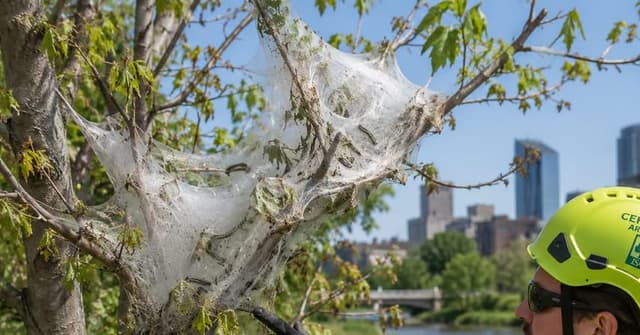
The Eastern tent caterpillar (Malacosoma americanum) is a common pest in West Michigan. In April and May, it builds large silk tents where tree branches meet. During years with many caterpillars, one tree may have several large tents. The insect’s life cycle follows the seasons.
- In late summer, the female moth lays eggs on small twigs. The eggs stay there through the winter in a shiny, protective covering. They hatch in late April, around the time new leaves begin to grow in Grand Rapids. This usually happens when temperatures stay in the 50s and 60s. The young caterpillars need these fresh leaves for food.
- After hatching, the caterpillars build a shared silk tent. The tent gives them shelter and a safe place to rest between feeding. By the middle of May, the tent can become large and easy to see. By late May, the caterpillars are fully grown. They leave the tent and make their own cocoons. Adult moths come out in late June and July, lay eggs, and then die.
Which Trees Do Eastern Tent Caterpillars Target in Kent County, MI?
Eastern tent caterpillars strongly prefer members of the rose family. In Grand Rapids, the trees most commonly and heavily targeted include – wild black cherry, chokecherry, ornamental cherry, apple, crabapple, and hawthorn.
Ornamental cherry and crabapple trees are extremely common in Grand Rapids residential landscapes, making property owners with these species particularly attentive during April and May. The encouraging news for homeowners is that most healthy, established trees can tolerate a single season of significant defoliation by Eastern tent caterpillars without lasting harm. Trees typically re-leaf after feeding ends, and while the tree expends energy reserves, one defoliation event rarely causes permanent damage. Concern rises meaningfully when the same tree is defoliated repeatedly over consecutive years, when a tree is already under stress, or when young trees with limited energy reserves are involved.
Fall Webworm: A Late-Season Pest with a Much Wider Host Range
Fall webworm, Hyphantria cunea, is a very different insect from the Eastern tent caterpillar despite both producing silk webbing on trees. The differences are important for both identification and management. The most immediately obvious visual difference is the location of the webbing. Eastern tent caterpillar tents are built inside branch forks early in the season. Fall webworm nests are built at the tips and ends of branches and expand outward to enclose more foliage as the colony grows. If you see webbing at branch tips encasing leaves that are visibly browning inside the nest, you are looking at fall webworms.
The timing is also entirely different. Fall webworm is a late-season insect. In Grand Rapids, colonies typically become noticeable starting in July and can remain active through September well after Eastern tent caterpillars have already completed their life cycle. There are typically two generations of fall webworm per year in Michigan, with the second-generation colonies being the most visible and extensive in late summer.
Which Trees Fall Webworm Targets in West Michigan
Unlike the host-specific Eastern tent caterpillar, fall webworm is a generalist feeder that attacks an extremely wide range of deciduous trees.
- In Grand Rapids and Kent County, documented hosts include – walnut, hickory, cherry, apple, crabapple, ash, elm, mulberry, linden, and many others meaning virtually any deciduous tree on your property is a potential target.
- Properties with black walnut trees, which are common throughout Kent County, frequently see significant activity. As with Eastern tent caterpillars, healthy established trees generally tolerate fall webworm defoliation without lasting damage because the damage occurs late in the season when trees have already completed most annual growth. Repeated heavy infestations and already-stressed or young trees warrant more serious attention.
When to Act: The Right Timing for Each Pest
Timing of intervention is critical for both insects. Acting too early or too late reduces effectiveness and may result in unnecessary treatment.
- For Eastern Tent Caterpillars: The most effective window is early in the larval period before significant defoliation occurs. In Grand Rapids, this means monitoring host trees in mid-to-late April and acting when small tents first appear. Small tents in early stages can be physically removed by hand or with a stick during early morning or evening hours when caterpillars are congregated inside, eliminating entire colonies with no chemical application needed. For larger infestations or where physical removal is impractical, biological controls such as Bacillus thuringiensis (Bt) can be applied as a spray during early larval stages. Bt is a naturally occurring soil bacterium toxic to caterpillars when consumed but harmless to birds, mammals, and beneficial insects when applied correctly and at the appropriate time.
- For Fall Webworm: Monitor trees in late June and July for the first small nests at branch tips. Small nests can be pruned out along with the enclosed branch tip and destroyed. Bt applications are also effective against fall webworm larvae during early larval stages before the nest becomes large and webbing makes thorough coverage difficult.
- For both pests, waiting until nests are fully mature and defoliation is already extensive significantly limits the practical value of any intervention. At that point, the feeding damage has occurred and treatment primarily prevents the next generation rather than reversing current season damage.
Big Chipper Tree Service has been serving Grand Rapids homeowners and property managers throughout Kent County since 1986. Our team understands the seasonal rhythm of tree pests in West Michigan.
Big Chipper Tree Service is an ISA and TCIA certified, BBB A+ accredited, OSHA certified, and fully licensed and insured. Our certified arborists can evaluate your trees for pest activity, identify whether intervention is warranted, recommend the most appropriate and targeted control approach, and safely remove pest-damaged or structurally weakened branches.
We serve Grand Rapids, Rockford, Ada, Caledonia, Lowell, Grandville, Wyoming, Holland, and Hudsonville and all surrounding Kent County communities with transparent pricing, a workmanship guarantee, and 24/7 emergency service. Call Big Chipper Tree Service at (616) 300-1811 to schedule a free consultation and keep your West Michigan trees healthy from spring through fall.
Frequently Asked Questions About Tent Caterpillars and Fall Webworm in Grand Rapids, Michigan
Are Eastern tent caterpillars and fall webworms the same insect?
No. They are two entirely different species. Eastern tent caterpillars appear in spring and build tents in branch crotches. Fall webworm appears in summer and fall and builds webs at branch tips, with a much wider host range.
Will tent caterpillars kill my cherry or crabapple tree in Grand Rapids, Michigan?
A single severe defoliation is unlikely to kill a healthy, established tree. Repeated heavy infestations over consecutive years can weaken trees significantly, and young trees are at greater risk than mature ones.
When should I start watching fall webworms in Grand Rapids?
Begin monitoring your deciduous trees in late June and July. Small nests at branch tips are much easier to manage than fully developed nests in August and September.
Can I spray the nests to kill the caterpillars?
Spraying directly into a large mature nest is generally not effective because the webbing protects the caterpillars inside. Physical removal or timely Bt applications during the early larval stage are more effective approaches.
Summary Checklist: Eastern Tent Caterpillar vs. Fall Webworm in Grand Rapids
| Feature | Eastern Tent Caterpillar | Fall Webworm |
| Active Season | April through May | July through September |
| Web Location | Branch forks and crotches | Branch tips and ends |
| Primary Hosts | Cherry, apple, crabapple, hawthorn | Walnut, linden, cherry, elm, and many others |
| Best Intervention Window | Mid-to-late April when tents are small | Late June through July when nests first appear |
| Physical Removal Effective? | Yes, when nests are small | Yes, when nests are small |
Final Advice
Eastern tent caterpillars and fall webworms are a normal part of the tree ecosystem in Grand Rapids and throughout Kent County. Most healthy, established trees can tolerate their presence without long-term damage. In many cases, the visible webbing and defoliation look worse than the actual impact on tree health. However, this does not mean they should always be ignored. Regular monitoring during spring and midsummer emergence periods is essential. Early detection makes infestations much easier to manage and control. Small outbreaks can often be handled quickly before they spread. Trees that are young, stressed, or already weakened need closer attention. A professional and dedicated tree service firm in Grand Rapids, Michigan can assist in countering heavy or repeated infestations through timely evaluation and treatment. They can also take proactive care steps to protect long-term tree health and appearance. Consistent seasonal observation helps keep your landscape more resilient year after year. For expert assessment and treatment options, call Big Chipper Tree Service at (616) 300-1811 to schedule your free estimate now.