Key Takeaways
- Tree topping removes 50-100% of a tree’s leaf-bearing canopy, creating severe energy deficits and stress responses.
- Topped trees produce fast-growing water sprouts that are weakly attached and far more likely to fail in storms.
- Large topping wounds heal poorly, inviting decay organisms, insects, and disease for years after the initial cuts.
- ANSI A300 pruning standards explicitly prohibit topping as an unacceptable practice that compromises tree health and safety.
- Proper crown reduction achieves size control goals without the long-term structural damage topping causes.
Tree topping is one of the most misunderstood and damaging practices in tree care. Homeowners often request topping when a tree grows too tall near power lines or structures, viewing it as a quick, inexpensive solution. Some tree companies still offer topping, marketing it as “tree trimming” without explaining long-term consequences. But experienced & certified arborists in Grand Rapids, MI universally advise against topping because it creates more problems than it solves, compromising tree health, structural integrity, and safety for years.
Understanding why topping is so harmful requires knowing how trees actually grow and respond to severe pruning. Trees aren’t like hedges that can be sheared back repeatedly without consequence. Every cut affects the tree’s ability to produce energy, defend against pathogens, and maintain structural strength. Topping violates fundamental principles of tree biology, which is why industry standards explicitly prohibit it except in rare emergency situations.
What Is Tree Topping?
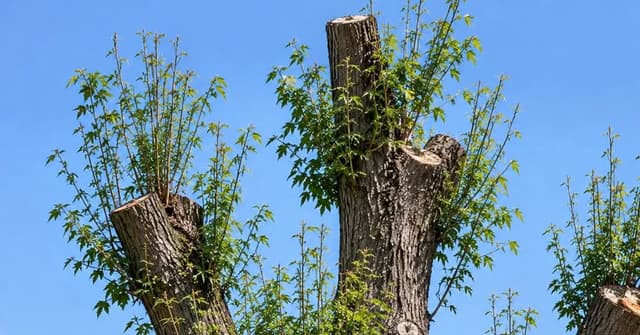
Tree topping is the practice of cutting large branches or the main trunk back to stubs or small lateral branches, usually to reduce overall height quickly. The cuts are made arbitrarily, without regard for natural branch structure or proper pruning techniques. Topping removes the terminal leader and upper canopy, leaving behind a framework of stubs from which new growth emerges.
Topping differs fundamentally from proper crown reduction.
Crown reduction cuts branches back to laterals large enough to assume the terminal role, maintaining natural form and structural integrity. Topping makes heading cuts at random points along branches, ignoring branch collars and natural defense zones.
Why Topping Damages Tree Health
A mature tree’s canopy is its food-production system. Leaves convert sunlight into carbohydrates through photosynthesis, providing energy trees need to grow, fight disease, maintain roots, and heal wounds. Topping can remove 50 to 100 percent of a tree’s leaf-bearing canopy in a single visit. This creates an immediate, severe energy deficit at the exact moment the tree needs maximum resources to heal numerous large wounds.
ANSI A300 pruning standards limit live canopy removal to no more than 25 percent in a single season for good reason. Exceeding this threshold triggers defensive stress responses. When a tree loses half or more of its canopy, it enters survival mode, diverting resources away from root maintenance toward rapid regrowth.
Large topping wounds, often 4-12 inches in diameter – heal far more slowly than properly placed pruning cuts. The exposed wood provides entry points for decay organisms, insects, and disease. Unlike proper reduction cuts made at branch collars, topping cuts leave stubs that cannot compartmentalize effectively, leaving the tree vulnerable to internal decay.
The Regrowth Problem: Weak, Fast-Growing Limbs
In its effort to recover lost canopy, a topped tree pushes out a flush of rapid new growth called water sprouts. These are thin, fast-growing shoots that cluster densely around the topping cuts, emerging from dormant buds just beneath the bark. Water sprouts can grow 3-10 feet in a single season, quickly restoring much of the height that was removed.
The problem is that water sprouts are structurally unsound. Unlike naturally developed branches that form strong branch collars over years of growth, water sprouts attach only to the outer wood layers. They lack structural reinforcement, making them inherently unstable even when they appear thick and vigorous.
Within 2-5 years after topping, these sprouts can restore the tree’s original height. But now the tree has a canopy of weakly attached branches that are far more likely to fail in wind, ice, or snow than the original structure. This creates a cycle: a tree gets topped to reduce storm risk, grows back fast and weak, and ends up posing more of a hazard than before.
Increased Storm Risk and Safety Hazards
Topped trees are consistently more likely to fail during storms, both because the regrowth is weakly attached and because internal decay from old topping wounds can hollow out limbs from the inside. The combination of weakly attached branches increasing in size on limbs with spreading internal decay significantly increases branch failure risk.
West Michigan experiences severe spring and summer storms with high winds, heavy snow loads in winter, and occasional ice events. Trees that have been topped are disproportionately represented in storm damage reports. When water sprouts fail, they can damage roofs, vehicles, power lines, and landscaping.
What to Do Instead: Proper Crown Reduction
If the goal is reducing height or managing canopy size near structures, proper pruning methods achieve these objectives without long-term damage.
- Crown reduction selectively cuts branches back to lateral branches large enough to assume terminal growth, reducing overall size while preserving natural form. ANSI A300 standards specify that the remaining lateral should be at least one-third the diameter of the removed branch.
- Crown thinning removes select interior branches to reduce wind resistance and canopy density without changing overall height.
- Selective clearance pruning targets specific limbs growing toward structures or utilities rather than cutting the entire canopy uniformly.
These techniques take more skill and time than topping, which is why topping is sometimes offered as the cheaper option. But the cost difference disappears when factoring in eventual removal costs for trees weakened beyond recovery.
How Big Chipper Can Help
Big Chipper Tree Service follows ANSI A300-standard pruning practices to manage tree size and clearance while supporting long-term tree health. We do not use topping and instead apply appropriate reduction cuts, thinning, and selective clearance pruning. If a tree has previously been topped, our team can assess its condition and determine whether corrective pruning may support healthier future growth. Our ISA-certified arborists evaluate existing topping damage, potential storm risks, and appropriate corrective measures based on the tree’s condition.
Frequently Asked Questions About Tree Topping in Grand Rapids, Michigan
Is tree topping ever appropriate?
Most certified arborists avoid topping except in rare emergency situations. Standard crown reduction or thinning almost always achieves the same goals without health risks.
How can I tell if a tree has been topped?
Look for large, flat-cut stubs on major limbs with clusters of thin, upright branches growing from around the cut. That regrowth pattern is a telltale sign.
Will a topped tree recover on its own?
Some trees survive topping, but they rarely recover fully. Corrective pruning over several years can improve structure, though the tree may carry decay long-term.
Does topping save money compared to proper pruning?
It’s cheaper upfront but often costs more over time, since topped trees are more likely to need removal or storm cleanup within a decade.
Summary Checklist: Topping vs. Proper Pruning
| Factor | Tree Topping | Proper Crown Reduction / Thinning |
| Cut type | Heading cuts back to stubs, arbitrary points | Reduction cuts to suitable laterals at branch collar |
| Canopy removal | Often 50–100% in one visit | Limited to 25% or less per season per ANSI A300 |
| Regrowth | Dense water sprouts, weakly attached | Natural branching pattern, structurally sound |
| Healing | Large wounds heal poorly, decay enters easily | Proper cuts seal efficiently, minimal decay risk |
| Storm risk | Increases over time due to weak sprouts and decay | Reduces or maintains risk with proper structure |
| ANSI A300 status | Explicitly prohibited, unacceptable practice | Recognized, standard pruning method when done correctly |
| Long-term cost | Higher due to removal, storm damage, repeated pruning | Lower over tree’s lifetime, preserves health and structure |
| Tree lifespan | Significantly shortened, often by decades | Maintained or extended with proper care |
Final Advice
Avoid tree topping, even when a tree appears too tall or difficult to manage. Instead, choose pruning methods that control growth while maintaining the tree’s natural structure and health. Before hiring a tree service, confirm that the crew follows ANSI A300 standards and has ISA-certified arborists on staff. If a tree has already been topped, have an arborist assess it and recommend corrective care before the next storm season.
Big Chipper Tree Service uses professional pruning practices to prioritise the long-term health and structural integrity of your trees. Our ISA-certified arborists can assess your trees and provide appropriate pruning or corrective recommendations. We focus on addressing specific tree needs while reducing potential risks to your property. This approach helps maintain healthy growth and supports the tree’s condition over the long term.