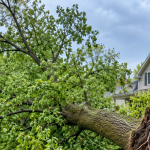
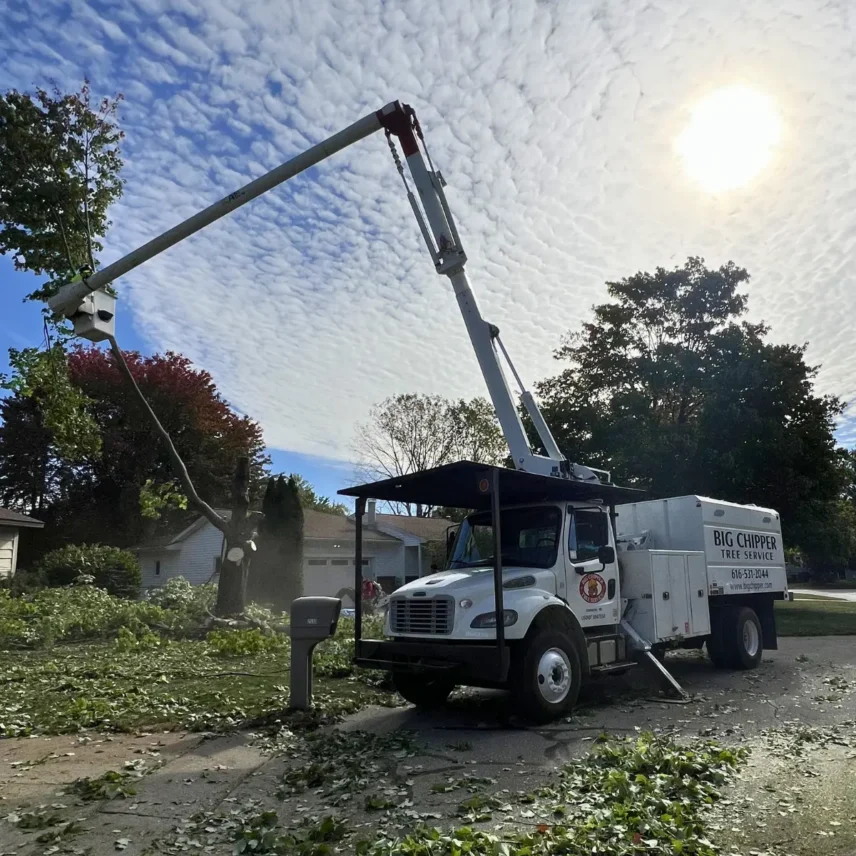
Some trees can’t come down the normal way. A leaning oak over a roofline, a split trunk hanging above a driveway, a dead ash wedged between two houses with no room for a controlled fall. These jobs don’t get safer with more chainsaws and more time. They get safer with different equipment entirely.
This article covers what a stick crane actually is, why it changes the math on dangerous removals, and how to tell whether the tree on your property is a crane job or a standard tree removal.
Key Takeaways
- Stick cranes lift tree sections safely instead of letting them fall.
- Crane removals are ideal for trees near homes, power lines, and tight spaces.
- Proper crane sizing depends on reach and site conditions, not just lifting capacity.
- In-house crane crews improve safety, efficiency, and scheduling.
- A professional assessment determines whether crane-assisted removal is the safest option.
What Is a Stick Crane, and Why Does It Change the Approach?
A stick crane is a straight-boom crane mounted on a truck that lifts large tree sections vertically off a property instead of dropping or lowering them by hand-operated rigging. Big Chipper runs 18-to-40-ton stick cranes across Grand Rapids and Kent County, sized to the tree and the site.
The core difference from traditional tree work is direction of movement. A climbing crew cuts sections and lowers them with ropes, or fells the tree in a chosen direction with enough open space to land it. A crane lifts the cut section straight up and swings it clear before it ever has a chance to fall toward the house, the fence, or the crew standing below.
Why Lifting Beats Dropping in a Tight Yard
Here’s the part most homeowners never think about: a falling piece of wood and a lifted piece of wood follow completely different physics, even if the cut itself looks identical.
A dropped or lowered section still has to travel through open space, and rope rigging absorbs shock rather than eliminating momentum. Even a well-rigged piece can swing, twist, or overshoot its target if the angle is off by a few degrees. A crane-lifted section never enters free fall. The crane’s hydraulic system controls the load through the entire movement, from the cut to the ground, which is why crane-assisted work is the standard choice when a tree hangs directly over a roof, patio, or parked car.
The Misconception About “Bigger Equipment”
Most people assume a bigger crane just means a stronger crane. Capacity matters, but reach and control matter just as much, and that’s where a lot of removals actually go wrong.
An 18-ton crane and a 40-ton crane can both lift a heavy log. The difference shows up in how far out the crane can extend while still holding that weight safely, which determines whether the crane can be set up on the street instead of driving onto the lawn, and whether it can reach a tree tucked behind a house without swinging the load over a neighbor’s property. Matching crane capacity to the actual site conditions, not just the tree’s size, is what separates a clean removal from a damaged yard.
What We See on Tight Grand Rapids Lots
Older Grand Rapids neighborhoods were platted long before anyone planned for a crane truck to show up. Narrow side yards, mature landscaping, and driveways barely wide enough for one vehicle are the norm in areas like Heritage Hill and Eastown.
On these lots, the crane often sets up from the street and reaches over the house entirely, lifting sections up and over the roofline rather than bringing any equipment onto the grass. Ground protection mats go down wherever the truck or outriggers touch the lawn, which is a small detail that saves homeowners from the ruts and compacted soil that heavy equipment can otherwise leave behind for a full growing season.
A Simple Way to Picture It
Think of a crane-assisted removal like moving a couch out through a second-story window with a hoist, instead of wrestling it down a narrow staircase. Both get the couch outside. Only one of them risks scraping the walls, twisting an ankle, or dropping it on the stairs along the way.
When Climbing Works vs. When a Crane Is the Right Call
| Situation | Typical Approach |
| Open yard, clear fall zone, healthy tree | Directional felling or standard climbing |
| Tree leaning toward a roof, deck, or driveway | Crane-assisted sectional removal |
| No safe drop zone due to fences, sheds, or neighboring property | Crane-assisted sectional removal |
| Tree near power lines | Crane or bucket truck, coordinated with the utility |
| Storm-damaged tree with an unpredictable failure point | Crane-assisted removal, prioritizing crew safety |
Why It Matters That the Crane Isn’t Subcontracted
Not every tree company that advertises crane-assisted removal actually owns a crane. Many subcontract the crane and operator from an outside outfit for the day, which adds coordination overhead and makes it harder to control scheduling, especially during storm season when demand for cranes spikes across an entire region.
Big Chipper runs its 18-to-40-ton stick cranes, bucket trucks, grapple log trucks, and aerial lifts in-house, without subcontracting. That matters for two practical reasons: the crew operating the crane works with it daily and knows its exact capabilities on unusual sites, and scheduling isn’t held hostage to a third party’s availability when a tree is actively leaning toward a roof.
Signs Your Tree Is Likely a Crane Job
Storm damage is one of the most common triggers for a crane call, since a tree that’s already cracked or leaning after high wind needs emergency tree service rather than a routine appointment. A few signs point toward a crane job specifically:
- The tree leans toward the house, garage, or a neighbor’s property
- There’s no open space large enough to safely drop full sections
- Large limbs overhang a roof, deck, or parked vehicle
- The trunk or major limbs show cracking, meaning the failure point is unpredictable
- Power lines run through or near the canopy
The 60-Second Removal Type Check
Before calling anyone, a quick look tells you what kind of job you’re likely dealing with:
- Is there open ground on at least one side big enough for the tree’s height?
- Does anything valuable sit directly under the canopy?
- Is the tree touching, or close to, a power line?
- Does the trunk look split, hollow, or unstable at the base?
Two or more “no” or “yes-that’s-a-problem” answers usually means it’s a crane conversation, not a standard trim-and-drop job.
Safety Standards Behind the Work
Arboricultural crane work in the U.S. is governed by the ANSI Z133 safety standard for arboricultural operations, alongside OSHA’s crane and material handling requirements. Crews working near structures or power lines should hold current ISA certification and be OSHA trained, since crane work adds load calculations, radio communication protocols, and site setup requirements that standard climbing work doesn’t involve.
Frequently Asked Questions
Is crane-assisted tree removal more expensive than traditional removal?
It depends on the job. Crane work often costs less overall once you account for total time, crew size, and the cost of avoiding roof, fence, or lawn damage. A tree that would take a climbing crew two days to dismantle by hand can often come down in a few hours with a crane.
Will a crane damage my lawn or driveway?
Ground protection mats are placed under the truck and any outriggers to distribute weight and prevent ruts. Crews also plan the setup position in advance to minimize how much of the property the equipment touches.
Can a crane remove a tree near power lines?
Yes, but it requires coordination. If a tree is touching or near a power line, the utility company typically needs to de-energize or clear the area before crane work begins. A qualified crew will always confirm this before starting.
How do I know if my tree removal needs a crane instead of a standard crew?
If the tree leans toward a structure, has no safe drop zone, or shows signs of instability like cracking or a shifting root plate, a crane-assisted approach is usually safer and, often, faster. A professional on-site assessment is the most reliable way to know for sure.
Does a bigger crane always mean a safer removal?
Not necessarily. Capacity has to match the site, not just the tree. A crane sized correctly for the reach and setup position, with an experienced operator, matters more than raw tonnage alone.
What happens to the wood after a crane removal?
Sections are typically lowered directly onto a grapple log truck for hauling, rather than left in piles on the lawn. This keeps cleanup fast and avoids extra equipment traffic across the property.
Protect Your Property with Crane-Assisted Tree Removal
A tree that can’t safely be felled or climbed isn’t a job to guess on. The difference between a clean, controlled removal and a damaged roof or an injured crew member often comes down to whether the right equipment showed up in the first place.
The safest removal is the one where nothing was ever in free fall. If you have a tree leaning toward your house, overhanging a driveway, or standing too close to power lines to trust a standard approach, the team at Big Chipper Tree Service can evaluate the site and tell you honestly whether a crane is the right call.