A tree failure on a residential lot is a homeowner’s problem. A tree failure over a commercial parking lot, a retail entrance, or a leased office courtyard is a liability event, and the difference in consequences is bigger than most property managers realize until it happens.
Key Takeaways
- Regular arborist inspections identify hidden structural defects before they become costly failures.
- A TRAQ tree risk assessment evaluates failure likelihood, target exposure, and potential consequences not just tree health.
- Documented inspections help commercial property owners demonstrate proactive tree management and reduce liability exposure.
- Annual assessments, along with inspections after storms or construction, help protect people, property, and business operations.
- ISA Certified Arborists with TRAQ credentials provide the most reliable evaluations for commercial tree risk management.
This article covers what a professional tree risk assessment actually evaluates, why a tree’s appearance alone doesn’t tell you what you need to know, and how documented inspections change a company’s position if something does go wrong.
What Does a Commercial Tree Risk Assessment Actually Involve?
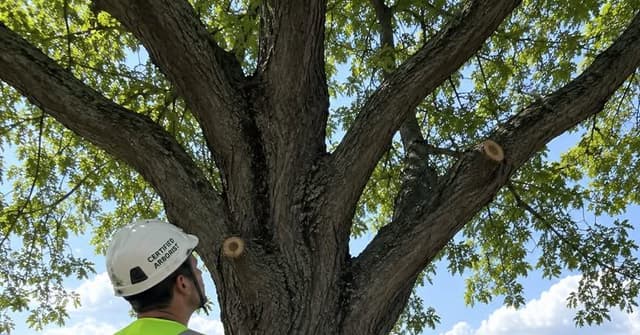
A commercial tree risk assessment is a structured evaluation of a tree’s likelihood of failure, what it could hit if it fails, and the consequences of that failure, not simply a visual check for obviously dead branches. The industry standard method, ISA’s Tree Risk Assessment Qualification (TRAQ), is built on ANSI A300 Part 9 and produces a documented risk rating for each tree: Low, Moderate, High, or Extreme.
Why a Healthy-Looking Tree Can Still Be High Risk
Most property managers assume risk is mainly about the tree’s health. A tree with green leaves and no obvious dead limbs gets mentally filed as “fine.” That assumption misses half of what actually determines risk.
TRAQ evaluates risk as a combination of three factors: the likelihood the tree or a branch will fail, the likelihood it hits something if it does, and the severity of the consequences if it does. A perfectly healthy oak in an empty field carries almost no practical risk, because there’s nothing under it to hit. That same oak, or one with a hidden structural defect, positioned over a busy parking lot entrance where dozens of people walk and park every day, can carry a High or Extreme rating even with a full, green canopy, because the “target” underneath changes the entire calculation.
The Fire Alarm Comparison
Businesses don’t wait for a fire to find out whether the alarm system works. Fire suppression and alarm systems get inspected on a scheduled cycle precisely because the cost of skipping that inspection only shows up when it’s too late to matter.
Trees on commercial property carry a similar kind of liability weight but rarely get the same scheduled discipline. A parking lot canopy tree is functionally part of the property’s safety infrastructure, sitting directly above cars, pedestrians, and building entrances, yet it’s common for a property to have a rigorous fire and elevator inspection log and no tree inspection record at all.
The Documentation Gap That Actually Matters After an Incident
Here’s the part that surprises a lot of property managers: whether a tree failure becomes a manageable insurance claim or a serious liability exposure often comes down to what was documented before the failure, not just what happened during it.
A written risk assessment, with a defined re-inspection interval and documented findings, gives a property owner a record showing reasonable, ongoing care. Without that record, a tree failure can read as something the property owner should have caught, particularly if the defect that caused the failure would have been visible to a trained assessor. This is a general pattern in premises liability, not a guarantee of any specific outcome, and property owners should talk to their insurer or legal counsel about what documentation their specific policy and jurisdiction expect.
A typical written assessment includes the tree’s location, species, and condition at the time of inspection, the specific defects identified, the assigned risk rating for each defect and target combination, the recommended action, and a suggested date for reassessment. That last detail matters more than it sounds. A report that’s several years old with no follow-up inspection scheduled tends to carry less weight than one showing an active, ongoing review cycle.
What We See on Commercial Sites Across Grand Rapids
Landscaping crews on commercial contracts are usually hired for clearance pruning: keeping branches off the building, away from signage, and clear of drive lanes. That work is valuable, but it’s a different task from a structural risk assessment, and the two get confused constantly.
A crew can prune a tree for clearance every year for a decade without anyone ever evaluating root health, trunk cavities, or crown structure for actual failure risk. The tree can look perfectly maintained from the ground while carrying a defect that clearance pruning was never designed to catch.
TRAQ Risk Ratings and What They Mean
| Risk Rating | What It Means | Typical Action |
| Low | Failure improbable under normal conditions | Continue routine monitoring |
| Moderate | Failure possible but unlikely under normal weather | Monitor on a defined schedule |
| High | Failure may be expected under normal weather | Mitigate promptly (pruning, cabling, or removal) |
| Extreme | Failure has started or is imminent | Address immediately, restrict access if needed |
When to Schedule a Commercial Tree Inspection
- Annually, as part of a standing property maintenance contract
- After any major storm with high winds, heavy snow, or ice, the kind the National Weather Service’s Grand Rapids office regularly issues warnings for, and after any emergency tree service call
- Before finalizing a commercial lease or property purchase with mature trees on site
- Following any visible change: new lean, cracking, dieback, or fungal growth
- Before or after major construction that disturbs root zones or grade
The 60-Second Parking Lot Walk
A property manager can catch a surprising amount without an arborist on-site, just by walking the lot with these questions in mind:
- Are there any trees with a visible lean toward parking spaces, walkways, or the building?
- Is there dead wood in the canopy directly over a high-traffic area?
- Are there mushrooms, fungal growth, or exposed roots at the base of any tree?
- Has clearance pruning ever been paired with an actual structural assessment?
Any “yes” to the first three, or a “no” to the last one, is worth escalating to a professional evaluation.
Frequently Asked Questions
How often should a commercial property get a tree risk assessment?
Annually is the common baseline for properties with mature trees over parking, walkways, or building entrances, with additional assessments after major storms or significant site changes. High-traffic properties or those with older, larger trees may warrant more frequent review.
Is a TRAQ assessment the same as routine tree trimming?
No. Routine trimming and clearance pruning maintain a tree’s shape and keep branches off structures, but they don’t evaluate structural risk. A TRAQ assessment specifically evaluates likelihood of failure, target exposure, and consequences, and is typically documented in a written report.
Does a tree risk assessment guarantee a tree won’t fail?
No assessment can guarantee that, since trees are living organisms and weather is unpredictable. What a documented assessment does is identify known, visible risk factors and support a defensible record of reasonable care, which is different from eliminating all risk.
What happens if an assessment finds a High or Extreme risk tree?
Typical next steps include mitigation, such as structural pruning, cabling, or bracing, monitoring on a shortened interval, or removal if the risk can’t be reasonably reduced. The right response depends on the specific defect, the tree’s value, and what’s beneath it.
Who should perform a commercial tree risk assessment?
Look for an ISA Certified Arborist with TRAQ credentialing specifically, since general landscaping or lawn care companies typically aren’t trained in structural risk evaluation methodology.
Does this apply to municipal or multi-family properties too?
Yes. Any property where trees overhang areas with regular foot or vehicle traffic, including apartment complexes, HOAs, schools, and municipal sites, faces a similar liability profile to retail and office properties, and benefits from the same documented inspection approach.
The Bottom Line on Commercial Tree Risk
A tree that looks fine from the leasing office window isn’t the same thing as a tree that’s been evaluated for structural risk. The gap between those two things is exactly where liability tends to live.
Big Chipper Tree Service works with residential, commercial, and municipal properties throughout Grand Rapids and Kent County. If your property has mature trees over parking areas, walkways, or building entrances and it’s been a while since anyone evaluated them for structural risk rather than just appearance, request an assessment before the next storm makes that decision for you.