A confirmed dead tree should be removed as soon as practical, but it is not always an immediate emergency. The urgency depends on whether the tree could strike people, buildings, vehicles, roads, utility lines, or other frequently used areas. A dead tree in an open area may be scheduled for removal, while a leaning or damaged tree near a home may require immediate attention.
The important step is to evaluate the risk before strong winds, heavy snow, saturated soil, or another West Michigan storm makes the decision for you.
The Short Answer: Remove a Dead Tree Before It Becomes Unstable
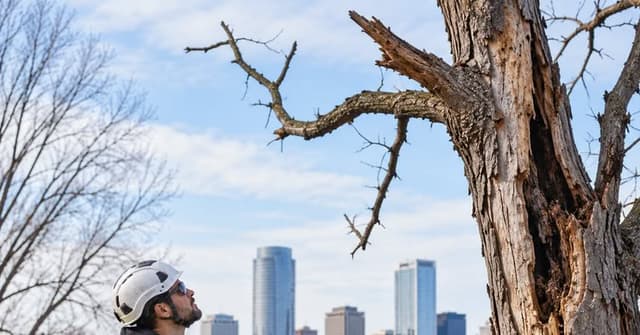
Once an entire tree is dead, it cannot recover. Its wood and roots gradually lose strength as decay progresses. Branches can break without warning, and the trunk may eventually split, topple, or uproot.
That does not mean every dead tree will fall tomorrow. Some remain standing for years, while others fail during the next period of high wind. There is no reliable countdown because the timing depends on the species, size, root condition, decay, soil, weather, and surrounding environment.
Our recommendation is straightforward: once death has been confirmed, determine the tree’s risk level and schedule removal accordingly. Do not wait for obvious movement or a major branch failure if the tree is within striking distance of something important.
If you are still unsure whether the tree is dead or simply dormant, review our guide to identifying a dead tree versus a dormant tree. That resource covers the warning signs in more detail. This article focuses on what to do after the tree has been confirmed as dead.
When a Dead Tree Requires Immediate or Emergency Removal
A dead tree becomes an emergency when failure appears possible and the consequences could be serious. The combination of poor structural condition and a nearby target usually determines the urgency.
Contact qualified emergency professionals immediately if:
- The tree has developed a new or noticeably worsening lean toward a home, garage, road, driveway, or neighboring property.
- The root plate is lifting, the soil is cracking around the base, or major roots have been exposed or damaged.
- The trunk has a widening crack, deep split, large cavity, or extensive decay.
- A large limb has broken and remains suspended over a regularly used area.
- Part of the tree has already fallen onto a roof, vehicle, fence, driveway, or roadway.
- The tree shifted or sustained additional damage during a recent storm.
- The tree is blocking access needed by residents or emergency vehicles.
- The trunk or branches are touching, leaning toward, or suspended over power lines.
If electrical lines are involved, do not approach the tree, touch any branches, or attempt to move debris. Keep other people and pets away, contact the appropriate utility provider, and follow its safety instructions. Tree work should begin only after the electrical hazard has been addressed and the area has been declared safe.
Our 24/7 emergency tree service is intended for urgent situations involving fallen trees, storm damage, blocked access, and immediate hazards. Large, unstable, or storm-damaged trees should never be treated as a do-it-yourself removal project.
When Removal Can Be Scheduled Promptly
A confirmed dead tree may not require an emergency response if it remains upright, shows no recent movement, and stands away from people and property. However, removal should still be scheduled before its condition worsens.
Prompt scheduling may be appropriate when:
- The tree has no significant lean, cracks, hanging branches, or visible root movement.
- There is a reasonably clear area around the tree.
- The tree is not close enough to strike a home, garage, road, sidewalk, driveway, or utility line.
- The property owner can restrict access to the potential fall zone.
- No severe weather is expected before the tree can be evaluated and removed.
“Not an emergency” should not be confused with “safe indefinitely.” Deadwood becomes more brittle over time, and internal decay may not be visible from the ground. Arrange a professional assessment so the tree can be placed on an appropriate removal schedule.
Our tree removal services in Grand Rapids and West Michigan include an on-site evaluation of the tree, its surroundings, equipment access, and other conditions that affect the work.
Dead Tree Removal Urgency Checklist
Use this decision guide to determine your next step. It does not replace an on-site assessment, but it can help you recognize when a situation should not wait.
Call Immediately
- The tree or a major limb has fallen on a structure, road, vehicle, or access point.
- A large branch is hanging overhead.
- The tree is touching or threatening a power line.
- The tree suddenly leaned or shifted after a storm.
- Soil is lifting around the base or roots appear to be pulling from the ground.
- The trunk is actively splitting or making cracking sounds.
- People cannot safely avoid the potential fall zone.
Arrange an Assessment as Soon as Possible
- The tree is dead and located near a house, garage, sidewalk, driveway, road, or neighboring property.
- There are visible cavities, cracks, decay, damaged roots, or missing bark.
- The tree is a large dead ash that may have been damaged by emerald ash borer.
- Branches have started falling, even during calm weather.
- The tree leans, but you are unsure whether the lean is new or structurally significant.
- You cannot determine whether the surrounding area provides a safe fall zone.
Schedule Removal Before the Condition Worsens
- The tree has been confirmed dead but remains stable.
- It stands in an open area away from structures and frequently used spaces.
- There are no hanging limbs, recent cracks, or signs of root movement.
- Access to the area can be restricted until removal.
- The tree can be removed under normal scheduling rather than emergency conditions.
How the Tree’s Location Changes the Urgency
Risk is not based on the tree alone. We also consider what the tree or its branches could hit.
A dead tree beside an unused field presents a different level of concern than one of the same size beside a Grand Rapids home. Trees near bedrooms, garages, playgrounds, parking areas, sidewalks, and busy driveways deserve faster attention because people and property are regularly within reach.
Property lines also matter. A tree growing on your property may be able to strike a neighbor’s roof, fence, vehicle, or yard. Do not enter the neighboring property or begin work across the property line without permission. A professional assessment can help document the tree’s condition and clarify what may be affected.
Trees near roads and public sidewalks can create risks beyond the property itself. If a dead branch could fall into traffic or onto pedestrians, arrange an assessment promptly. Trees within public rights-of-way may also be subject to local requirements, so ownership and applicable rules should be confirmed before removal.
Why a Dead Tree Becomes More Hazardous Over Time
Living wood has moisture and flexibility. After a tree dies, the wood dries and decay organisms begin breaking down its internal structure. Branch attachments weaken, cavities expand, and roots gradually lose their ability to anchor the tree.
The deterioration does not always happen evenly. One limb may remain attached while another breaks during an ordinary wind. The outside of the trunk may appear solid even when decay has reduced the strength of the interior.
Dead ash trees deserve particular caution in West Michigan. Emerald ash borer damage has left many ash trees with brittle wood and compromised root systems. A dead ash may be unsafe to climb and can shed branches or break apart as deterioration advances.
Waiting also increases the chance that a manageable removal becomes an urgent cleanup. Once branches fall onto a structure or the tree becomes tangled with another tree, the work may involve more hazards and tighter operating conditions.
How West Michigan Weather Can Accelerate Tree Failure
Grand Rapids and surrounding West Michigan communities experience weather that can place substantial stress on weakened trees.
Strong winds apply force to the trunk and remaining canopy. Heavy wet snow and ice add weight to branches that may already have weak attachment points. Freeze-thaw cycles can widen existing cracks as moisture enters openings, freezes, and expands.
Saturated soil creates another concern. After heavy rain or melting snow, wet ground may provide less support to a damaged or decaying root system. A dead tree with compromised roots can become less stable even if the trunk has not visibly changed.
Check the area from a safe distance after severe weather. If the tree has shifted, dropped a large branch, developed a new crack, or caused soil to lift around the base, keep people away and request an urgent evaluation.
Why Earlier Removal May Make the Work Simpler
Removing a dead tree earlier does not guarantee that the job will be simple, but it may prevent additional deterioration from reducing the available options.
A recently dead tree may have stronger branch attachments and a more stable trunk than one that has been decaying for several years. As the wood becomes brittle, crews may need to use more controlled methods to avoid placing weight on unstable sections.
The site also affects the plan. A dead tree in a clear yard with good access may be less complicated than a decayed tree positioned between a house, fence, and overhead lines. Our team evaluates access, nearby structures, ground conditions, and the tree’s stability before deciding how removal should proceed.
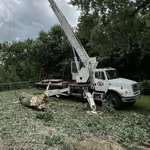
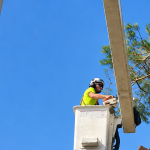
Our tree removal equipment includes cranes, bucket trucks, aerial lifts, grapple trucks, and other equipment used for different property and tree conditions. The appropriate setup is determined during the site assessment rather than assumed from the tree’s height alone.
Should the Tree Be Inspected Before Removal?
Yes, unless the tree has already failed and the emergency is obvious. An inspection helps confirm whether the entire tree is dead, identify structural hazards, evaluate the fall zone, and determine how quickly removal should occur.
Visible symptoms alone do not always provide a complete diagnosis. A leafless tree may be dormant, stressed, or dead. A living tree may also have isolated dead branches that can be addressed without removing the entire tree.
If the tree is still alive and the primary concern is deadwood or an overextended limb, professional tree trimming and pruning may be more appropriate. We do not assume that removal is necessary simply because part of a canopy looks unhealthy.
An assessment is especially important for large trees, trees with uncertain ownership, and trees close to buildings, utilities, roads, or neighboring property. It also helps identify access issues and whether stump work should be included in the project.
What to Do While Waiting for Service
Until the tree has been evaluated or removed, reduce exposure to the area rather than trying to correct the problem yourself.
- Keep children, pets, vehicles, and outdoor activities outside the potential fall zone.
- Avoid parking beneath the tree or its large branches.
- Do not stand under the tree to inspect cracks or hanging limbs.
- Do not pull on loose branches or attach ropes, ladders, or equipment to the tree.
- Avoid mowing or working near visible root lifting or unstable soil.
- Watch the tree from a safe location after high winds, ice, or heavy rain.
- If its condition changes, report the change when contacting the tree service.
- If utility lines are involved, stay away and contact the utility provider.
Do not climb, cut, rig, or attempt to fell a large dead tree. Dead branches and trunks may break under a person’s weight, and the direction of failure can be difficult to predict.
What Happens After a Dead Tree Is Removed?
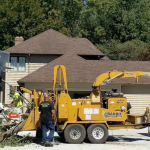
After the tree is taken down, branches and trunk sections are cleared according to the agreed scope of work. The stump may remain unless stump grinding or full removal is included.
Whether the stump needs attention depends on its location and what you plan to do with the area. A stump beside an unused wooded edge may be a lower priority than one in a lawn, walkway, planting area, or future construction site.
Stump grinding can reduce the stump below ground level so the area can be restored or reused. Full removal may be considered when major roots or the entire root mass must be taken out. Our guide to stump grinding and stump removal explains the difference and the factors that affect the choice.
Before scheduling the work, ask what the estimate includes. Confirm whether wood, branches, and debris will be removed, whether stump work is included or separate, and what site access may be needed.
Frequently Asked Questions About Dead Tree Removal
Does every dead tree need to be removed?
Not every dead tree is an immediate emergency, but a dead tree near people, buildings, roads, or utilities generally should be removed. A tree in a remote area with a completely clear fall zone may sometimes remain temporarily for habitat purposes. That decision should be based on a professional risk assessment and continued monitoring.
How quickly should a dead tree be removed?
A hazardous dead tree should be addressed immediately. A stable dead tree in an open area can usually be scheduled through normal service, but it should not be ignored. The longer it remains, the more its wood and roots may deteriorate.
Is a dead tree more likely to fall during a storm?
Yes. Dead trees have lost the living tissue that supports flexible wood and active root function. Strong winds, heavy snow, ice, saturated soil, and freeze-thaw cycles can expose weaknesses and trigger branch, trunk, or root failure.
Can a dead tree remain standing if it is far from buildings?
Possibly, if the entire fall zone is clear of people, paths, roads, utility lines, neighboring property, and valuable structures. Its condition should still be assessed because branches can travel beyond the trunk’s immediate footprint, and future changes to the property may increase exposure.
Should the stump be removed after the tree is taken down?
Stump removal is not always required. Grinding may be useful when the stump creates a trip hazard, interferes with mowing or landscaping, or occupies an area you want to reuse. Full removal may be more appropriate when construction or hardscaping is planned over the location.
Can homeowners insurance cover dead tree removal?
Coverage varies by policy and circumstances. Preventive removal of a standing dead tree may be treated differently from removing a tree that fell during a covered event and damaged an insured structure. Review your policy and speak directly with your insurance provider before relying on coverage.
Schedule a Dead Tree Assessment or Removal in West Michigan
If you have a confirmed or suspected dead tree in Grand Rapids or elsewhere in West Michigan, we can evaluate its condition, location, fall zone, and surrounding hazards. You can learn more about Big Chipper Tree Service or review our full range of local tree services.
To arrange an assessment, use our contact page or call (616) 300-1811. Our team can provide a free estimate and help you determine whether the tree requires immediate attention or can be scheduled for removal.
Larger removal projects may also qualify for our 10% off offer for new customers.