Key Takeaways
- The Scratch Test: A simple way to check for green, living tissue beneath the bark.
- Fungal Red Flags: Mushrooms at the base often indicate internal root rot or decay.
- Structural Warning: Deep cracks or seams in the trunk suggest a tree is losing its integrity.
- Bud Inspection: Living trees produce buds for the next season, even in the depths of a Michigan winter.
- Safety First: Dead mature trees are significant liabilities during West Michigan wind and snowstorms.
In West Michigan, the change of seasons brings a dramatic shift in our landscape. As the vibrant oranges and reds of autumn fade, our majestic Maples, Oaks, and Walnuts shed their leaves and enter a state of biological rest known as dormancy. For many homeowners in Grand Rapids, this transition can be nerve-wracking. A dormant tree can look remarkably like a dead one, leafless, brittle-looking, and seemingly lifeless against the gray winter sky. However, mistaking a dead tree for a dormant one can lead to catastrophic property damage during a high-wind event or a heavy ice storm.
Distinguishing between these two states is critical for the safety of your home, vehicles, and family. A dormant tree is simply sleeping to conserve energy and protect itself from freezing temperatures; its internal systems remain intact and ready to spring back to life. A dead tree, conversely, has ceased all biological function and is actively decomposing. Over time, the wood loses its flexibility and strength, transforming a beautiful landscape feature into a multi-ton hazard. This guide explores the top five definitive signs that your mature tree has passed the point of no return.
1. The Scratch Test and Brittle Twigs
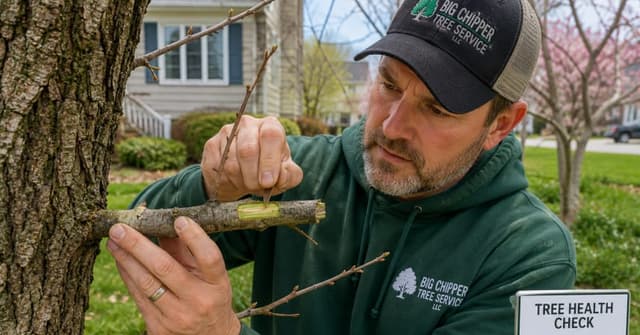
The most immediate and reliable way to check a tree’s vitality is the scratch test. This method allows you to look past the protective outer bark and see the cambium layer, which is the living tissue responsible for transporting water and nutrients.
How to Perform the Test
Using your fingernail or a small pocketknife, gently scratch a small strip of bark off a young twig or a branch. In a living, dormant tree, the layer immediately beneath the bark will be moist and vibrant green. If the area is brown, dry, and woody, that specific branch is dead. To ensure accuracy, perform this test on several different areas of the tree. If the trunk itself shows brown beneath the bark, the entire organism has likely failed.
The Snap Factor
During dormancy, living branches retain a degree of moisture that keeps them flexible. If you bend a small twig and it has a rubbery feel before eventually snapping, it is likely alive. If the twig snaps instantly with a sharp, dry crack, similar to a dry pencil, it is a sign of advanced dehydration and death.
2. Trunk Integrity: Vertical Cracks and Peeling Bark
A tree’s bark functions much like human skin; it protects the internal systems from pests, disease, and environmental stress. While some species, like the Shagbark Hickory or Sycamore, have naturally peeling bark, most mature trees in Grand Rapids should have a relatively continuous skin.
Deep Vertical Seams
Large, deep cracks that penetrate through the bark and into the wood of the trunk are significant red flags. These seams often indicate that the tree is struggling to support its own weight or that internal decay has caused the wood to contract and split. In the volatile climate of West Michigan, water can seep into these cracks, freeze, and expand, further compromising the tree’s structural stability.
Localized Bark Loss
If large chunks of bark are falling off the tree and leaving smooth, drywood exposed, the tree is no longer producing the new bark necessary for protection. This often happens on the side of a tree that has suffered a canker or a localized infection. If more than 25% of the bark is missing around the circumference of the trunk, the tree’s circulatory system is likely broken beyond repair.
3. The Presence of Shelf Fungi and Mushrooms
While mushrooms in your lawn are often a sign of healthy, organic soil, mushrooms growing directly on your tree’s trunk or around its root flare are a dire warning. These are the fruiting bodies of wood-decay fungi that feed on dead or dying organic matter.
Root Flare Decay
If you notice shelf fungi (hard, woody growths that look like brackets) or soft mushrooms growing at the base of the tree where the trunk meets the soil, the root system is likely rotting. Since the roots provide the anchor for the tree, a mature tree with root rot is a fall hazard waiting to happen. In Grand Rapids, where saturated soil and high winds are common, these trees are often the first to uproot during a storm.
Internal Cavities
Fungus is an indicator of moisture and rot. If you see fungal growth near a hole or hollow in the trunk, it means the heartwood, the structural core of the tree, is being consumed from the inside out. A tree can remain green and produce leaves for several years even while its core is hollow, but it lacks the strength to withstand a Michigan ice storm.
4. Missing Buds and Bare Architecture
Even in the middle of January, a living tree is not truly empty. Healthy trees produce buds for the following spring during the previous growing season. These buds are small, tight packages of future leaves and flowers.
Inspecting the Tips
If you look at the very tips of the branches on a dormant tree, you should see small, often slightly fuzzy or waxy buds. If the branches are completely smooth and end in dry, shriveled points, the tree did not have the energy to produce buds before winter. This is a common sign of a tree that died during the previous summer or fall but hasn’t dropped its dead branches yet.
Deadwood Retention
Mature trees that are dying often exhibit clutching, where dead leaves stay attached to the branches long after the autumn shed is over (common in diseased Oaks with Oak Wilt). Additionally, if a tree is dead, it will begin to shed its smaller, fine branches first, leaving only the large, heavy branches of the tree. If your tree looks like a skeleton compared to similar trees in your neighborhood, it is time for a professional inspection.
Lean and Soil Heaving
A tree doesn’t always have to look dead to be a dead risk. Sometimes the signs are in the ground rather than the branches.
The New Lean
Many trees grow with a natural lean toward the sunlight. However, if a tree suddenly develops a lean or if the lean has noticeably increased after a storm, the root system has failed. A tree that is leaning because of root failure is technically dead in terms of its ability to remain upright, regardless of whether there is still green foliage at the top.
Soil Heaving
Look at the soil on the side of the tree opposite the lean. Do you see cracked earth or mounded soil? This is called heaving, and it occurs when the roots are being pulled out of the ground. This is a critical emergency. In the Grand Rapids area, this often happens to mature trees with shallow root systems, such as Maples, when the ground is soft and winds are high.
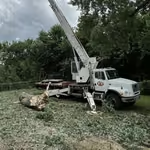
Identifying a dead mature tree is the first step toward preventing a property disaster. At Big Chipper Tree Service LLC, we have been the trusted authority for Grand Rapids homeowners since 1986. Our family-owned and operated team understands the unique stresses that West Michigan weather places on our urban canopy. We specialize in the safe removal of large, hazardous, and dead trees, utilizing advanced equipment like stick cranes and grapple trucks to protect your home and landscaping.
Big Chipper Tree Service LLC provides a wide range of tree care services, such as tree removal, tree pruning and trimming, shrub removal, and trimming, 24/7 emergency tree service, stump removal and grinding, and land clearing. Whether you need a professional health assessment to see if a tree is dormant or an emergency removal of a critical hazard, our BBB A+ rated team is ready to help 24/7. We offer no-surprise pricing, a workmanship guarantee, and clear communication from the first estimate to the final debris cleanup. Don’t leave your safety to chance; let our decades of experience give you peace of mind. Call us at (616) 300-1811 today for your free estimate.
Frequently Asked Questions by the Homeowners in Grand Rapids, MI
1. Can a dead tree be brought back to life?
No. Once a tree’s vascular system has completely failed and the cambium layer is brown and dry, the tree is biologically dead. While some localized deadwood can be pruned out of a living tree, an entirely dead tree cannot be revived.
2. Is it safe to leave a dead tree standing if it’s far from the house in Grand Rapids, Michigan?
Only if the fall zone is entirely clear of structures, power lines, and paths. However, dead trees attract pests like carpenter ants and termites, which can eventually migrate to your home. In Grand Rapids, dead trees also become brittle and shed large limbs unexpectedly.
3. How long does it take for a dead tree to fall?
There is no set timeline. Some trees stay standing for years, while others fall in the first strong wind after they die. Factors like wood density (Oak vs. Pine), soil moisture, and the presence of root rot all play a role.
4. My tree has leaves on only one side. Is it half-dead?
This is often a sign of localized root damage or a canker on the trunk. While the tree is still technically alive, it is structurally unbalanced and likely in a state of decline. A professional assessment is needed to determine its stability.
5. Does homeowners’ insurance cover the removal of a dead tree in Grand Rapids, Michigan?
Generally, insurance only covers tree removal if the tree has already fallen and hit a covered structure. They rarely pay for the preventive removal of a dead tree, as they consider that a part of standard property maintenance.
6. What is the best time of year to remove a dead tree in Grand Rapids?
While removals can be done year-round, winter is often an excellent time. The frozen ground protects your lawn from heavy equipment, and the lack of foliage makes the tree lighter and easier to handle.
7. Can a professional tell the difference between dormancy and death instantly?
Yes. A certified arborist can quickly identify subtle signs like bud condition, bark texture, and fungal presence that may be invisible to the untrained eye.
8. Will Big Chipper Tree Service help with the insurance paperwork?
Yes. If a tree has fallen on your home, we provide detailed documentation and assessments to help streamline the claims process with your insurance provider.
Summary Checklist: Dead vs. Dormant
| Condition | Risk Level | Recommended Action |
| Brittle, dry twigs that snap easily | High | Perform a scratch test and contact an arborist if the inner tissue appears brown |
| Shelf fungi growing near the base | Critical | Schedule an immediate inspection for root rot and structural instability |
| Deep cracks in the trunk | High | Monitor for widening cracks and arrange a professional tree risk assessment |
| Green tissue beneath the bark | Low | The tree may still be dormant and healthy. Wait for spring growth before removing |
| New lean or soil heaving around roots | Critical | Call for emergency tree removal immediately due to fall risk |
Final Advice
Distinguishing between a dormant tree and a dead one is a fundamental skill for any West Michigan property owner. The solution to the uncertainty of tree health is a proactive approach to monitoring and maintenance. If your scratch test reveals brown tissue or you notice the sudden appearance of mushrooms at the base of your mature oak, the tree is signaling a structural failure that cannot be ignored. Do not wait for a heavy Grand Rapids snowstorm or a high-wind gust to test the integrity of your trees for you. A dead tree is essentially a standing liability that loses strength with every passing season. By identifying the top five signs of death, from brittle twigs and peeling bark to fungal growth and root failure, you can act before the tree dictates the timeline through a catastrophic fall. Secure your property by removing confirmed hazards and investing in regular pruning for your healthy, dormant trees. This ensures that when spring finally arrives in West Michigan, your landscape is not just safe, but thriving. For the most accurate diagnosis and safest removal options, always partner with a certified local tree service that has the equipment and expertise to handle mature timber.