
Key Takeaways
- Trees can recover from moderate drought stress, but severe or prolonged drought can cause permanent damage or death.
- Early drought symptoms include wilting, leaf scorch, premature leaf drop, and reduced shoot growth.
- Recovery depends on the tree’s species, age, overall health, and how long drought conditions persisted.
- Proper watering, mulching, and reduced stress during recovery improve a tree’s chances of bouncing back.
- Some drought damage like dead branches or root loss may not be reversible and requires professional assessment.
Drought stress is one of the most common tree health issues homeowners face, particularly during hot, dry summers or extended periods without rainfall. When soil moisture drops below what trees need, they enter survival mode, shutting down non-essential processes to conserve water. This shows up as visible symptoms in the canopy, but actual damage often occurs underground in the root system long before leaves start to brown.
The question many homeowners ask is whether a tree showing severe drought symptoms can actually recover, or if the damage is permanent. The answer depends on several factors:
- the tree’s species and age, drought severity and duration
- the tree’s overall health before drought, and
- what care it receives during recovery
Some trees bounce back remarkably well with proper attention. Others suffer irreversible damage leading to decline over months or years.
How Drought Affects Trees
Trees need water for photosynthesis, nutrient transport, cell turgor pressure, and temperature regulation through transpiration. When soil moisture becomes limited, trees prioritize water allocation to essential functions, sacrificing less critical growth.
- The first response is closing stomata tiny pores on leaf surfaces. This reduces water loss but also limits carbon dioxide intake for photosynthesis. The tree’s energy production drops, slowing growth. If drought continues, the tree sheds leaves to reduce surface area and water demand. This is why drought-stressed trees show premature leaf drop, particularly in the lower canopy.
- Underground, fine root hairs begin dying when soil becomes too dry. This reduces the tree’s capacity to take up water even when moisture becomes available again.
- Prolonged drought can kill significant portions of the root system, creating a long-term deficit in water absorption capacity.
- Different species have different drought tolerance. Native species adapted to local climate like oaks and hickories typically handle drought better than non-natives. Young trees with shallow root systems are more vulnerable than mature trees with deep, established roots.
6 Signs of Drought Stress
Early drought symptoms develop gradually and are easy to miss until the tree looks obviously stressed.
- Wilting and leaf curling are among the first visible signs. Leaves lose turgor pressure and droop, particularly during the hottest part of the day.
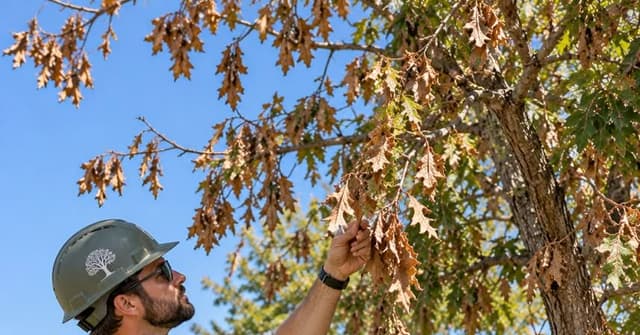
- Leaf scorch appears as browning along leaf margins, often with a yellow halo between brown and green tissue. This is dead tissue where the tree couldn’t supply enough water.
- Premature leaf drop typically starts in the lower, inner canopy where leaves are oldest. The tree sacrifices these leaves first to conserve water.
- Reduced shoot growth means new branches are shorter than normal, and the tree’s overall expansion slows or stops.
- Canopy thinning develops as the tree sheds more leaves than it produces, making the canopy look sparse.
- Dieback starts at branch tips and progresses inward as the tree can no longer supply water to the outermost foliage.
Can Trees Recover From Drought?
The answer depends on severity and timing.
- Moderate drought stress where a tree shows wilting, some leaf scorch, and premature leaf drop but retains most of its canopy typically recovers well with proper watering and care. Once soil moisture returns, the tree can produce new leaves and fine roots within weeks to months. Full recovery may take one to two growing seasons.
- Severe drought stress where 30-50 percent of the canopy shows dieback, leaves are extensively scorched or dropped can still recover, but the process is slower and less certain. These trees need consistent watering over multiple seasons. Recovery can take 2-5 years, and the tree may never fully regain its pre-drought vigor.
- Critical drought stress where more than 50 percent of the canopy is dead, major limbs show dieback to the trunk, or the tree has dropped nearly all its leaves by mid-summer often indicates permanent damage. At this point, the root system is typically so compromised that even with watering, the tree cannot support enough canopy to survive.
- Age matters significantly. Young trees under 10 years can sometimes recover from severe drought if the main stem remains alive. Mature trees with extensive canopy loss rarely recover fully because they can’t produce enough energy to rebuild their structure.
Recovery Steps That Actually Help
If a tree shows drought stress but hasn’t crossed into critical decline, several steps improve recovery chances:
- Deep, infrequent watering is more effective than frequent shallow watering. Apply 10-15 gallons per inch of trunk diameter, measured at breast height. Water slowly at the drip line, not at the trunk, where most absorbing roots are located. Water once or twice weekly during drought.
- Mulching with 2-4 inches of organic mulch around the tree’s base kept 3-6 inches away from the trunk helps retain soil moisture, moderate temperature, and reduce competition from grass.
- Avoid fertilizing stressed trees. Fertilizer promotes new growth that the compromised root system can’t support, adding stress. Wait until the tree shows clear recovery before considering fertilization.
- Reduce other stressors. Don’t prune heavily during drought recovery unless removing obviously dead branches. Avoid construction or soil compaction near the tree.
- Monitor for secondary pests and diseases. Drought-stressed trees are more attractive to borers, scale insects, and fungal pathogens. Watch for increased deadwood or unusual leaf spotting.
- Give it time. Recovery is measured in years, not weeks. Don’t declare a tree dead until it fails to leaf out for two consecutive springs.
When Recovery Isn’t Possible
Some drought damage is irreversible. Trees with the following conditions typically won’t recover and should be evaluated for removal:
- More than 50 percent of the canopy is dead with no signs of new growth
- Dieback has progressed to the main trunk or root collar
- Bark is loose, cracked, or falling off in large sections
- No leaves emerge by early summer for two consecutive years
How Big Chipper Tree Service Can Help
Big Chipper Tree Service can help homeowners determine how severely drought has affected their trees. Our ISA-certified arborists assess the tree’s canopy, branches, trunk, and root-zone conditions to understand its recovery potential. We can identify signs of drought stress and help determine whether the tree can recover with proper care. Our team can also recommend appropriate watering, mulching, and other steps to support recovery. If damage appears irreversible, we can explain the available options and whether removal should be considered.
A professional tree service firm in Grand Rapids, MI like Big Chipper Tree Service can conduct timely assessments to help you make an informed decision before the tree’s condition worsens. Our arborists can also provide practical guidance based on the tree’s condition and the needs of your property.
Frequently Asked Questions About Drought Stress in Grand Rapids, MI
What trees are most vulnerable to drought stress?
Young trees, newly planted trees, and species with higher water requirements can be more vulnerable during prolonged dry periods. Trees already affected by pests, disease, root damage, or poor soil conditions may also struggle to recover.
Should I prune a drought-stressed tree?
Avoid heavy pruning while a tree is recovering from drought. Remove only clearly dead, damaged, or hazardous branches when necessary, and consider having an arborist determine what pruning the tree can safely tolerate.
Can watering too much harm a drought-stressed tree?
Yes. Excessive watering can saturate the soil, reduce oxygen around the roots, and create conditions that encourage root problems. Water slowly and deeply while allowing the soil to drain between watering sessions.
How much should I water a drought-stressed tree?
Apply 10-15 gallons per inch of trunk diameter, measured at breast height. Water at the drip line, not the trunk, once or twice weekly during drought.
Can I save a tree that’s dropped all its leaves?
It depends on timing. If leaves drop by mid-summer, recovery is unlikely. If they drop in fall after a normal season, the tree may leaf out normally next spring.
Should I fertilize a drought-stressed tree?
No. Fertilizer promotes growth the compromised root system can’t support. Wait until the tree shows clear recovery before fertilizing.
How long does drought recovery take?
Moderate stress: weeks to months. Severe stress: 2-5 years. Critical stress: often irreversible.
Summary Checklist: Drought Stress Recovery Potential
| Symptom Level | Canopy Condition | Recovery Likelihood | Recommended Action |
| Moderate stress | Wilting, some leaf scorch, <25% leaf drop | High – weeks to months | Deep watering, mulching, monitor |
| Severe stress | 30-50% dieback, extensive scorch, heavy leaf drop | Moderate – 2-5 years | Consistent watering, deadwood removal, professional assessment |
| Critical stress | >50% canopy dead, dieback to trunk, bare by mid-summer | Low – often irreversible | Professional evaluation, likely removal |
| Young trees | Canopy loss but main stem alive | Moderate to high | Protect root collar, water deeply, wait for sprouting |
| Mature trees | >50% canopy loss | Low | Professional assessment, removal often safest |
| Drought-tolerant species | Oak, hickory, black locust | Better recovery potential | Continue standard drought care |
| Moisture-loving species | Birch, dogwood, magnolia | Poorer recovery potential | Extra watering, consider replacement if decline continues |
Final Advice
Drought stress doesn’t automatically mean a tree is doomed, but recovery isn’t guaranteed either. The key is early intervention, recognizing symptoms before damage becomes severe and providing consistent, appropriate care during recovery.
Homeowners should water deeply and infrequently during drought, mulch to retain moisture, avoid fertilizing stressed trees, and give recovery time measured in years, not weeks. Don’t declare a tree dead until it fails to leaf out for two consecutive springs.
For trees showing severe drought symptoms, consult Big Chipper Tree Service for professional assessment. Our ISA-certified arborists can determine whether the tree has recovery potential or has crossed the threshold into irreversible decline.