
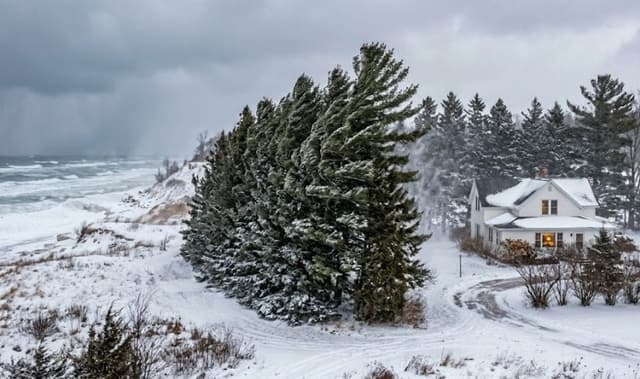
Wind-proofing a West Michigan landscape comes down to three things: choose wind-resistant tree species, design a proper windbreak on the prevailing wind side, and keep your existing trees structurally sound through regular pruning. Done together, these steps reduce property damage during high-wind events and lower long-term tree maintenance costs.
West Michigan deals with prevailing westerly winds off Lake Michigan, summer thunderstorm gusts that can hit 70+ mph, and winter gales that drive lake-effect snow and ice for days at a time. Brittle trees and exposed yards lose limbs fast.
This guide gives you the exact species, layouts, and maintenance strategies that actually work in our region.
Key Takeaways
- Prevailing winds in West Michigan come from the west and northwest, especially in winter.
- Most wind-resistant trees: bur oak, eastern red cedar, white oak, bald cypress, hackberry.
- Most wind-vulnerable trees: silver maple, Bradford pear, Norway maple, willow, boxelder.
- A properly designed windbreak reduces wind speed for a distance of 10 to 20 times its height downwind.
- Structural pruning every 3 to 5 years is the cheapest insurance against wind damage.
Why West Michigan Wind Is Different
West Michigan sits at the receiving end of weather that has built energy across hundreds of miles of open Lake Michigan. By the time it hits Grand Rapids, Walker, Holland, and Muskegon, it has nothing left to slow it down.
Three wind patterns matter most:
- Winter northwesterlies drive lake-effect snow and ice loading.
- Spring and summer thunderstorms produce straight-line winds, microbursts, and the occasional tornado.
- Fall pre-frontal gusts strip leaves and break weakened limbs.
Properties on the lakeshore, on hilltops, or at the corners of subdivisions catch the worst of it. Yards with mature trees and no windbreak are most exposed.
Wind-Resistant Tree Species for West Michigan
These species combine deep roots, strong wood, flexible branches, and proven track records in Michigan:
Bur Oak
Best overall. Massive root system, dense wood, handles any soil. The single toughest large tree in the region.
White Oak
Strong wood, deep roots, lives 200+ years. Slower growing, but a generational investment.
Eastern Red Cedar
Evergreen windbreak workhorse. Roots deep, tolerates wind and drought. According to MSU Extension’s Michigan native tree guide, it’s specifically noted as wind- and drought-resistant.
Bald Cypress
The pyramidal shape sheds wind. Tolerates both wet and dry sites once established. Surprisingly cold-hardy.
Hackberry
Underrated workhorse. Handles wind, salt, drought, and pollution. Fast establishment.
Black Walnut
Dense, hard wood. Deep taproot. Extremely wind-resistant once mature.
Sugar Maple and Red Maple
Stronger wood than their fast-growing cousins (silver and Norway). Good shade trees with reasonable wind tolerance.
Eastern White Pine (with caveats)
Michigan’s state tree. Wind tolerance is moderate when grown in well-drained soil and with room to develop a balanced canopy.
Trees to Avoid in Exposed West Michigan Locations
These species have brittle wood, weak unions, or shallow roots and consistently fail in high winds:
- Silver maple (brittle wood, weak unions)
- Bradford / Callery pear (notorious for splitting)
- Norway maple (tight unions, dense crown catches wind)
- Boxelder (soft wood, common breakage)
- Willow (brittle, shallow roots)
- Eastern cottonwood (massive but brittle)
- Lombardy poplar (short-lived, frequent failures)
If you have these on an exposed corner or near your house, consider replacement before they cause damage.
How a Proper Windbreak Works
A windbreak is a row (or rows) of trees and shrubs designed to slow prevailing winds. According to the USDA Natural Resources Conservation Service, a properly designed windbreak protects an area extending 10 to 20 times the windbreak’s height downwind.
A 30-foot-tall windbreak protects a zone roughly 300 to 600 feet behind it.
The Three Things That Matter Most
- Orientation. Plant perpendicular to the prevailing wind. In West Michigan, that means oriented north-south with the windbreak on the west side of the area you’re protecting.
- Density. Aim for 60 to 80 percent density at maturity. Too dense (solid wall) creates turbulence on the leeward side. Too open (less than 40 percent) lets too much wind through.
- Length. A windbreak should extend at least 50 feet beyond each end of the area you’re protecting. Wind wraps around short windbreaks.
Best Species for a West Michigan Windbreak
- Eastern red cedar (evergreen, dense, drought-tolerant)
- White spruce (evergreen, dense lower branches)
- Norway spruce (fast establishment, tall)
- Eastern white pine (taller, moderate density)
- American arborvitae (smaller properties, narrower spaces)
For larger lots, mix species and rows for better long-term performance.
Windbreak Design for Different Property Sizes
| Lot Size | Recommended Layout | Best Species |
|---|---|---|
| Small urban lot (under 1/4 acre) | Single row of privacy evergreens placed strategically along the wind-exposed property edge | Emerald Green arborvitae, eastern red cedar |
| Suburban (1/4 to 1 acre) | Single mixed evergreen row with proper spacing for mature growth and airflow | White spruce, Norway spruce, eastern red cedar |
| Large suburban or rural (1+ acre) | Two-row windbreak using an evergreen outer row and a deciduous inner support row | Eastern white pine with bur oak, or red cedar with hackberry |
| Farmstead (5+ acres) | Multi-row shelterbelt design based on agricultural windbreak planning principles | Multi-species windbreak mix selected for site conditions and long-term resilience |
Structural Pruning: The Cheapest Wind Protection
Even the right species fails in the wind if it has structural defects. Regular pruning by a certified arborist removes the weak points before they break.
What Structural Pruning Addresses
- Codominant trunks with included bark
- Crossing or rubbing branches
- Dead and declining limbs
- Long horizontal limbs that act as wind sails
- Crowded canopies that catch too much wind
Pruning Frequency by Tree Age
- Young trees (1-10 years): every 2 to 3 years to build a strong structure
- Mid-life trees (10-30 years): every 3 to 5 years
- Mature trees (30+ years): every 2 to 3 years for inspection and selective work
Expert insight: The trees we remove after a wind event are almost always the trees we offered to prune the previous fall. Wind damage is mostly preventable with the right pre-storm work.
Other Wind-Proofing Strategies That Work
1. Plant in Groups, Not Singles
A single tree alone in a yard is exposed on every side. Trees planted in groups or clusters of three to seven shelter each other and develop stronger root systems together.
2. Vary Heights and Layers
Layered landscapes (canopy trees, understory trees, shrubs, ground cover) create natural turbulence that breaks up wind energy before it reaches structures.
3. Position Trees Strategically
- West side of house: windbreak species and shade trees
- South side: deciduous trees for summer shade and winter sun
- Between house and street: wind-tolerant species since they get the most exposure
- Avoid: large, brittle trees within falling distance of the house
4. Maintain a Mulch Ring on Mature Trees
A 3 to 6-foot mulch ring 2 to 3 inches deep protects the root flare, retains moisture, and lets roots establish as deep and wide as possible. Strong roots are the foundation of wind resistance.
5. Cable High-Risk Mature Trees
For valuable mature trees with weak unions worth saving, professionally installed steel cables share the load between large limbs and prevent catastrophic splits in high wind.
Common Mistakes West Michigan Homeowners Make
- Topping a tree to “reduce wind catch.” Topping creates weak regrowth that breaks worse than the original branches.
- Planting brittle trees like Bradford pear in exposed locations.
- Single-row windbreaks of one species, which fail completely if a disease or pest hits.
- Skipping young tree pruning. A poorly trained tree at 10 years old becomes a wind hazard at 25.
- Planting too close to the house. Mature trees need at least 20 feet of clearance from structures.
- Ignoring root zone damage from construction or compaction. Damaged roots = uprooted trees.
Wind Damage vs. Wind Tolerance: The Real Math
| Action | Cost | Result |
|---|---|---|
| Fall structural pruning visit | $500–$1,500 | Helps significantly reduce storm-related branch failure risk |
| Removing one brittle tree near the house | $800–$2,500 | Removes a high-risk hazard near structures |
| Planting a 5-tree windbreak | $1,500–$4,000 | Long-term wind buffering and landscape protection |
| Cabling two weak-union maples | $400–$800 | Extends structural stability and usable service life |
| Doing nothing | $0 upfront | May lead to significantly higher repair or emergency response costs later |
The math is straightforward. Preventive work always costs less than emergency response.
When to Call a Professional vs. DIY
DIY-friendly:
- Planting young trees and shrubs
- Mulching and watering
- Removing small dead branches under 2 inches at ground level
Call a certified arborist:
- Any work above shoulder height
- Removing branches over 4 inches
- Cabling or bracing
- Diagnosing why a tree is leaning or declining
- Designing a multi-row windbreak
Frequently Asked Questions
What is the best wind-resistant tree for a West Michigan front yard?
Bur oak for a large yard, white oak for a generational shade tree, or hackberry for a faster-establishing wind-tough option. All three handle our climate and soils well.
How tall does a windbreak need to be to actually work?
A windbreak protects an area extending 10 to 20 times its height downwind. A 30-foot-tall windbreak protects roughly 300 to 600 feet behind it. Even a 15-foot windbreak helps significantly.
Should I plant evergreens or deciduous trees for a windbreak?
Evergreens for year-round protection, especially against winter winds. Deciduous trees work in mixed windbreaks for extra height and depth, but they don’t block winter winds when leafless.
Can I plant a windbreak too close to my house?
Yes. Maintain at least 50 feet between large windbreak trees and your house. Closer plantings risk root and structural conflicts as trees mature.
What direction should a windbreak face in West Michigan?
Orient your windbreak perpendicular to the prevailing wind, which in West Michigan typically means a north-south line on the west side of the area you want to protect. An L-shape covering both the west and north sides handles winter and summer winds.
How long does it take a new windbreak to become effective?
Five to ten years for moderate protection. Twenty years for full mature function. Plant taller stock when the budget allows to shorten the wait.
Is it true that topping trees makes them safer in the wind?
No. Topping is the worst thing you can do. It triggers weak, fast regrowth that fails worse in subsequent storms and shortens the tree’s life dramatically.
Do windbreaks really save energy?
Yes. A properly designed farmstead windbreak can reduce winter heating costs by 10 to 25 percent by reducing wind chill against the house. Summer cooling benefits also occur from shade.
Can I plant a windbreak on a small urban lot?
Yes, on a smaller scale. A single row of arborvitae, upright junipers, or columnar spruces along the west property line provides meaningful wind reduction without taking much space.
How often should mature trees be inspected for wind damage risk?
Every 2 to 3 years for healthy mature trees, every year for trees over 50 years old or with visible defects, and after every major storm event.
What if my neighbor has a brittle tree leaning toward my house?
Document the tree with dated photos, notify your neighbor in writing, and inform your insurance carrier. If the tree falls, your insurance generally handles damage to your property regardless of whose tree it was.
Will a windbreak attract wildlife?
Yes. Multi-species windbreaks provide excellent habitat for songbirds, pollinators, and small mammals. This is a feature, not a bug.
Prepare Your Landscape for West Michigan’s Strongest Winds
Wind-proofing a West Michigan landscape is not about stopping storms. It’s about preparing your property to handle them. The right tree species, a properly designed windbreak, and consistent structural pruning prevent most wind-related damage before it starts.
Most storm damage we see comes from issues that could have been addressed in advance. Fixing them early is always easier and far less expensive than dealing with emergency repairs.
Need help wind-proofing your property? Contact Big Chipper Tree Service LLC for a free on-site landscape and tree assessment. Get clear recommendations tailored to your exposure so your landscape holds up through West Michigan’s toughest weather.