Key Takeaways
- The 24-Hour Window: Immediate assessment prevents secondary damage to structures caused by shifting limbs.
- Tension and Torsion: Storm-damaged wood is under extreme physical pressure; cutting it without professional rigging is life-threatening.
- Insurance Navigation: Documenting damage before cleanup begins is critical for successful homeowner insurance claims.
- Hidden Weakness: Not all storm damage is visible; internal cracks can turn a standing tree into a future hazard.
Grand Rapids is no stranger to the volatile weather patterns of West Michigan. From heavy “lake-effect” snow loads in the winter to high-velocity straight-line winds and thunderstorms in the summer, our urban forest is constantly under siege. When a major weather event strikes, the transition from a beautiful landscape to a debris-strewn hazard zone happens in seconds.
For homeowners in the Grand Rapids area, the aftermath of a storm is overwhelming. Large limbs may be resting on rooflines, driveways might be blocked by trunk sections, and “widow-makers” could be hanging precariously in the canopy. Understanding the professional cleanup process is essential for making informed decisions during a crisis.
1. The Immediate Priority: Safety and Hazard Assessment
The moments following a storm are the most dangerous. Before you step outside to inspect the damage, you must be aware of the “invisible” threats.
- Power Lines: Always assume a downed wire is live. In Grand Rapids, storm-damaged trees frequently bring down utility lines. If a tree is touching a wire, do not approach it.
- Structural Tension: This is the most overlooked danger. When a tree falls or leans, it is often held in place by extreme tension. A single cut with a chainsaw can cause the wood to “spring” or “kick back” with enough force to be fatal.
- Ground Stability: Heavy rains accompanying storms soften the soil. If you notice a tree leaning or see “heaving” (soil lifting at the base), the foundation of the tree has failed. This tree is no longer a candidate for “waiting and seeing”; it is an active threat.
2. The Professional Cleanup Process: What Happens First?
When you call a professional service, the process follows a strict hierarchy of safety and efficiency.
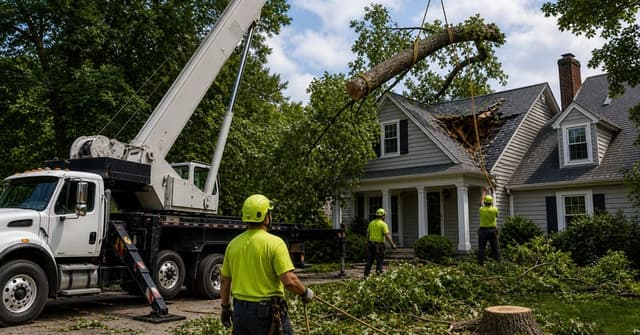
Phase 1: Stabilization –The crew first addresses limbs that are actively touching structures (homes, garages, cars). Using specialized rigging and sometimes cranes, the weight is carefully redistributed and removed to prevent further “crush” damage to your property.
Phase 2: Clearing Access – Once the house is safe, the focus shifts to clearing driveways, sidewalks, and municipal right-of-ways. This ensures that emergency vehicles or your own family can move freely.
Phase 3: The Detailed Cleanup – After the immediate hazards are neutralized, the crew begins the labor-intensive process of “bucking” the wood (cutting it into manageable sections), chipping the brush, and hauling away the debris.
3. Evaluating Standing Trees: The “Hidden” Damage
Not every tree that survives a storm is safe. In fact, some of the most dangerous trees are those that look okay but have suffered structural failure.
- Vertical Trunk Cracks: High winds can twist a tree, causing deep internal splits that don’t always show on the surface.
- Crown Thinning: If a tree loses more than 50% of its canopy in a storm, its ability to photosynthesize and recover is severely compromised.
- Root Plate Disturbance: Even a slight lean after a storm indicates that the “anchor” roots have snapped. These trees are highly likely to fall during the next minor wind event.
4. The Role of Insurance and Documentation
In Grand Rapids, most homeowners’ insurance policies cover tree removal if the tree has fallen on a covered structure (like your house or fence). However, they often do not cover “trees in the yard” that didn’t hit anything.
- Take Photos First: Before any wood is moved, take clear photos of the tree in relation to the damaged structure.
- Keep Receipts: Professional cleanup is a valid claim expense. Ensure your contractor provides a detailed invoice that specifies “emergency hazard mitigation.”
5. Post-Storm Rehabilitation: Saving the Survivors
Not every tree that sustains damage needs to be removed. In many cases, professional intervention can stabilize a tree, allowing it to heal and continue providing value to your Grand Rapids property for decades.
- Strategic Crown Thinning: After a storm, a tree may be “top-heavy” or off-balance. Professional trimming can redistribute the weight of the canopy, reducing the leverage that wind exerts on the trunk during future storms.
- Cabling and Bracing: If a tree has developed a structural split or has a weak “V-shaped” union that was stressed by high winds, we can install high-strength steel cables or braces. This hardware acts as a supplemental support system, holding the tree together and preventing a total failure.
- Soil Aeration and Mulching: Storms often involve heavy rainfall that compacts the soil around the roots. Using vertical mulching or aeration helps restore oxygen to the root zone, which is critical for the tree to produce the energy needed to compartmentalize (heal) its wounds.
Protect Your Home with Big Chipper Tree Service
Storm cleanup is not a DIY project. It requires heavy machinery, precision rigging, and an arborist’s understanding of wood physics. Big Chipper Tree Service is the premier choice for storm damage restoration in the greater Grand Rapids area. As a veteran-owned business, Caleb and his team bring military-grade discipline and 24/7 emergency response to every disaster site. From precision tree trimming to clear “widow-makers” to high-stakes tree removal of fallen giants, we prioritize your family’s safety and the integrity of your property. We utilize specialized equipment to handle even the most complex lakeside or urban removals without damaging your lawn.
Don’t wait for the next gust of wind to finish the job; call or text Caleb at (262) 210-9763 for a free storm damage evaluation and safe cleanup today.
Frequently Asked Questions
How soon can you arrive after a storm?
We offer 24/7 emergency dispatch. We prioritize jobs where trees are actively resting on homes or blocking primary access points.
Does the city of Grand Rapids clean up trees on my property?
No. The city is typically only responsible for trees located within the “parkway” (the area between the sidewalk and the street). Trees on private property are the homeowner’s responsibility.
Is stump grinding included in storm cleanup?
Standard storm cleanup involves removing the hazard and debris. Stump grinding is usually a separate service, but it is highly recommended if the root plate has been uprooted, as it leaves a massive, dangerous hole in your yard.
Can a “leaning” tree be straightened after a storm?
For mature trees, the answer is almost always no. Once the structural roots have pulled out of the soil, they cannot be “reset.” The tree must be removed for safety.
What is a “widow-maker”?
This is a term for a large dead or broken limb that is caught in the upper canopy. It is called this because it can fall at any moment without warning, even on a calm day.
Will my insurance pay for the entire removal?
If the tree hits a covered structure, most policies cover the portion of the removal required to remove it from the building. Every policy is different, so we recommend calling your agent immediately.
Why is professional rigging important?
When a tree is leaning on a house, it is a game of weight and balance. Removing the wrong branch first can cause the trunk to “pivot” and crash further into the home. Professional rigging ensures the weight is controlled.
Can I keep the wood for firewood?
Absolutely. If you would like us to leave the wood for you, we can “buck” it into fireplace-sized lengths and leave it in a designated area, which can also reduce your total cleanup cost.
Summary Checklist: Grand Rapids Storm Damage Evaluation
| Condition | Risk Level | Recommended Action |
| Tree resting on the roof or structure | Critical | Evacuate the immediate area and call for 24/7 emergency stabilization |
| Hanging “widow-maker” limbs | High | Secure the area below and avoid any attempt to pull or shake the limb |
| Soil heaving at the root plate | Critical | Root system failure. Immediate professional removal is required |
| Trunk splitting or vertical cracks | High | Schedule an arborist inspection to assess cabling, bracing, or removal |
| Limbs near power lines | High | Stay clear and contact the utility company and a licensed tree service immediately |
Final Advice
If you notice any of these warning signs, do not wait for a storm to force the issue. A professional assessment from an arborist can determine if the tree can be saved through specialized care or if it must be removed to protect your property. For expert tree service in the Grand Rapids area, call Big Chipper Tree Service LLC.