
Key Takeaways
- The Transmission Vector: Oak Wilt is spread by sap-feeding beetles attracted to fresh pruning cuts; trimming in summer is like inviting the disease to your property.
- The Danger Zone: In Grand Rapids, the highest risk for infection occurs from April through July, though caution is advised throughout the entire growing season.
- Rapid Decline: Red Oaks are particularly vulnerable and can die within weeks of infection, while White Oaks may decline over several years.
- Emergency Sealing: If an Oak is damaged by a summer storm, the wound must be sealed within minutes to prevent beetles from landing.
- Dormant Season Safety: The only truly safe time to prune Oaks in West Michigan is during the winter months when beetles and the fungus are inactive.
For homeowners in Grand Rapids, East Grand Rapids, and the surrounding Kent County area, the towering Oak trees that line our streets are more than just landscape features; they are legacy assets. However, as the weather warms and we head into the peak of the growing season, these giants face a silent and deadly threat. If you are reaching for the pruning shears this July, stop.
In West Michigan, summer is the most dangerous time to touch an Oak tree. Pruning during the active growing season opens a “doorway” for a devastating fungal pathogen known as Oak Wilt. Understanding why this disease is so aggressive and why timing is everything can mean the difference between a thriving canopy and a dead tree that costs thousands to remove.
The Biology of a Killer: How Oak Wilt Moves
Oak Wilt is caused by the fungus Bretziella fagacearum. It is a vascular disease, meaning it attacks the “plumbing” of the tree – the xylem, which is responsible for transporting water and nutrients from the roots to the leaves.
The disease spreads through two primary methods in the Grand Rapids region:
1. The Overland Move (The Beetle Vector)
The primary way Oak Wilt enters a new area is via the Nitidulid beetle, also known as the sap-feeding beetle. These tiny insects are highly attracted to the scent of fresh tree sap. When you prune a branch, or when a storm snaps a limb, the tree produces sap to seal the wound.
If a beetle has recently visited a “spore mat” on an infected Oak, it carries those fungal spores on its body. As it lands on your healthy tree to feed on the fresh sap, it inadvertently “injects” the fungus into your tree’s vascular system. In Michigan, these beetles are most active from April 15th to July 15th, though they remain a threat as long as temperatures are warm.
2. The Underground Move (Root Grafting)
Once Oak Wilt establishes itself in a single tree, it doesn’t need beetles to travel to the next one. Oaks of the same species often grow with interconnected root systems, known as root grafts. The fungus can travel through these “shared veins” from tree to tree. In a typical Grand Rapids neighborhood where houses are lined with mature Red Oaks, a single infection can decimate an entire block’s canopy in a few short years.
Red Oaks vs. White Oaks: A Tale of Two Deaths
Not all Oaks react to the fungus the same way, but in West Michigan, the “Red Oak Group” (which includes Pin Oaks, Black Oaks, and Northern Red Oaks) is in the most immediate danger.
- Red Oaks: These trees have open vascular tubes that allow the fungus to spread rapidly. Once infected, a Red Oak will begin to wilt from the top down. You may notice leaves turning a dull green or bronze at the edges before dropping while still partially green. In many cases, a healthy 80-foot Red Oak can be completely dead within three to six weeks of the first symptoms appearing.
- White Oaks: The White Oak group (including Bur Oaks and Swamp White Oaks) has a slightly different internal structure that includes “tyloses” – growths that help block the spread of the fungus. While these trees can still die from Oak Wilt, they usually decline over several years, one branch at a time.
Why Summer Trimming is a “Code Red” Risk
Trimming an Oak in the summer is essentially signaling the beetles to bring the disease to your doorstep. Because Grand Rapids experiences humid, warm summers, the fungus produces “spore mats” under the bark of recently killed trees. These mats exert pressure, cracking the bark and releasing a fruity, fermenting odor that is irresistible to the Nitidulid beetle.
When you prune during this window, you are creating an entry point exactly when the “carriers” are most active and the “pathogen” is most abundant. This is why arborists across Michigan strictly adhere to the no-trimming rule for Oaks during the spring and summer.
Red Flags: Identifying Oak Wilt in Your Yard
If you are concerned about the health of your trees, look for these specific symptoms during the mid-to-late summer:
- Sudden Leaf Drop: If your lawn is suddenly covered in brown and green Oak leaves in July, the tree is in distress.
- Flagging: The topmost branches lose their leaves first, creating a “thin” look at the crown.
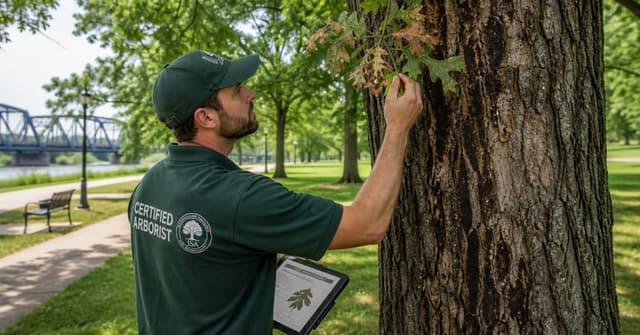
- Vascular Streaking: If you peel back the bark on a wilting branch, you may see dark staining or streaking in the wood underneath.
- The Spore Mat: On trees that died the previous year, look for vertical cracks in the bark where the fungus is pushing through.
What to Do If a Summer Storm Causes Damage
We live in West Michigan; we know that summer thunderstorms and microbursts don’t follow the “April to July” pruning rules. If a storm snaps a limb on your Oak tree during the summer, you must act with extreme speed.
The “Golden Window” for sealing a wound is 15 to 30 minutes. If a limb breaks, the wound must be covered immediately with a latex-based paint or a specialized tree wound sealer. This creates a physical barrier that prevents the sap-feeding beetles from reaching the tree’s internal tissues. This is the only time tree paint is recommended by professional arborists.
Why Choose Big Chipper Tree Service LLC?
Protecting the Grand Rapids canopy requires more than just a chainsaw; it requires local ecological knowledge. At Big Chipper Tree Service LLC, we have been serving West Michigan since 1986. We understand the specific soil types, climate stressors, and disease pressures that affect our local trees.
Our team, led by a Certified Arborist, doesn’t just cut trees; we manage their health. We know that the best time to prune your Oaks is during the dormant season (late fall and winter), and we schedule our maintenance work to ensure your trees are never at risk.
Frequently Asked Questions
Is Oak Wilt the same as Oak Decline?
No. Oak Decline is a slow process caused by environmental stress, pests, and age. Oak Wilt is an aggressive, infectious fungal disease that can kill a healthy tree almost overnight.
Can I use the wood from an Oak Wilt tree for firewood?
Only if it is burned on-site or debarked. Moving firewood is the #1 way invasive pests and diseases travel. If you move infected Oak wood to a cabin up north, you could start a new outbreak.
If my neighbor’s Oak died of Oak Wilt, are my trees safe?
Unfortunately, probably not. Because of root grafting, the fungus can move under fences and property lines. You should consult an arborist to discuss “trenching,” which involves cutting the root connections between trees to save yours.
Is it safe to prune other trees in the summer?
Generally, yes, though species like Elms also have specific timing requirements. However, Oaks are the most critically time-sensitive species in our region.
When exactly is it “safe” to prune Oaks again?
In Grand Rapids, we generally wait until the first hard frost, typically in late October or November. The safest window is January and February.
How do you treat Oak Wilt?
For high-value trees, macro-infusions of fungicide can be used as a preventative measure, but this must be done before the tree shows significant symptoms.
Conclusion
Your Oak trees are not only a cornerstone of your property’s value but also vital to the health of our Grand Rapids neighborhoods. Don’t let a well-meaning pruning job put your landscape at risk. By understanding Oak biology and timing your maintenance during the winter months, you can help prevent the spread of Oak Wilt, a devastating disease.
If you’re unsure whether your tree shows signs of Oak Wilt or needs immediate storm damage cleanup with professional sealing and removal, don’t wait. At Big Chipper Tree Service LLC, we prioritize the long-term health of our local canopy, strictly following Oak Wilt prevention protocols. Our expert team specializes in tree trimming and pruning, ensuring all routine work is done during the safe, dormant season. Should a storm strike, our 24/7 emergency tree service is ready to act quickly, sealing wounds and removing hazards to protect your trees. From removing infected trees to stump grinding and providing fresh mulch, we offer comprehensive care for your West Michigan property. With over 40 years of local experience, we’re the trusted team to safeguard your investment. Call or text us today at (616) 531-2044 for your FREE estimate.