A lot of tree problems in Grand Rapids start the same way: someone plants a tree that looks perfectly reasonable for the space, and ten or fifteen years later it isn’t. A five-gallon nursery tree doesn’t tell you much about what it will look like once it hits mature height and spread. By the time a fast-growing shade tree starts pressing against the roofline or lifting a section of sidewalk, moving it is not an option anymore.
We work on a lot of properties where the tree itself is healthy but simply outgrew the spot it was given. This guide covers small-yard trees in Grand Rapids that stay proportional to a compact lot, what to check before you plant, and a handful of species we see thrive in West Michigan conditions without becoming a problem down the road.
What to Evaluate Before Choosing a Tree
Before picking a species, it helps to think through the site the way we would during an assessment. A few questions make the difference between a tree that fits and one that fights the space for the next twenty years:
- How much overhead room is there, including power lines and roof overhangs?
- How far is the planting spot from the foundation, driveway, or sidewalk?
- What’s the sun exposure? Full sun, partial shade, and deep shade all narrow the list differently.
- What kind of soil is on the property? Grand Rapids yards range from heavy clay to sandy pockets near the Grand River to compacted fill in newer developments.
- How does water drain in that spot after a heavy rain?
- Are there other trees nearby competing for root space and light?
A tree that checks every box on paper can still struggle if the soil doesn’t match its needs. Our guide to trees for clay and sandy West Michigan soils goes deeper into matching species to soil type if you’re not sure what you’re working with.
Small Trees That Work Well in Grand Rapids Yards
None of these trees are universally perfect. Cultivars within each species vary in mature size, disease resistance, and growth habit, so it’s worth checking the specific variety a nursery is selling rather than assuming every tree with the same common name behaves the same way.
Serviceberry (Amelanchier species)
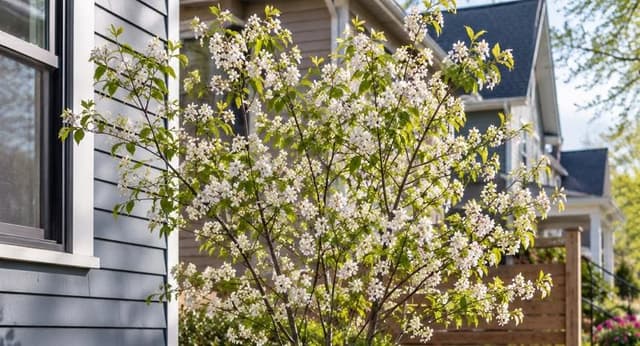
Serviceberry is one of the most dependable small trees for a compact Grand Rapids lot. Most landscape varieties reach roughly 15 to 25 feet tall with a similar spread, though some cultivars stay more compact. It tolerates full sun to partial shade and adapts to a range of soil types as long as drainage is reasonable.
White spring flowers arrive before most other trees have leafed out, followed by small edible berries that birds tend to find first, and reliable orange-red fall color. Multi-stem forms can spread wider at the base than single-trunk forms, so give it real room to fill out rather than tucking it against a foundation.
Eastern Redbud (Cercis canadensis)
Eastern redbud is a Michigan native with a rounded, vase-shaped form that typically reaches 20 to 30 feet tall with a similar or slightly wider spread. It handles full sun to partial shade and prefers well-drained soil, though it doesn’t like consistently wet sites.
The main draw is the show of small pink to magenta flowers that cover bare branches in early spring, followed by heart-shaped leaves through summer and yellow fall color. Redbud has a moderately fast growth rate for a small tree, which means it fills in a young landscape faster than some of the slower species on this list, but it also means early structural pruning matters to establish a strong form.
Pagoda Dogwood (Cornus alternifolia)
Pagoda dogwood earns its name from its distinctive tiered, horizontal branching pattern, which gives it real architectural interest even in a small space. It typically grows 15 to 25 feet tall with a similar spread and does best in partial shade with consistently moist, well-drained soil, making it a good fit for a yard with some existing canopy overhead.
Creamy white flower clusters appear in late spring, followed by blue-black berries that attract birds. The tradeoff is a susceptibility to golden canker, a fungal disease that can kill branches or the whole tree over time. Keeping the tree properly watered during dry spells and avoiding trunk or branch wounds reduces the risk, but it’s worth knowing about before you commit to this species.
American Hornbeam (Carpinus caroliniana)
Also called blue beech or musclewood, American hornbeam is a slow-growing native tree that reaches about 20 to 35 feet tall with a similar spread at maturity. It tolerates full sun to fairly deep shade and does well in the moist, slightly acidic soils common in older Grand Rapids neighborhoods, though it struggles in prolonged drought.
The smooth, muscular-looking gray bark gives it four-season interest, and the orange to red fall color is a highlight. Because it grows slowly and holds a dense, symmetrical crown, it needs less corrective pruning over time than faster-growing species, which is worth factoring in if you’d rather not have a tree on a frequent maintenance schedule.
Disease-Resistant Crabapple Cultivars (Malus species)
Crabapples cover a huge range of mature sizes, from under 15 feet to well over 25 feet, so the cultivar matters more here than with almost any other tree on this list. Michigan State University Extension has evaluated crabapple cultivars for resistance to apple scab, a common fungal disease that causes early leaf drop, and cultivars with strong scab resistance hold their leaves and look far better through the season than susceptible ones.
Look specifically for a cultivar bred for disease resistance and a mature size that matches your space rather than picking based on flower color alone. A well-chosen crabapple gives you spring flowers, persistent fall and winter fruit that feeds birds, and a manageable canopy. A poorly chosen one can mean fungicide sprays and a mess of dropped leaves by midsummer.
Winter King Hawthorn (Crataegus viridis ‘Winter King’)
Hawthorns have a reputation for aggressive thorns, but ‘Winter King’ is a widely available cultivar bred to be largely thornless, which makes it a much more practical choice near a patio, sidewalk, or play area than the species form. It typically reaches 20 to 35 feet tall with a similar spread, so it belongs toward the larger end of what fits a genuinely small yard.
It tolerates a range of soil types, including clay, and produces white spring flowers followed by bright red fruit that persists into winter and draws birds when little else in the yard is offering color. It’s more disease-resistant than most hawthorns, though it can still develop cedar-hawthorn rust if planted near eastern red cedar.
Japanese Tree Lilac (Syringa reticulata)
Japanese tree lilac grows larger than the shrub lilacs most homeowners picture, reaching roughly 20 to 30 feet tall with a 15 to 25 foot spread. It needs full sun for the best flowering and isn’t particular about soil type, tolerating the compacted or urban soil conditions common on newer Grand Rapids properties.
Large, fragrant, creamy white flower clusters bloom in early summer, later than most other lilacs, and the reddish-brown, cherry-like bark adds winter interest. It’s considered one of the more trouble-free small trees available, with good resistance to the pests and diseases that affect shrub lilacs, and its compact root system and low branching habit make it a common choice for planting near utility lines.
How Sunlight, Soil, Drainage, and Space Affect the Choice
Every species above has a preferred light range, and matching it matters more than most homeowners expect. A pagoda dogwood or American hornbeam planted in full, unshaded sun will struggle in ways that don’t show up until a hot, dry July stretch, while a redbud or hawthorn in deep shade will flower poorly and stretch awkwardly toward available light.
Soil drainage matters just as much. Standing water after a heavy rain signals a spot that will stress most of these species, particularly hornbeam and pagoda dogwood, which prefer consistent moisture without waterlogging. If you’re dealing with heavy clay or fast-draining sand and aren’t sure which species tolerate your specific conditions, our breakdown of trees for clay and sandy West Michigan soils covers that in more detail.
Available space isn’t just about square footage at ground level. A tree planted eight feet from a fence with a mature spread of 25 feet is going to end up growing into that fence, a neighbor’s yard, or both. Measure the actual mature spread of the specific cultivar you’re considering, not the average for the species, before you dig.
Planting Near Homes, Sidewalks, Driveways, and Utilities
Small trees still need real clearance planning. Before planting, check the tree’s expected mature canopy width and root spread against its distance from your house, garage, driveway, and any fence lines. There’s no single safe distance that works for every species. A tree with a wide, shallow root system needs more lateral room than one with a deeper taproot, and a species with an upright, narrow form needs less horizontal clearance than one with a broad, spreading crown.
Roots don’t typically break a sound foundation on their own, but they can exploit existing cracks or joints, lift pavement in confined planting strips, or create ongoing conflicts when a larger-growing tree ends up too close to a driveway or sidewalk. Planning for the tree’s mature size from the start avoids most of these situations entirely.
Before digging anywhere on the property, call 811 to have underground utility lines marked. This is a free service and it protects you from hitting gas, electric, or water lines during planting. For overhead clearance, check for power lines running through or near the planting area. Species like Japanese tree lilac and redbud are commonly planted under power lines specifically because of their modest mature height, but always confirm actual line height and local utility guidance before finalizing placement.
Also think about what falls from the tree. Crabapple fruit, hawthorn fruit, and serviceberry fruit all drop over a period of weeks and can stain a driveway or patio surface. Placing these species away from parking areas and frequently used walkways cuts down on cleanup.
Growth Habits That Cause Problems in Small Yards
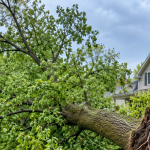
Some trees are simply the wrong scale for a compact property no matter how well they’re placed. Fast-growing shade trees that top out at 60 feet or more will eventually overwhelm a small lot’s canopy space, shade out other plantings, and create much larger removal costs down the line if they ever need to come down. If you’re drawn to a fast grower for quick shade, our article on the advantages and risks of fast-growing trees covers the tradeoffs in more depth.
Trees with aggressive, shallow root systems can also cause headaches in tight spaces, lifting nearby pavement or competing hard with turf and garden beds. And species prone to weak branch unions or brittle wood are a poor match for a small yard where storm damage is more likely to land on a structure simply because there’s less open space for a falling limb to miss.
How Early Pruning Supports Long-Term Structure
Young trees benefit enormously from structural pruning in their first several years, and this matters even more in a small yard where there’s little room for a poorly shaped canopy to correct itself. Early pruning establishes a strong central form, corrects weak branch angles before they mature into full-sized limbs, and reduces the amount of corrective work needed later.
This is different from routine trimming for appearance. It’s a deliberate process of guiding a young tree’s structure while the cuts are still small and the tree recovers quickly. Homeowners in East Grand Rapids and similar established neighborhoods often see the payoff in both storm resilience and curb appeal, which our piece on structural pruning in East Grand Rapids covers in more detail. If you already have a young tree that hasn’t had any structural work done, professional tree trimming and pruning now is far easier and less expensive than correcting a mature tree’s structure later. Timing matters too, and our guide to the best time to trim trees in West Michigan breaks down the right season for different species.
Common Small-Yard Planting Mistakes
- Choosing a tree based on its size at the nursery instead of its size in twenty years
- Skipping a soil check and planting a moisture-loving species in fast-draining sand or a drought-sensitive species in wet clay
- Planting directly under power lines with a species that will eventually need to be topped or removed
- Placing a tree too close to the foundation, driveway, or sidewalk without accounting for mature spread
- Ignoring fruit or seedpod drop near patios, walkways, or parking areas
- Skipping structural pruning in the tree’s early years and letting weak branch angles set in
Get the Right Tree for Your Grand Rapids Property
Choosing a tree for a compact Grand Rapids lot comes down to matching mature size, light, soil, and placement to the actual space you have, not just what looks good in a five-gallon pot at the garden center. Get that right and a small tree can anchor a landscape for decades with very little ongoing work.
If an existing tree on your property has already outgrown its spot, needs structural pruning to correct years of neglect, or has reached the point where removal makes more sense than continued maintenance, we’re glad to take a look. Our team can also handle stump grinding and removal if you’re clearing space to replant, or full tree removal in Grand Rapids if a tree has outgrown its usefulness in a small yard. Reach out through our contact page for a straightforward assessment of what your property needs before your next planting season.