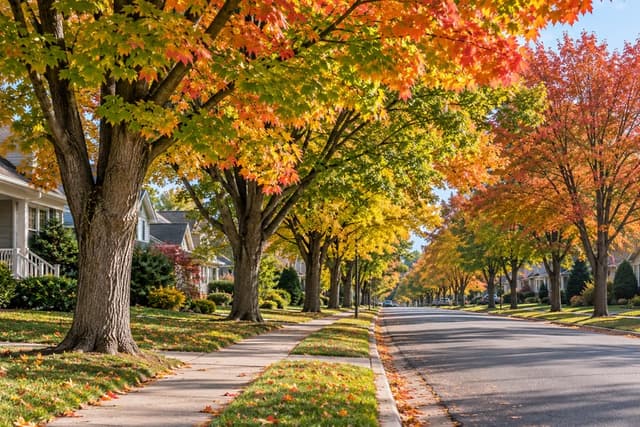
Key Takeaways
- Many trees that appear to be part of a homeowner’s yard are actually located in the public right-of-way and fall under city jurisdiction.
- Grand Rapids generally regulates planting, removal, and significant pruning of street trees to protect public safety and canopy health.
- Homeowners typically cannot remove or heavily prune a right-of-way tree without city approval, even if it sits directly in front of their home.
- Utility clearance, sidewalk conflicts, and storm risk are common reasons the city becomes involved with street tree maintenance.
- Big Chipper can help homeowners determine whether a tree falls within the right-of-way and coordinate any required permits before work begins.
A right-of-way is the strip of land, typically between the sidewalk and the street or between the sidewalk and the property line, that a municipality controls even though it often sits directly adjacent to or within view of a private yard. In Grand Rapids, Michigan as in most cities, this area is used for sidewalks, utility access, snow storage, and, frequently, street trees planted or maintained by the city or with city approval.
Homeowners often assume that any tree near their home, especially one they’ve watered or mulched for years, is theirs to manage as they see fit. In many cases, however, a tree in this zone is legally a public tree, and altering it without authorization can result in code violations, fines, or the homeowner being responsible for correcting unauthorized work.
This distinction matters most when a homeowner is planning landscaping changes, driveway work, or a fence installation, since digging or grading within the right-of-way can also require separate approval, independent of any tree that happens to be growing there.
This overlap between tree rules and general right-of-way regulations is one reason it’s worth checking with the city early in any project that touches the area near the curb, even if the tree itself isn’t the main focus of the work.
How to Tell If a Tree Is in the Right-of-Way
The most reliable way to determine whether a tree sits within the right-of-way is to check the property’s plat map or survey, which shows the boundary between private property and public land.
- In many older Grand Rapids neighborhoods, the right-of-way extends several feet behind the sidewalk, meaning a tree that looks like part of the front yard may actually be city property.
- Homeowners who are uncertain can contact the City of Grand Rapids Forestry division, which maintains records of the municipal tree inventory and can clarify jurisdiction for a specific address before any work is scheduled.
- It’s also worth noting that right-of-way width can vary from block to block, particularly in older parts of the city where streets were platted before modern zoning standards. Two neighboring properties on the same street may have different right-of-way depths, so assumptions based on a neighbor’s situation aren’t always reliable.
What Homeowners Can and Cannot Do
Generally, homeowners are not permitted to remove, top, or perform major structural pruning on a right-of-way tree without city approval, since these trees are considered public infrastructure and contribute to community-wide canopy goals.
- Minor maintenance, such as clearing low branches that obstruct a sidewalk, may be allowed within certain limits, but larger work typically requires a permit.
- Removal requests are usually considered case by case, based on factors like tree health, safety risk, and whether the tree is contributing to sidewalk or utility conflicts.
- Even when removal is approved, the city may require replacement planting to maintain the overall street tree canopy.
- Planting a new tree in the right-of-way is also typically regulated, both to keep sightlines clear near intersections and driveways and to ensure new plantings won’t create future conflicts with sidewalks or utilities as they mature.
- Species selection guidelines are often available from the city to help homeowners choose an appropriate tree if they’d like to plant one themselves.
- Emergency situations, such as a tree that has already fallen or is actively hazardous, are typically handled differently, with the city or an approved contractor often responding more quickly than the standard permit process would otherwise allow.
Utility Lines and Street Tree Conflicts
Overhead utility lines are one of the most common sources of conflict with street trees.
- Utility companies typically have the authority to prune trees growing into power lines, sometimes resulting in a lopsided or heavily cut appearance that homeowners may not have requested. This type of clearance pruning is generally done for public safety and to reduce outage risk during storms.
- Homeowners planning new plantings near the street should consider mature tree height and utility line location in advance, since species selection can help avoid future conflicts and repeated utility pruning.
- Underground utilities present a separate set of concerns, particularly for root growth and any digging planned near the right-of-way.
- Calling for utility locates before planting or excavating near a street tree helps prevent damage to buried lines and protects the tree’s root system from unnecessary disturbance.
Sidewalk Damage and Root Conflicts
Street trees planted decades ago were often placed with limited consideration for how large their root systems would eventually become relative to nearby sidewalks and driveways. As these trees mature, roots can lift or crack pavement, creating both a maintenance issue and a trip hazard.
- Addressing root-related sidewalk damage typically requires coordination between the homeowner, the city, and a qualified tree service in Grand Rapids, Michigan, since removing roots incorrectly can destabilize the tree, while replacing sidewalk sections without addressing the root cause often leads to repeat damage.
- In some cases, a modest sidewalk realignment around a root, rather than root removal, is the better long-term solution, preserving the tree’s stability while still addressing the immediate trip hazard. This kind of decision generally benefits from an arborist’s input alongside any city engineering review.
Working With a Professional Tree Service
Because right-of-way rules, permit requirements, and utility coordination can be difficult for homeowners to navigate alone, working with an experienced local tree service can simplify the process. A qualified crew can help determine jurisdiction, prepare any necessary permit documentation, and carry out approved work safely and in compliance with city standards.
This kind of guidance is often most valuable early in a project, before a homeowner has scheduled removal or major pruning, since correcting an unauthorized action after the fact is typically more complicated and costly than confirming requirements up front.
If you are unsure, Big Chipper Tree Service can assess the tree’s location and help you understand what type of work may be appropriate. We can also help identify situations where city approval or a Tree Maintenance Permit may be required before pruning or removal.
For trees near sidewalks, driveways, homes, or utility lines, Big Chipper Tree Service’s team can assess the risks and recommend a safe approach. When a permit is needed, we can help coordinate the required process so work is planned correctly before our crew begins.
Big Chipper Tree Service has served Grand Rapids and West Michigan since 1986, with professional equipment and an ISA-Certified Arborist on staff. We handle everything from routine pruning to complex and hazardous tree removals, including jobs that require specialised equipment and careful rigging. If you are unsure about a street tree or upcoming tree project, contact Big Chipper for a professional assessment and a clear plan for the work.
Frequently Asked Questions About Grand Rapids, MI Rights-of-Way and Tree Work
How do I find out if a tree in front of my house is in the right-of-way?
Checking a property survey or plat map is the most direct method, though homeowners can also contact the City of Grand Rapids Forestry division to confirm jurisdiction for a specific address.
Can I remove a dead or hazardous street tree myself?
Generally no. Even hazardous right-of-way trees typically require city notification or approval before removal, since these trees are considered public property.
Who is responsible for pruning trees away from power lines?
Utility companies usually handle line-clearance pruning for safety reasons, which can result in a different pruning style than a homeowner might otherwise choose.
Does the city replace a right-of-way tree after it’s removed?
In many cases, yes. Replacement planting is often required or encouraged to maintain the overall street tree canopy after an approved removal.
Can Big Chipper help with right-of-way permit questions?
Yes. Big Chipper can help assess a tree’s location, explain likely permit requirements, and coordinate work that complies with city rules.
Summary Checklist: Rights-of-Way and Tree Work in Grand Rapids, MI
| Evaluation Area | What to Confirm |
| Jurisdiction | Confirm whether the tree is on private property or in the right-of-way |
| Permit requirements | Determine if city approval is needed before pruning or removal |
| Utility conflicts | Check for overhead line clearance issues |
| Sidewalk and root damage | Assess pavement lifting or trip hazards near the tree |
| Species and mature size | Consider long-term size for any new street tree planting |
| Replacement requirements | Understand replanting expectations after approved removal |
| Professional coordination | Work with a tree service familiar with local right-of-way rules |
Final Advice
Trees along Grand Rapids streets often provide shared community benefit, which is why right-of-way rules exist to protect them even when they sit close to a private home. Homeowners who understand these boundaries can avoid unintentional code issues and help preserve the city’s street tree canopy.
Big Chipper Tree Service can help Grand Rapids homeowners confirm whether a tree falls within the right-of-way, understand permit requirements, and carry out any approved work safely and correctly.