Key Takeaways
- Michigan does not require a license to operate a tree service, so third-party accreditation is the primary verification homeowners have.
- TCIA Accreditation requires documented audits of safety, training, insurance, and business practices every three years.
- ISA Certified Arborists complete a minimum of three years of field experience plus a comprehensive exam and ongoing continuing education.
- Workers compensation coverage matters most: without it, an injured worker can pursue the homeowner under Michigan premises liability law.
- The U.S. Bureau of Labor Statistics ranks tree work among the highest risk occupations in the country.
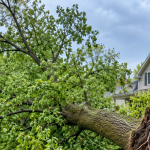
A 60 foot oak coming down over your house is not a job where you want to find out the contractor cut corners on insurance. Yet every year in Kent County, homeowners hire crews based on the lowest bid, then discover after a problem (a dropped limb on a neighbor’s roof, an injury, a job left half finished) that the “tree guy” had no real credentials, no proper coverage, and no path to making it right.
This article explains what professional accreditation actually means in the tree care industry, why it changes how a job runs, and what homeowners in Grand Rapids should verify before signing any contract.
What Tree Care Accreditation Actually Means
According to the U.S. Bureau of Labor Statistics, tree care consistently ranks among the most dangerous occupations in the country, alongside commercial fishing and logging. Chainsaws, gravity, weather, electrical lines, and equipment failure all stack risk into every job.
Accreditation is third-party verification that a tree care company meets industry standards for safety, training, insurance, and business practices. Two credentials matter in Michigan:
- TCIA Accreditation: Issued by the Tree Care Industry Association. Companies undergo a documented audit covering safety programs, employee training, insurance verification, customer service practices, and equipment maintenance. Reaccreditation is required every three years.
- ISA Certified Arborist: Issued to individual professionals by the International Society of Arboriculture. Requires a minimum of three years of full time arboricultural experience, passing a comprehensive exam, and continuing education to maintain certification.
These are not decorative logos on a website. They represent ongoing accountability to outside standards.
What Happens When You Hire an Uninsured Tree Service
Picture this scenario, which plays out across West Michigan every storm season:
A homeowner gets three quotes for a large hazard removal. Two are from accredited companies. One is from a crew that knocked on the door after a windstorm, offering a price 40 percent lower. The homeowner picks the cheap quote.
What can go wrong:
- The crew has no workers compensation insurance. A climber falls, and the injury claim comes back to the homeowner’s homeowners policy
- The general liability policy is fake or expired. A dropped section damages the garage, and there is no real coverage to file against
- The crew misjudges the lean of the tree. Half the canopy lands on the neighbor’s fence
- They do not grind the stump because that “was not included,” but the contract was vague
- They leave town. The phone number stops working
None of this is theoretical. Michigan does not require a state license to operate a tree service, which means anyone with a truck and a chainsaw can call themselves a tree company.
The Insurance Question Every Homeowner Should Ask
Real insurance for a tree care company looks like this:
- General liability: Typically 1 to 2 million dollars in coverage for property damage caused during work
- Workers compensation: Covers crew members injured on the job. Required for every employee working on your property
- Commercial auto: Covers the trucks and equipment in transit
A legitimate company can produce a certificate of insurance (COI) within minutes, naming you as the certificate holder. If a company hesitates, gives excuses, or sends a screenshot of a paper they cannot verify, that is the answer.
Workers’ comp matters most. Without it, an injured worker can pursue the homeowner directly under Michigan premises liability law. A serious chainsaw injury or a fall from height can result in six-figure medical claims.
Insurance Comparison Table
| Coverage Type | Minimum You Should Accept | Why It Matters |
| General liability | $1M per occurrence | Covers damage to your property and structures |
| Workers compensation | Full Michigan coverage | Protects you from injury claims by crew members |
| Commercial auto | Required by Michigan law | Covers crew vehicles arriving at your property |
| Umbrella policy | $1M to $5M (preferred) | Adds protection for severe property damage events |
Training Standards That Affect Job Quality
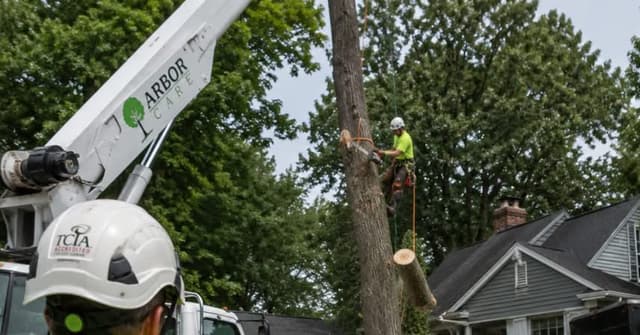
ANSI A300 is the American National Standard for tree care operations. It covers how cuts should be made, how loads should be rigged, how trees should be pruned, and how worksites should be set up. Accredited companies train to A300.
This is why two crews can remove the same tree and produce completely different results. A trained crew:
- Uses proper cut placement to protect remaining branches from decay
- Rigs heavy sections so they descend in controlled motion, not freefall
- Protects lawn, beds, and hardscape with mats and proper traffic patterns
- Cleans up to industry standards rather than leaving chips and limb debris
Untrained crews leave torn bark, flush cuts that invite decay, ruts in the lawn, and damaged irrigation lines they did not know were there.
Why Tree Care Standards Matter More in Grand Rapids
West Michigan’s tree population skews old. Many neighborhoods were planted 60 to 100 years ago with oaks, maples, and elms that are now nearing the end of their structural lifespan. Combined with heavy lake-effect snow loads, freeze thaw cycles, and severe summer thunderstorms, large hazardous removals are common across the area.
Removing a 90 foot silver maple over a 1920s house in Heritage Hill is not the same job as cutting a small tree in an open field. It demands rigging, planning, and crew coordination that only comes from documented training. Our emergency tree service and tree removal service follow full ANSI A300 standards across Kent and Ottawa counties.
What We Commonly See In The Field
Calls to clean up after other companies come in more often than anyone would like. The patterns repeat: stumps left ground too shallow because the operator did not know better, climber’s spikes used on living trees (which causes decay and is prohibited under ANSI A300 for non-removal pruning), and brush piles abandoned at the curb.
The bigger pattern: homeowners who tell us they thought they were saving money. The bill to fix the mistakes (repair, replant, reseed) almost always exceeds what an accredited company would have charged in the first place. Properly handled stump grinding costs a fraction of replanting and regrading a lawn destroyed by an under-equipped crew.
Questions to Ask Any Grand Rapids Tree Service Before Hiring
Before signing anything, ask for and verify:
- Insurance verification: Ask for a current certificate of insurance for both general liability and workers compensation, sent directly from the insurance carrier with your name as certificate holder
- TCIA Accreditation status: Verifiable at treecareindustry.org
- ISA Certified Arborist credential: Of the person assessing your trees. Verifiable at isa-arbor.com
- Written estimate: That specifies scope, debris handling, stump treatment, and timeline
- Local references: From work performed in your area within the last 12 months
- Equipment fit: Right-sized equipment for your property and the tree size
Any company that resists this kind of verification is telling you what you need to know.
Warning Signs of an Unqualified Tree Service Company
- Door-to-door solicitation right after a storm
- Cash-only payment requirements
- No physical business address
- Inability to produce a certificate of insurance the same day
- Pressure to sign immediately
- Bids significantly below market without clear scope differences
- No mention of debris removal in the written estimate
Frequently Asked Questions
Does Michigan require a license to operate a tree service?
No. Michigan does not require state licensing for tree care, which is why third-party accreditation through TCIA and ISA matters so much.
What is TCIA Accreditation?
Accreditation from the Tree Care Industry Association, awarded after a documented audit of safety, training, insurance, and business practices. Reaccreditation is required every three years.
How do I verify a tree company’s insurance in Michigan?
Ask for a certificate of insurance sent directly from the insurance agent or carrier, with your name listed as certificate holder. Verify that both general liability and workers compensation are current.
Are ISA Certified Arborists the same as TCIA Accreditation?
No. ISA certification is held by individual arborists. TCIA Accreditation is held by the company. Strong tree care providers hold both.
What happens if an uninsured tree worker is hurt on my property?
In Michigan, the homeowner can be held liable for injuries to uninsured workers on their property under premises liability law. Verifying workers compensation coverage protects you.
Is hiring an accredited tree company more expensive?
Initial quotes may be higher than those of uninsured operators. Total cost (accounting for property damage risk, repair work, and liability exposure) is almost always lower with an accredited company.
How do I find an ISA Certified Arborist in Grand Rapids?
Use the Find an Arborist tool on the ISA website, or ask any tree company for the certification number of their lead arborist and verify it directly through ISA.