Most emergency tree calls in Grand Rapids don’t start with a storm. They start years earlier, with a branch nobody looked at.
A tree that gets professional tree pruning every few years rarely surprises anyone. A tree left alone for a decade tells a different story. Weak unions, dead wood, and a slow lean sit quietly until a 60 mph gust or a heavy snow load finds the weak point.
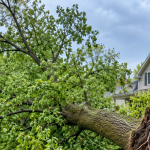
By then, what could have been a $300 pruning job becomes a $3,000 emergency removal, sometimes with a damaged roof or fence attached.
Key Takeaways
- Routine pruning reduces the risk of costly emergency tree work.
- Trees seal wounds instead of healing them, which is why crews limit how much canopy they remove at once.
- Fast-growing trees like silver maple often pose more risk than old, dense-wood oaks.
- A narrow, V-shaped branch union is a warning sign, even without a visible crack.
- Timing matters most for oaks (never April to July) and ash (watch for canopy loss).
This article covers what routine tree care actually prevents, why Grand Rapids’ climate makes that maintenance more important than in a lot of other cities, and how to spot the early warning signs yourself before they turn into a costly call.
What Does Regular Tree Maintenance Actually Prevent?
Regular tree maintenance prevents emergency tree work by identifying and correcting structural problems before storms, decay, or heavy snow cause branches or entire trees to fail.
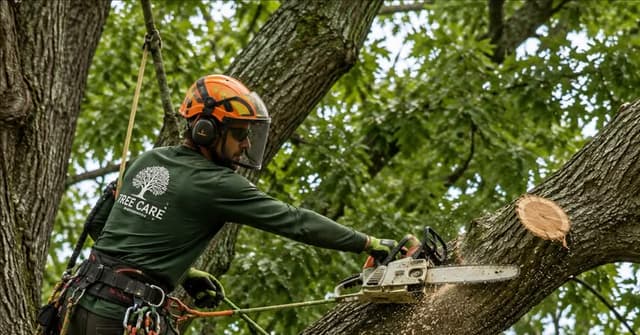
Periodic pruning, deadwood removal, and a trained eye for structural problems address the specific failures that turn into emergency calls: broken limbs over roofs, split trunks, and full tree failures from decay nobody spotted.
Maintenance doesn’t storm-proof a tree. It removes the failure points before wind or ice load finds them. A three-inch branch with a slight crack is a five-minute cut. Left alone for ten years, that same branch is a foot thick, hanging over a roofline, and failing during a February ice storm instead of on a calm Tuesday when a crew can plan the work.
Why Trees Can’t “Heal” a Bad Pruning Cut, and Why That Changes Everything
Here’s something most homeowners never hear from a landscaping crew: trees don’t heal wounds the way people do. A tree can’t regenerate damaged tissue. Instead, it seals the wound off internally, walling off the injured wood so decay can’t spread into the healthy trunk. Arborists call this process compartmentalization.
As a general rule, arborists avoid removing more than about 25% of a tree’s living canopy during a single pruning cycle. Removing more than that overwhelms the tree’s ability to seal its cuts and forces it to draw on stored energy it needs for winter survival. There are exceptions, such as restoration pruning on a tree that’s already storm-damaged, but a crew that routinely “cleans up” healthy trees by taking off half the canopy in one afternoon isn’t doing a favor. They’re setting up the next round of decay.
Why Grand Rapids’ Climate Makes This More Than a Cosmetic Issue
West Michigan doesn’t get hurricanes, but it gets a steady diet of smaller stressors that add up over a tree’s lifetime.
Grand Rapids sees roughly 70 inches of snow a year, plus lake-effect snow bands, ice storms, and spring thunderstorms with sudden wind gusts. The National Weather Service’s Grand Rapids office tracks and warns for these events throughout the year. None of them is unusual on its own. The problem is that they repeat every year, against trees also dealing with heavy clay soil common across Kent County.
Clay drains slowly, so roots stay shallower. Shallow roots loosen more easily when the ground saturates during a storm. That combination of repeated wind and ice loading on shallow roots is exactly why a tree that looked fine in October can fail in a January storm.
Older, tree-lined neighborhoods like Heritage Hill and Eastown carry extra risk simply because their canopy is older. A late-winter freeze-thaw cycle, common in Grand Rapids by February, can coat already-stressed limbs in ice right as the ground beneath them softens, which is a common setup for the sudden limb failures seen in those areas every year.
The Counterintuitive Truth About “Big Old Trees”
Most homeowners assume the biggest, oldest tree in the yard is the riskiest one. In practice, it’s often the opposite.
Old oaks and sugar maples grow slowly and build dense, tight-grained wood over decades. That density is what makes them resistant to breakage. The trees that actually cause the most storm damage tend to be fast-growing species like silver maple, Bradford pear, and cottonwood, which pack on size quickly using looser, weaker wood.
We see this pattern constantly in the field: a homeowner is worried about the 80-year-old oak in the backyard, while the real hazard is the 20-year-old silver maple by the driveway that grew twice as fast and has half the structural strength.
The Real Cost Difference: Maintenance vs. Emergency Removal
| Factor | Scheduled Maintenance | Emergency Tree Work |
| Timing | Planned around dormant season | Immediate, often after hours or during a storm |
| Access | Crew can plan the safest approach | Complicated by downed lines or blocked access |
| Cost | Predictable, based on scope | Higher due to urgency and limited scheduling |
| Property Risk | Low, hazards removed before failure | High, damage to roofs, fences, or vehicles is common |
| Insurance Involvement | Rarely needed | Frequently needed, with documentation and claims |
A tree with a developing structural problem often gives two or three years of warning signs before it fails. Emergency tree work usually happens because that window gets missed, not because the failure came without warning.
Should You Monitor, Prune, or Remove?
| Condition | Recommended Action |
| Minor deadwood, no cracks, healthy canopy | Monitor and reassess next season |
| Crossing branches or canopy over a roofline | Schedule preventive pruning |
| Trunk cracks, more than half the canopy dead, or a worsening lean | Get a professional removal assessment |
| Fungus at the base or exposed, decayed roots | Get a professional removal assessment |
The One Detail That Predicts Whether a Branch Will Fail
Most people check for cracks and dead branches, but professionals look at something else first: the shape of the union where two large limbs meet the trunk.
A wide, U-shaped union is strong. A tight, V-shaped union usually means bark has grown inward between the two limbs instead of wood bonding solidly. Arborists call this bark inclusion, and it’s one of the most reliable predictors of a future split, often years before any visible crack appears. This exact pattern often shows up on trees the homeowner assumed were perfectly healthy.
A tree with hidden bark inclusion is a bit like a zipper that’s only half closed. It can hold for years under normal conditions, but under enough pressure, usually a wind gust or a heavy snow load, it can separate all at once.
Next time you’re looking at a tree with two large trunks or limbs splitting from one point, check the angle. A narrow V is worth a professional look, even if everything else about the tree looks healthy.
Signs a Tree Needs Attention Before Storm Season
- Dead branches in the upper canopy, especially on ash trees
- Cracks or seams in the trunk, particularly at a co-dominant union
- A visible lean that’s new or getting worse
- Fungus or mushrooms growing at the base
- Peeling bark with small D-shaped exit holes underneath (an emerald ash borer indicator)
- Large limbs hanging directly over the roof, driveway, or a play area
None of these signs mean a tree needs to come down immediately. One of the most common mistakes we see is a homeowner waiting for a sign that never comes, while the real damage builds up out of sight in the roots or trunk. Most of these signs mean it’s time for a professional assessment. A certified arborist, following International Society of Arboriculture standards, can tell the difference between a tree that needs routine care and one that’s genuinely a hazard.
Two Local Threats That Make Pruning Timing Non-Negotiable
Emerald ash borer has killed a large share of Grand Rapids’ ash trees over the past fifteen years by tunneling under the bark and cutting off water and nutrient flow. According to Michigan State University Extension, an ash tree with most of its canopy intact can sometimes be saved with treatment. Once canopy loss passes 50%, removal is usually the safer call.
Oak wilt is a fungal disease spread by sap-feeding beetles active in warm weather. It spreads fastest through fresh pruning wounds. That’s why oaks in Michigan should never be pruned between April and July. A cut made in June, even a small one, can open the door for infection. Any tree service working in West Michigan should follow this rule on every oak without exception.
Outside those two exceptions, late fall through early spring, roughly November through mid-March, is the best window for routine tree care on most hardwoods here. Trees are dormant, disease risk is lowest, and bare branches make the structure easy to see.
Seasonal Tree Maintenance Checklist
- Late fall to early spring: Schedule structural pruning on dormant hardwoods (skip oaks between April and July).
- Early spring: Walk the property for winter damage, cracked limbs, or frost heave near the roots.
- Summer: Watch ash trees for canopy thinning or bark damage.
- After any major storm: Inspect for new cracks, leans, or hanging limbs.
- Every 3 to 5 years: Have a certified arborist assess mature trees, even if nothing looks obviously wrong.
When to Call an Arborist
- A tree has a lean that’s new or getting worse
- Large limbs hang over the roof, driveway, or a play area
- An ash tree shows canopy thinning or bark damage
- There’s a crack or seam anywhere in the trunk
- Mushrooms or fungus are growing at the base
- A storm passed and something on the tree looks different
What Homeowners Can Handle vs. What Needs a Professional
Reasonable for a homeowner:
- Walking the property after storms for new cracks, leans, or hanging branches
- Keeping mulch and soil away from the trunk base
- Watching young trees for structural issues while limbs are still small
- Calling for an assessment at the first sign of canopy thinning
Best left to a professional:
- Any pruning above what’s reachable safely from the ground
- Cabling or bracing a tree with a structural weakness worth saving
- Deciding whether an ash tree is a treatment or removal candidate
- Removing any tree near a structure, driveway, or power line
- Pruning oaks, where timing mistakes carry real disease risk
If a tree is large enough to reach a house, garage, fence, or parked car when it falls, that’s the line where a homeowner’s judgment should hand off to an arborist’s.
Frequently Asked Questions
How often should trees be pruned in Grand Rapids?
Most mature trees benefit from structural pruning every three to five years. Younger trees may need more frequent, lighter pruning to correct structure early. Trees near a home or power line should be checked more often.
What time of year is best for tree pruning in West Michigan?
Late fall through early spring, roughly November through mid-March, is best for most hardwoods. The exception is oaks, which should never be pruned between April and July because of oak wilt risk.
How do I know if my ash tree can be saved from emerald ash borer?
If the tree still has at least half its canopy and shows no major trunk cracking, treatment may still work. Once canopy loss passes that point, removal is usually the safer, more cost-effective choice.
Is emergency tree removal covered by homeowners insurance?
Coverage depends on the policy and cause of damage. Storm-related failures that damage a structure are often covered, while routine removal of a declining tree usually is not.
What’s the difference between tree trimming and tree pruning?
Trimming typically means shaping a tree for appearance. Pruning means targeted cuts made to improve structure, remove hazards, and support long-term health. Preventive maintenance is closer to pruning.
Can a leaning tree be saved, or does it need to come down?
It depends on how long the lean has existed and what’s causing it. A tree that has always grown at a slight angle is often stable. A new or worsening lean can signal root failure and needs a professional look.
Do I need a permit to remove a tree in Grand Rapids?
Trees in the public right-of-way or on city property typically require a permit before removal or pruning. Trees entirely on private property generally do not, though this can vary by parcel.
How much does routine tree maintenance cost compared to emergency removal?
Routine pruning is priced by scope of work and is typically far less than emergency removal, which adds costs for urgent scheduling and complicated access. Scheduled maintenance is consistently the lower-cost path over a tree’s lifetime.
Protect Your Trees Before They Become an Emergency
Trees in Grand Rapids deal with heavy snow, ice storms, clay soil, and invasive pests every year. That steady stress is what turns a small, correctable problem into a five-figure emergency when nobody catches it in time.
Most trees that fail give some kind of warning first: a worsening lean, a thinning patch of canopy, a narrow branch union that was never quite right. Catching those signs early, and timing pruning around risks like oak wilt and emerald ash borer, is what keeps a tree on the maintenance list instead of the emergency list.
The best time to identify a tree’s weakest point is before the next storm does. If you’re unsure whether a tree on your property needs pruning, treatment, or removal, the team at Big Chipper Tree Service can take a look and provide a straightforward recommendation on the safest, most cost-effective next step.