Key Takeaways
- Grand Rapids trees face a mix of West Michigan winter storms, freeze-thaw cycles, invasive pests, and heavy lake-effect snow loads.
- Emerald ash borer has already devastated much of the region’s ash tree population and remains an active threat to untreated trees.
- Improper pruning and topping are common, preventable causes of long-term structural weakness in residential trees.
- Road salt, soil compaction, and construction damage are under-recognized causes of gradual tree decline in urban and suburban Grand Rapids yards.
- Regular inspection catches most of these problems early, before they become a safety hazard or require full tree removal.
Grand Rapids, Michigan homeowners invest significantly in their landscapes, and mature trees represent some of the most valuable assets on any property. But West Michigan’s unique climate and environmental pressures create constant challenges for tree health and structural integrity.
The region’s location along Lake Michigan exposes trees to lake-effect weather patterns: heavier snow loads, more frequent ice accumulation, and stronger wind events. Combined with invasive pests, urban development pressures, and soil conditions typical of West Michigan, Grand Rapids trees face a complex array of threats.
Understanding these 10 common causes of tree damage and their early warning signs helps homeowners protect their landscape investment and avoid costly emergency removals.
1. Winter Storms and Ice Loading
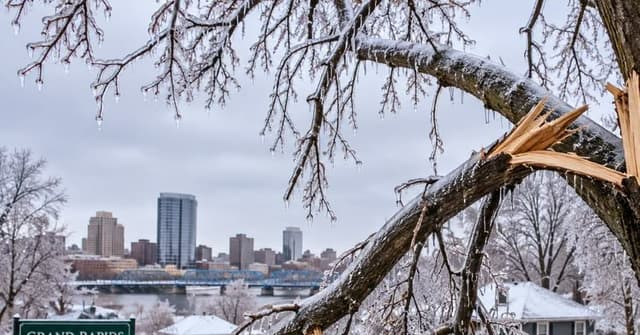
Grand Rapids sits in West Michigan’s lake-effect snow belt, and winter storms bring heavy, wet snow along with periodic ice accumulation on branches. That added weight snaps weak limbs and, in severe cases, splits entire trees, particularly ones with poor structure or included bark from earlier growth.
- Lake-effect snow differs from typical inland snowfall in both volume and density.
- Grand Rapids regularly receives 60-80 inches of snow annually, with individual storms dropping 12-24 inches of heavy, water-laden snow. When this accumulates on branches, the weight can exceed structural capacity.
- Ice loading presents an even greater threat. A quarter-inch of ice on a 20-foot branch can add 100+ pounds of weight. Trees with codominant stems, narrow branch angles, or pre-existing cracks are particularly vulnerable to catastrophic failure during ice events.
2. High Wind Events
Wind off Lake Michigan and seasonal storm systems put consistent stress on area trees throughout the year. Shallow-rooted species and trees already weakened by disease or poor pruning are the most likely to fail during high-wind events, often at a point of pre-existing weakness rather than a random spot on the tree.
- West Michigan experiences frequent wind events from multiple directions. Spring and summer thunderstorms bring straight-line winds exceeding 60 mph, while fall and winter storms can produce sustained winds of 40-50 mph with gusts over 70 mph.
- Species with systems, silver maple, tulip poplar, birch, and some ornamental cherries are disproportionately represented in storm damage reports.
- Shallow root trees prioritize lateral root spread over deep anchorage, making them prone to uprooting when soils are saturated.
3. Freeze-Thaw Cycles
Michigan winters bring repeated freezing and thawing rather than one long, steady freeze. This cycle causes frost cracks in bark, and it can heave and loosen soil around root systems, particularly for younger or recently planted trees that haven’t fully established yet.
- Frost cracks occur when bark and outer wood contract rapidly during extreme cold, then expand during mid-winter thaws. The different expansion rates create stress that exceeds tissue strength, producing vertical cracks that can extend several feet up the trunk.
- Soil heaving from freeze-thaw cycles physically moves root systems, breaking fine root hairs and loosening soil contact.
- Young trees planted in fall are especially vulnerable because their roots haven’t anchored before winter arrives.
4. Emerald Ash Borer
Grand Rapids has been at the center of the emerald ash borer’s spread through the Midwest since the pest was first identified in Michigan. This invasive beetle has killed the majority of untreated ash trees across the region, and any remaining ash tree on a property should be evaluated for treatment or, if too far gone, safe removal before it becomes a hazard.
- Emerald ash borer larvae feed on the cambium layer beneath ash tree bark, creating S-shaped galleries that disrupt water and nutrient transport.
- Infested trees typically show canopy thinning starting at the top, D-shaped exit holes, increased woodpecker activity, and epicormic sprouts along the trunk.
- Treatment options exist for valuable ash trees in good condition. Systemic insecticides can protect trees for 1-2 years per application, but treatment is an ongoing commitment.
- For ash trees already showing advanced decline, removal is the safer option.
5. Other Invasive Pests and Diseases
Grand Rapids trees face multiple pest and disease threats beyond emerald ash borer.
a.) Dutch Elm Disease
Dutch Elm Disease (DED) continues to affect surviving elm trees throughout West Michigan, spread by bark beetles and root grafts. Symptoms include wilting, yellowing, and browning of leaves. There is no cure, so prevention through prompt removal of infected trees is essential.
b.) Gypsy Moth (Spongy Moth)
Spongy moth outbreaks can cause severe defoliation and weaken trees over repeated seasons. Their caterpillars feed on many tree species, particularly oaks and aspens.
c.) Oak Wilt
Oak Wilt is a fungal disease capable of killing an oak within a single season, spread through root grafts and sap-feeding beetles. Red oaks are particularly susceptible, showing rapid leaf browning starting at branch tips.
d.) Beech Bark Disease
An emerging concern for beech trees in parts of Michigan, combining insect and fungal damage. Infested trees show rough, cracked bark with oozing sap, followed by canopy decline.
6. Poor Soil Drainage
Many Grand Rapids neighborhoods sit on heavier clay soils that hold water after spring rains and snowmelt. Waterlogged soil deprives roots of oxygen, contributing to root rot and gradual canopy decline that often isn’t traced back to a drainage issue until the tree is well into decline.
Clay soil’s dense structure creates small pore spaces that fill with water during wet periods, displacing the air roots needed for respiration. Prolonged saturation kills fine root hairs within days, reducing water and nutrient uptake even after soils dry.
Symptoms of poor drainage include –
- premature leaf yellowing
- smaller-than-normal leaves
- thinning canopy
- dieback starting at branch tips, and
- fungal growth at the tree’s base.
By the time mushrooms appear, significant root decay has often occurred.
7. Road Salt and De-Icing Chemicals
Trees near streets, sidewalks, and driveways in Grand Rapids are regularly exposed to road salt and de-icing chemicals through winter runoff. Salt accumulation in the soil can damage roots and cause leaf scorch, browning, or dieback concentrated on the side of the tree closest to treated pavement.
Sodium chloride and other de-icing compounds accumulate in soil through spring snowmelt and rain events. Salt draws moisture away from roots through osmotic pressure, creating physiological drought. Symptoms include marginal leaf browning with yellow halos, premature leaf drop, and dieback on the street-facing side.
Protection strategies include selecting salt-tolerant species for street-side plantings, flushing soil with deep watering in spring, and using alternative de-icers near valuable trees.
8. Improper Pruning and Topping
Topping and other improper pruning practices weaken a tree’s structure and trigger fast, weakly attached regrowth. This is one of the more preventable causes of tree damage on this list, since it traces back to a specific pruning decision rather than weather or pests.
Topping removes 50-100 percent of a tree’s leaf-bearing canopy, forcing survival-mode regrowth in the form of water sprouts. These sprouts attach only to outer wood layers and fail at much lower wind speeds than naturally developed branches.
ANSI A300 standards specify proper reduction cuts to laterals at least one-third the diameter of removed branches. This ensures structural support and proper wound compartmentalization. Hiring crews that follow these standards protects trees from preventable damage.
9. Construction and Soil Compaction
Home additions, driveway work, and utility trenching near mature trees are common in Grand Rapids’ established neighborhoods. Heavy equipment compacts soil and can sever roots, damage that frequently doesn’t show visible symptoms in the canopy for a year or more after construction wraps up.
Tree root systems extend 2-3 times the canopy diameter, with critical absorbing roots in the top 12-24 inches of soil. Construction damages roots through direct cutting, soil compaction, grade changes, and chemical contamination.
Symptoms appear 12-36 months post-construction: progressive canopy thinning, smaller leaves, increased deadwood, and premature fall color. Prevention through root protection fencing and limiting equipment access is far more effective than treatment after damage occurs.
- Lightning Strikes
Less common than the other causes on this list, but not rare, lightning strikes can split trunks, kill root systems, or cause internal damage that isn’t visible until the tree begins declining over the following season.
Lightning typically strikes the tallest tree in an area or isolated specimens in open spaces. Damage ranges from superficial bark stripping to complete trunk explosion. Trees with internal damage may appear fine initially but decline over months as vascular tissue dies.
Protecting Your Grand Rapids Trees
A professional tree service firm in Grand Rapids, Michigan can assist in identifying & preventing most of these tree problems early through regular inspections and proper care.
Big Chipper Tree Service provides comprehensive tree health assessments throughout the Grand Rapids area to evaluate trees for pest activity, disease, structural weaknesses, and soil or root-related concerns. Homeowners should arrange professional tree inspections with our team annually, preferably in early spring before the storm season begins. Our ISA-certified arborist can perform tree pruning to improve tree structure and reduce potential safety hazards. Big Chipper Tree Service can also assist you in effective soil and drainage management, along with timely pest and disease monitoring to further support tree health.
Frequently Asked Questions About Common Causes of Tree Damage in Grand Rapids, MI
Is emerald ash borer still a threat in Grand Rapids?
Yes. While the initial outbreak has passed through much of the region, untreated ash trees remain at high risk, and ongoing treatment is often necessary to keep a valuable ash tree alive.
How does road salt actually damage trees?
Salt runoff accumulates in soil near roads and driveways, drawing moisture away from roots and causing leaf scorch or dieback, typically concentrated on the side of the tree nearest the treated surface.
Can freeze-thaw cycles really crack a tree’s bark?
Yes. Repeated freezing and thawing causes bark and outer wood to expand and contract at different rates, which can produce vertical frost cracks, especially in younger or thin-barked trees.
Should I be concerned about construction near my trees?
Yes, especially work involving trenching or grading within a tree’s root zone. Root damage from construction often doesn’t show symptoms for a year or more, so proactive protection is worthwhile.
How often should Grand Rapids homeowners have their trees checked?
An annual inspection is a reasonable baseline, ideally in early spring before storm season and again after any major winter weather event.
Final Advice
Grand Rapids homeowners should take a proactive approach to tree care. Schedule annual inspections in early spring, before storm season, and seek professional advice when you notice unusual changes. When hiring a tree service, choose professionals who follow ANSI A300 standards and avoid routine tree topping. Monitor your trees throughout spring and summer for changes in canopy health, leaf colour, pests, or disease.
For professional inspections and reliable tree care in Grand Rapids, Big Chipper Tree Service can assess your trees and recommend appropriate care. We can help identify potential risks early and keep your trees healthy, safe, and well maintained.
Reviewed by Certified Arborist
This article has been reviewed by a certified arborist to ensure accuracy with tree health diagnostics, pest and disease identification, storm risk assessment, and proper tree care practices for Grand Rapids’ climate and growing conditions.