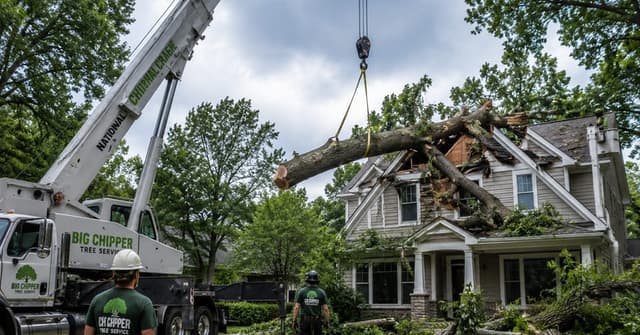
Key Takeaways
- Safety Over Speed: Cranes eliminate the need for arborists to climb unstable, storm-damaged trees, significantly reducing the risk of injury.
- Structural Preservation: By lifting tree sections vertically, cranes prevent additional impact damage to roofs, gutters, and siding.
- Surgical Precision: Crane-assisted removal allows for the extraction of massive trees from tight urban spaces, such as narrow Grand Rapids side yards.
- Landscape Protection: Because the tree is lifted over the yard rather than dragged across it, your lawn and ornamental plants remain untouched.
- Insurance Efficiency: Professional crane services provide the clear documentation and specialized invoices required for smooth insurance claim processing.
When a severe storm rolls through West Michigan, the aftermath is often a chaotic landscape of splintered wood, blocked driveways, and compromised structures. For homeowners in Grand Rapids, Ada, or Rockford, the sight of a multi-ton Oak or Maple leaning precariously over a roofline is a nightmare scenario. In these high-stakes situations, traditional tree climbing and cutting methods often fall short, or worse, they pose an unacceptable risk to the workers and the property itself. This is where crane-assisted tree removal becomes the ultimate solution for complex storm damage.
Using heavy machinery like stick cranes and grapple trucks isn’t just about raw power; it is about surgical precision. In the hands of experts, a crane transforms a dangerous, unpredictable hazard into a controlled, vertical extraction. This method has revolutionized how we handle tree emergencies in the Grand Rapids metro area, providing a level of safety and efficiency that was once impossible. Whether a tree has been uprooted by high winds or snapped by the weight of heavy, wet snow, the crane remains the gold standard for modern arboriculture in the face of disaster.
The Dynamics of Storm Damage in West Michigan
West Michigan’s climate is uniquely challenging for trees. With an average of 70 inches of snowfall per year and frequent freeze-thaw cycles, trees are often structurally compromised before a storm even hits. When you add high wind gusts and saturated soil to the mix, even the sturdiest Sugar Maple or White Oak can fail.
Storm-damaged trees are rarely straightforward. They are often under intense tension or compression, meaning a single chainsaw cut could cause the tree to barre-chair or snap in an unpredictable direction. Furthermore, trees that have landed on structures are often held up only by the weight of the house itself. Removing these trees requires a method that neutralizes gravity, which is exactly what a crane does. Without a crane, an arborist might have to stand on a roof or climb a leaning trunk, both of which are recipes for disaster when the wood is under stress.
Why Cranes Are the Gold Standard for Complex Removals
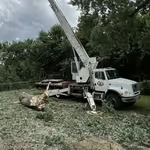
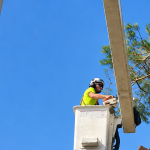
In a traditional removal, a climber ascends the tree and drops sections to the ground. In a storm emergency, the tree may be too unstable to climb safely. Crane removal solves this by allowing the arborist to be positioned in a bucket truck or harnessed safely while the crane picks pieces of the tree from the air.
Maximum Safety for People and Property
The primary advantage of using a crane is the elimination of the drop zone. Instead of letting heavy logs fall to the ground where they could bounce, roll, or crush landscaping, the crane operator lifts the sections vertically. This is critical when working near power lines, tight residential alleys in East Grand Rapids, or expensive lakefront properties in Holland, Michigan. The crane holds the weight of the limb before the cut is even made, ensuring that nothing moves unexpectedly once the wood is severed.
Efficiency in Time-Sensitive Situations
After a storm, time is of the essence. A tree resting on a roof is a ticking clock for structural water damage. If the roof is punctured, every minute the tree remains in place increases the risk of mold, interior water damage, and electrical issues. Crane work is significantly faster than manual rigging. What might take a crew two days to dismantle by hand can often be accomplished in a few hours with a stick crane. This speed is vital for clearing blocked access points and restoring safety to a neighborhood.
Protecting Your Lawn and Landscape
Traditional tree work often involves dragging heavy logs across a lawn or using skid steers that can tear up turf, especially when the ground is saturated from Michigan’s spring rains. Because the crane lifts the tree pieces directly to a landing zone, usually the street or a wide driveway, the impact on your grass, garden, and irrigation systems is nearly zero.
The Step-by-Step Process of Crane-Assisted Removal
How exactly does a 40-ton crane safely pluck a tree off a house? It requires a highly coordinated dance between the crane operator, the arborist in the air, and the ground crew.
- Site Evaluation: We begin by assessing the pick weight and the crane’s reach. We must ensure the ground is stable enough to support the crane’s outriggers. In Grand Rapids, this often involves navigating narrow driveways or hilly terrain.
- Rigging: A crew member attaches high-strength cables, straps, or chokers to a specific section of the tree. This rigging must be balanced so the piece doesn’t jump or swing wildly once cut.
- The Tensioning: Before any cutting occurs, the crane operator applies upward tension. This essentially takes the weight of that branch or trunk section.
- The Cut: The arborist makes the final cut. Because the crane is holding the piece, the wood doesn’t fall; it simply separates.
- The Lift: The operator gently lifts the section away from the house, power lines, or hazard, swinging it over to the processing area.
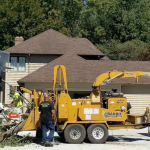
- Processing: The piece is lowered directly into a grapple truck or high-capacity chipper, keeping the work zone organized and clean.
Navigating Insurance and Documentation
One of the most stressful parts of storm damage is the financial aftermath. Because crane work is a specialized, higher-cost service, insurance companies require clear documentation. Hiring a professional tree service firm like Big Chipper Tree Service LLC will provide the necessary arborist reports and photo evidence to show that a crane was the only safe way to mitigate the hazard.
Insurance adjusters generally look for mitigation of further damage. If a tree is on your roof, the crane is the most effective tool to prevent the roof from collapsing further during the removal process. Providing your insurer with a detailed plan, including the use of specialized equipment, often helps streamline the claim and ensures that you aren’t left paying out-of-pocket for necessary safety measures.
When a tree emergency strikes, you need a team that possesses both the heavy equipment and the decades of experience to use it correctly. Big Chipper Tree Service LLC has been a staple of the Grand Rapids community since 1986. We specialize in high-risk, crane-assisted removals that other companies simply aren’t equipped to handle. Our fleet of stick cranes, bucket trucks, grapple trucks, and aerial lifts allows us to solve the most complex storm damage puzzles throughout West Michigan.
Whether you’re in Wyoming, Grandville, or Jenison, Big Chipper’s team is ready to handle tree removal in Grand Rapids and the surrounding area. We offer no-surprise pricing, a workmanship guarantee, and a no-cash-up-front policy on insurance-covered projects — and we handle the billing directly with your provider so you don’t have to.
From single tree removals to large, complex jobs, our family-owned crew brings the experience and equipment to get it done safely and cleanly.
Frequently Asked Questions by the Homeowners in West Michigan
1. Is crane-assisted tree removal more expensive than traditional removal in West Michigan?
While the hourly rate for a crane is higher, the total cost is often comparable because the job is completed much faster. In emergency storm situations, cranes are often the most cost-effective way to prevent further structural damage to your home and minimize labor hours.
2. Can a crane reach a tree in my backyard?
Yes. Our stick cranes have incredible reach and can often sit in a driveway or on the street while reaching over the house to lift a tree out of a fenced backyard or a wooded lot.
3. Will the crane damage my driveway?
We use specialized outrigger pads and mats to distribute the weight of the crane, protecting your concrete, asphalt, or pavers from cracking or sinking during operation.
4. Do I need a permit for crane work in Grand Rapids?
If the crane needs to be stationed on a city street or sidewalk, a permit from the City of Grand Rapids Public Works Department may be required. We handle the logistics of compliance and safety for our clients.
5. What happens to the wood after it’s lifted?
We typically process the wood on-site using our grapple trucks and high-capacity chippers. We can haul everything away, leaving your property completely clear.
6. Can a crane be used during high winds?
Safety is our priority. If wind speeds exceed safe operating limits for the crane, we will wait for a window of calmer weather to ensure the lift is 100% controlled.
7. Does insurance cover the cost of the crane?
If a tree has fallen on a covered structure, insurance typically covers the reasonable and necessary cost of removal, which often includes crane services if it is the only safe option.
8. How do I know if my tree requires a crane?
If the tree is leaning on a structure, located in a tight space between buildings, or is too decayed to be safely climbed, a crane is almost always the recommended and sometimes the only tool for the job.
Summary Checklist: When to Call for Crane-Assisted Removal
| Condition | Risk Level | Recommended Action |
| Tree resting on the roof or structure | Critical | Call for immediate emergency crane extraction to prevent further structural damage |
| Tree tangled in power lines | High | Contact the utility provider first, then schedule licensed crane-assisted removal |
| Large leaning tree in confined space | High | Use crane removal to control weight distribution and avoid property impact |
| Unstable or decayed storm debris | Moderate to High | Schedule a professional assessment to determine the safest removal method |
| Massive trunk or hardwood removal | Varies | Use crane-assisted removal to protect landscaping and speed up cleanup |
Final Advice
When a West Michigan storm brings down a large tree, standard manual removal often isn’t enough. For jobs where a trunk is leaning over your roof or there’s no safe drop zone, crane-assisted removal is the right call. Not a luxury, but a practical necessity.
Lifting sections vertically prevents heavy wood from shifting further into your roof or siding, protecting your home’s structure and keeping the crew safe. If you’re dealing with a downed tree on your property, don’t attempt to clear it yourself or hire a tree service in Grand Rapids, MI that doesn’t carry specialized heavy equipment for the job.
A professional crane crew removes the hazard with precision, minimizing repair costs and preventing secondary damage to your lawn and property. When vetting providers, make sure they are OSHA-certified and carry full liability insurance. That’s what separates a managed recovery from a bigger problem.