
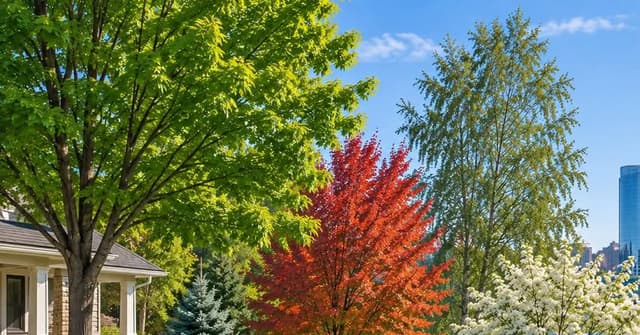
There’s no single answer to what trees grow best in Grand Rapids. The right tree depends on the space you have, the soil under your feet, how much sun the spot gets, and what you actually want the tree to do for the property. A tree that thrives on a wide, sunny lot in Cascade might struggle on a shaded, compacted lot downtown, and a tree bred for fast shade isn’t the right pick if you’re planting near a patio or foundation.
What we can say with confidence is that Grand Rapids supports a wide range of native and regionally adapted trees, and most of the failures we see come down to a mismatch between the species and the site rather than bad luck. This guide walks through the conditions that shape tree selection here, then breaks down species by the role they’re best suited to play in your landscape.
Growing Conditions That Shape Tree Selection in Grand Rapids
Trees That Perform Well Across Grand Rapids Properties
The species below are all supported by regional forestry and horticulture sources as good fits for West Michigan conditions. None of them are universally correct for every yard, and individual cultivars within each species can vary meaningfully in mature size, structure, and disease resistance, so it’s worth confirming the specific cultivar a nursery is offering rather than assuming the species name tells you everything.
Bur Oak (Quercus macrocarpa)
Bur oak is one of the toughest, longest-lived native trees available in West Michigan, commonly reaching 70 to 80 feet tall with a similar spread at maturity. It handles a wide range of soil types, including heavy clay and compacted urban soil, and tolerates drought better than most oaks once established.
Growth is slow, which means it takes patience, but the payoff is a durable, storm-resistant shade tree that can outlive the people who plant it. It needs a genuinely large property to accommodate its eventual size, and it isn’t a fit for a small or medium yard.
White Oak (Quercus alba)
White oak grows 50 to 80 feet tall and wide, forming a broad, rounded canopy with a short, stocky trunk. It prefers full sun and moist, well-drained soil, and it delivers strong red to burgundy fall color along with excellent wildlife value.
Like most oaks, it’s slow-growing and needs room to reach its mature form. Oaks in general carry an important seasonal restriction: pruning between April and July increases the risk of oak wilt, a disease that has affected trees throughout Kent County. Our guide to oak wilt prevention in Kent County covers that timing rule in more detail.
Northern Red Oak (Quercus rubra)
Northern red oak grows faster than most other oaks, often reaching significant size within a couple of decades, and matures to roughly 60 to 90 feet tall with a wide spread. It adapts to a broader range of soil conditions than white oak and handles urban stress reasonably well.
It’s a strong choice where a large, relatively fast-growing shade tree is the goal, though it still needs the same April-through-July pruning caution as other oaks to avoid oak wilt risk.
Swamp White Oak (Quercus bicolor)
Swamp white oak typically reaches 50 to 60 feet tall with a similar spread and, true to its name, tolerates wet, poorly drained soil better than almost any other oak. It handles occasional flooding and heavier clay without the root problems that affect drought-adapted species in the same conditions.
Distinctive peeling bark adds interest through the dormant season, and fall color runs yellow to reddish. It’s a strong option for low spots or drainage swales where standing water is common after heavy rain.
Hackberry (Celtis occidentalis)
Hackberry is an underrated workhorse for difficult urban sites. It typically grows 40 to 60 feet tall with a similar spread and tolerates compacted soil, drought, wind, road salt, and pollution better than most native shade trees, which is why it shows up so often as a street tree in Midwest cities.
The small purple berries that persist into winter are a valuable food source for birds. It isn’t the most ornamental tree on this list, but for a tough site where other species have failed, it’s often the right call.
Kentucky Coffeetree (Gymnocladus dioicus)
Kentucky coffeetree is a bold, adaptable shade tree that reaches 50 to 70 feet tall with a 40 to 50 foot spread. According to Michigan State University Extension, it tolerates alkaline soil, road salt, wind, and urban conditions about as well as any tree available for West Michigan landscapes, and it transplants easily.
Its coarse winter silhouette and blue-green summer foliage give it four-season interest. Female trees produce large seed pods that can be a litter concern, so male cultivars are generally the better choice for a tidier yard.
American Linden (Tilia americana)
Also called basswood, American linden typically grows 50 to 80 feet tall with a 30 to 50 foot spread in its straight species form, though named cultivars bred for landscape use stay more compact and uniform. It prefers full sun to light shade and moist, well-drained soil.
Fragrant June flowers make it a favorite with beekeepers, and it provides dense summer shade. It’s more sensitive to air pollution and urban stress than hackberry or Kentucky coffeetree, so it does best on a site with reasonable soil quality rather than a heavily compacted urban lot.
Black Gum (Tupelo) (Nyssa sylvatica)
Black gum is a slower-growing native valued mainly for fall color, typically reaching 30 to 40 feet tall in cultivated settings. It tolerates wet clay and also handles road salt, making it a flexible choice for a yard with variable drainage.
The scarlet and orange fall foliage is some of the best of any native tree in the region. Because it grows slowly and dislikes being transplanted after establishment, it’s best planted while young and left to develop in place.
Eastern Red Cedar (Juniperus virginiana)
Eastern red cedar is a native evergreen well suited to dry, sandy sites where few other trees perform well. It’s drought-resistant once established and tolerates poor soil, wind, and exposed conditions that would stress most deciduous species.
Its dense, upright form works well as a privacy screen or windbreak component. It should be kept away from susceptible crabapple and hawthorn plantings, since it’s an alternate host for cedar-apple rust, a fungal disease that can affect nearby trees in that family.
Recommended Trees by Property Goal
Best Large Shade Tree
Bur oak and northern red oak both deliver substantial, long-lasting shade for properties with room to accommodate a large canopy. Bur oak grows slower but tolerates a wider range of soil, while red oak fills in faster if you want shade sooner.
Best Tree for Compacted Urban Soil
Hackberry and Kentucky coffeetree both shrug off compacted, disturbed soil better than most alternatives, making either a strong pick for a newer property or a lot close to the street.
Best Tree for a Small or Medium Yard
Species that stay under 30 feet, like serviceberry or eastern redbud, are a better match for a compact lot than any of the large shade trees on this list. If you’re working with a tight lot, our separate guide on best trees for small yards goes into more detail on mature size and placement for tighter spaces.
Best Tree for Wet Soil
Swamp white oak and black gum both handle poorly drained, occasionally flooded soil better than most native trees, making either a solid choice for a low spot or an area near a downspout or drainage swale.
Best Option for a Drier Site
Eastern red cedar and bur oak both tolerate drought once established, and either works well on a sunny, sandy, or fast-draining lot where consistent moisture isn’t guaranteed.
Best Tree for Fall Color
Black gum’s scarlet and orange foliage is hard to match, though white oak and northern red oak both put on a strong red to burgundy display as well.
Best Evergreen Option
Eastern red cedar stands out as the most broadly adaptable native evergreen for West Michigan conditions, particularly on exposed or dry sites.
Best Durable Native Tree
Bur oak’s combination of longevity, storm resistance, and adaptability to a wide range of soils makes it one of the toughest long-term investments available for a property with the space to support it.
Placement and Mature-Size Considerations
Before planting anything, look up rather than just around. Check for overhead power lines and give large-growing species the vertical and horizontal clearance they’ll eventually need. Underground utilities matter just as much. Call 811 to have utility lines marked before digging anywhere on the property, which protects both your planting project and existing service lines.
Distance from your home, garage, driveway, and sidewalks should be based on the specific tree’s mature canopy width and root spread, not a single rule of thumb. A bur oak needs dramatically more clearance than a serviceberry, and a species with an upright, narrow habit needs less lateral room than one with a broad, spreading crown. Roots don’t typically break a sound foundation on their own, but they can exploit existing cracks, lift pavement in confined planting strips, or create ongoing conflicts when a large tree ends up too close to hardscaping.
A few other factors worth checking before you plant:
- Drainage at the planting site after a heavy rain
- Sun exposure through the full growing season, not just at midday
- Soil compaction, especially on newer or heavily used lots
- Proximity to other trees competing for root space and light
- Fruit, seedpod, or leaf litter near patios, driveways, and walkways
- Visibility near streets and driveway entrances as the canopy matures
Common Mistakes Homeowners Make When Selecting Trees
- Choosing a species based on its size at the nursery rather than its size in twenty or thirty years
- Planting a moisture-loving species like swamp white oak in fast-draining sand, or a drought-tolerant species like red cedar in a consistently wet spot
- Ignoring soil compaction on a newer property and planting a species that needs rich, loose soil
- Placing a large shade tree too close to the house, garage, or driveway without accounting for mature spread
- Skipping the oak wilt pruning window and trimming oaks between April and July
- Overlooking road salt exposure near streets and driveways when choosing a species
If you’d like a broader look at how fast growth trades off against long-term structure, our article on the benefits and risks of fast-growing trees is worth a read before choosing a species purely for speed.
How Early Maintenance Supports Long-Term Health
The trees on this list all benefit from structural pruning in their first several years, regardless of species. Early corrective pruning establishes strong branch angles and a stable central form while the cuts are still small and the tree recovers quickly. Skipping this step often means a homeowner ends up correcting much larger structural problems a decade or two later, when the fix is more expensive and the tree has already developed weak points.
Timing matters too. Our guide to the best time to trim trees in West Michigan covers seasonal pruning windows for different species, and professional tree trimming and pruning early in a tree’s life pays off for decades afterward. Homeowners with mature trees that have never had structural work done often see the difference in both storm resilience and appearance, which our piece on structural pruning in East Grand Rapids covers in more depth. Wind exposure is also worth planning around from the start, and our guide to wind-resistant landscaping in West Michigan covers how tree placement and structure work together to reduce storm risk.
Planning Your Next Planting in Grand Rapids
Choosing the right tree for a Grand Rapids property comes down to matching species to site, not chasing a single “best” answer that doesn’t account for your actual soil, sun, and space. Get that match right and a tree can anchor your landscape for generations with a fraction of the maintenance a poorly matched species would require.
If an existing tree on your property needs a professional evaluation, corrective pruning, or removal before you replant, we’re glad to help. Reach out through our contact page and we’ll give you a direct, practical read on what your property needs.